Quick Answer
AI customer support platforms with e-commerce integration use AI agents and workflows to handle order, return, refund, and FAQ requests across chat, email, SMS, WhatsApp, and more, while connecting directly to platforms like Shopify, Magento, and WooCommerce.
There’s nothing simple about modern e-commerce support. Every spike in sales brings an avalanche of “Where is my order?” queries, return requests, and frustrated customers across chat, email, and social channels. In my experience, it’s the context-switching and manual lookups that leave even good teams feeling overwhelmed.
Automation alone won’t save you. But, when AI agents blend with your order systems and workflows, teams finally get space to focus on sensitive problems, while the basics resolve themselves. That’s the shift I’ve seen for support and CX leaders willing to rethink their toolkit.
This guide unpacks which AI customer support platforms truly integrate with e-commerce, how to spot shallow integrations, and which tools fit each support model—so you spend less time reacting and more time improving CX.
Why AI Customer Support Platforms with E-commerce Integration Matter
AI customer support platforms with e-commerce integration combine AI agents, workflow automation, and helpdesk features to automate order tracking, returns, refunds, and product questions across chat, SMS, email, WhatsApp, and voice—while connecting to core commerce tools like Shopify, Magento, WooCommerce, and BigCommerce.
From what I’ve seen, it’s these deep integrations—not the AI itself—that transform support. Basic bots fail when they can’t access order data or trigger workflows. Integrated platforms fetch shipping status, initiate returns, escalate exceptions, and sync conversations across every channel to avoid agents digging for answers in five browser tabs. For high-volume teams, this is the foundation for faster service, higher CSAT, and real cost reduction.
Buyer Snapshot for AI Customer Support Platforms with E-commerce Integration
When leaders tell me they want “AI support for e-commerce,” what they really want is relief from repetitive WISMO tickets, fewer agent pivots, and safe automation tied to real order data. Not all platforms deliver on that.
Here’s how top platforms compare based on best-fit use case, integration depth, supported channels, AI capabilities, and handoff logic. Use this as your shortlist filter.
Quick Comparison Table
| Platform | Best For | E-commerce Integrations | Channels | AI Strength | Workflow Capability | |||
|---|---|---|---|---|---|---|---|---|
| Gorgias | Shopify/DTC teams | Shopify, Magento, WooCommerce, BigC | Email, Chat, SMS, Social | Order info + macros | Good | Yes | DTC, SMB, Retail | Limited beyond retail |
| Yuma AI | High-volume automation | Shopify, BigC, Magento, WooCommerce | Chat, Email, Social (config) | Action-taking AI agent | Strong | Yes | High-volume stores | Focused mainly on e-commerce flows |
| Zendesk | Helpdesk users scaling AI | Shopify, Marketplaces, Others | Email, Chat, Voice, Social | Agent assist + routing | Robust | Yes | Mid/Enterprise | Setup complexity |
| Freshdesk | Omnichannel SMB/Mid teams | Shopify, Apps | Email, Chat, Phone, Social | Freddy AI for automation | Moderate | Yes | SMB/Mid | Advanced workflows may be limited |
| Ada | Enterprise self-service | Shopify, API-based | Chat, Social Messaging, SMS, Voice | No-code AI builder | Strong | Yes | Enterprise | Complex workflow build required |
| Salesforce Service Cloud | Enterprise/Omnichannel | Salesforce Commerce | Email, Chat, SMS, Voice, Social | Einstein for routing/assist | Deep/Enterprise | Yes | Large Enterprise | Overkill and expensive for SMB |
| Commplify | Omnichannel beyond chatbots | API, Webhook, Channel connectors | Voice, Chat, SMS, Email, WhatsApp | Configurable AI agents | Advanced no-code | Yes | E-com, BPO, Global | Native connectors setup required |
Best-Fit Categories
- Best for Shopify-first DTC brands: Gorgias
- Best for high-volume e-commerce automation: Yuma AI
- Best for existing helpdesk users: Zendesk, Freshdesk
- Best for enterprise retail: Salesforce Service Cloud, Ada
- Best for omnichannel e-commerce support: Commplify
- Best for SMB stores: Tidio, Freshdesk
Notable Alternatives
- Intercom: SaaS support with e-commerce integrations
- Tidio: Simple e-commerce chatbot for SMBs
- ManyChat: Automation-first for social/Shopify
- Forethought: AI agent for enterprise helpdesk
- Kayako, Kustomer, Help Scout, HubSpot Service Hub: Helpdesk/CX platforms with various e-commerce options
What E-commerce Integration Actually Means in AI Customer Support Platforms
“Integrated” gets thrown around so much that teams soon expect disappointment. Real e-commerce integration is more than reading order numbers. It’s AI and automation with permission to take action, grab history, and update records, not just answer FAQs.
For buyers, the details matter because surface-level integrations only solve surface-level problems.
Basic Integration Versus Operational Integration
Basic integrations give the AI a data window—order status, customer info—which helps answer questions. Operational integration covers:
- Action-taking workflows: Refunds, returns, address changes, cancel orders
- CRM/helpdesk sync: Update records and preserve full conversation context
- Omnichannel view: Customer history across chat, voice, SMS, WhatsApp, email
The difference is like reading someone’s contact card versus managing their account permissions. In my POV, teams should always demo order actions, not just data lookups.
Integrations Buyers Should Verify
No single app covers every stack. Always check your must-haves for native or reliable API integration:
- Shopify, Shopify Plus
- Magento, Adobe Commerce
- WooCommerce, BigCommerce
- Salesforce Commerce Cloud
- Order management systems
- Shipping carriers
- Returns platforms
- Payment processors
- Subscription tools
- CRM and helpdesk
Without these, many “AI” claims collapse at go-live.
Use Cases Mapped to Integration Depth
Here’s where integration depth impacts what you can automate:
- Order tracking/WISMO: Needs read/write order data access
- Returns and exchanges: Needs returns platform integration and business rule checks
- Refunds: Requires workflow automation, not just info lookups
- Complaint escalation: Needs CRM/helpdesk sync and human routing
- Abandoned cart follow-up: Needs order/cart data plus outbound messaging flow
Align use cases with actual integration—not just logos.
The AI customer service market represents one of the fastest-growing segments in enterprise technology, with a projected market value of $47.82 billion by 2030, driven by increasing adoption of AI-powered chatbots, virtual assistants, and automated customer engagement solutions across industries (MarketsandMarkets).
Key Risks to Evaluate
Every day, someone asks me “What could go wrong if we move fast with AI?” The truth is most issues stem from weak integrations or poor guardrails:
- AI hallucinations giving wrong answers
- Wrong refunds or return approvals
- Missing context for escalations
- Automating broken or outdated workflows
- Analytics that hide CSAT drops or escalation jumps
Be direct with vendors about governance, escalation logic, and QA before rolling out advanced automation.
1. Commplify — Best for Omnichannel AI Customer Support Beyond Chatbots
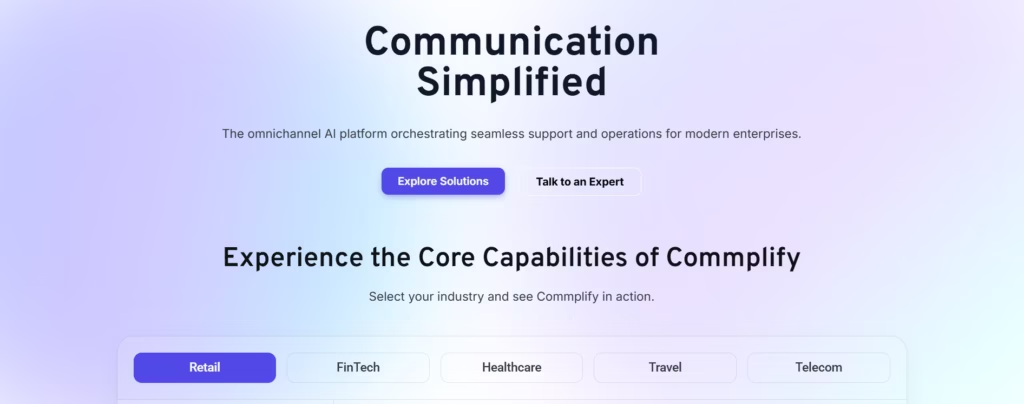
What sets Commplify apart is its omnichannel reach—spanning voice, chat, SMS, email, WhatsApp—and a unified AI agent framework that covers conversation management, workflow automation, and intelligent human handoff.
In my POV, this fits teams overwhelmed by scattered support channels and rising complexity. Commplify’s AI agents are configurable by channel, use case, and tone. No-code workflows trigger notifications, escalations, CRM updates, and channel handoffs. Analytics drill into AI-handled vs human escalation, CSAT, response times, and customer sentiment.
The unified inbox brings every conversation—voice, chat, SMS, email, WhatsApp—into one place. This is critical for brands where customers jump between channels, and legacy chatbots simply can’t keep up.
Quick Verdict: Commplify serves e-commerce and retail teams who want AI-powered order, return, FAQ, and escalation support across all channels, with analytics and workflow control.
Best Fit
E-commerce and retail orgs supporting customers on chat, voice, SMS, email, WhatsApp, and social—especially those that need order support, returns triage, policy-driven FAQs, complaint escalation, and control over handoff.
E-commerce Support Workflows It Can Support
- Order and delivery support across every channel
- Returns and refunds triage with workflow triggers
- Product and policy FAQs, warranty/warranty checks
- Abandoned cart recovery and missed-call follow-up
- Automatic escalation of complaints
Relevant Capability Angle
- AI agents configurable by channel, team, policy, and knowledge base
- Knowledge grounding covers orders, returns, shipping, and more
- Visual no-code workflow automation: notifications, CRM updates, follow-ups
- Unified inbox: chat, voice, email, SMS, WhatsApp—no silos
- Full analytics: AI resolution, escalation rate, CSAT, and channel tracking
Limitations to Evaluate
Data access and governance planning is a must for compliance
API/webhook or custom connector setup for deep e-commerce stack
Teams need to design workflows and knowledge base for best results
2. Yuma AI — Best for High-Volume E-Commerce Automation
Yuma AI suits brands who can’t keep headcount in line with ticket spikes, especially during peak retail or multi-sale campaigns.
Unlike generic bots, Yuma’s strength is its e-commerce-specific AI automations—using order and customer data to resolve repetitive support across Shopify, Magento, WooCommerce, and BigCommerce. This means faster automation of post-purchase, return, or refund requests.
In my experience, teams best-equipped for Yuma already know their high-volume pain points and need more than basic deflection—they want AI to resolve, not just triage.
Quick Verdict: Yuma AI fits high-volume e-commerce teams needing AI resolution for core order and return support, not just chatbot handoff.
Best Fit
Scaled-up Shopify, Magento, WooCommerce, or BigCommerce brands, with high ticket volume and repetitive, rules-driven support needs.
E-commerce Integration Strengths
- E-commerce-first ticket automation with order data
- Returns/refunds workflow integration
- Plug-and-play with existing helpdesk tools
Where It Works Best
- Repetitive order tracking automation
- Returns eligibility checks and self-service
- Quick updates on shipping, delays, or lost items
- Reducing agent load on simple tasks
Limitations to Evaluate
- Fewer channels vs full omnichannel suites
- Not ideal for non-commerce/B2B verticals
- Advanced setup needed for multi-brand workflows
- Guardrails and human review controls must be checked
3. Zendesk — Best for Teams Scaling from Helpdesk to AI Support
Zendesk is the “next step” for many because it extends existing helpdesk processes with AI-powered routing, triage, agent assist, and self-service options.
Zendesk shines when multi-agent teams want to add Shopify or marketplace integrations to mature ticket and workflow systems. AI features focus on better triage, agent help, and knowledge-driven automation.
In practice, success with Zendesk depends on existing process maturity and ability to invest in setup—teams lacking integration support or good helpdesk hygiene often struggle.
Quick Verdict: Zendesk is best for teams already using Zendesk or needing a robust helpdesk with scalable AI and e-commerce connectors.
Best Fit
Mid-market and enterprise support teams, or brands who have outgrown their basic helpdesk and want ticketing plus scalable automation.
E-commerce Integration Strengths
- Shopify/marketplace connectors expand order visibility
- Agent assist, knowledge base, workflow automation all in one
- Strong reporting and ticket routing
Where It Works Best
- Multi-agent operations needing ticket triage
- Help center self-service for FAQs and order issues
- Teams scaling up agent productivity
Limitations to Evaluate
- Add-on costs for stronger AI features
- Implementation can become complex
- E-commerce action-taking may need extra build
- Omnichannel continuity can suffer if not configured well
4. Freshdesk — Best for Omnichannel Helpdesk Teams Adding AI
Freshdesk helps SMB and mid-sized e-commerce teams unify chat, email, phone, and social support with AI features layered in.
Freddy AI brings automation and agent help; Shopify and app ecosystem power basic order and ticket flows. Teams ready to centralize multi-channel support with growing automation find Freshdesk delivers, as long as they validate which integrations are included in their plan.
I have seen Freshdesk succeed where support is spread thin and teams need smart routing, campaign follow-ups, and knowledge-driven FAQ automation—but deep e-commerce actions still require effort.
Quick Verdict: Freshdesk is best for SMB/mid-market stores needing omnichannel helpdesk plus built-in AI for routing and basic automation.
Best Fit
Growing e-commerce teams managing increasing volume across chat, email, phone, and social. Teams needing helpdesk/AI combo without major setup.
E-commerce Integration Strengths
- Shopify and major store platform apps
- Omnichannel ticketing inbox
- Freddy AI for FAQ automation and productivity
- Knowledge base for self-service
Where It Works Best
- Ticket assignment and routing
- Growing support teams managing multi-channel queries
- Pre/post-sale product questions
- FAQ deflection
Limitations to Evaluate
- Advanced AI and workflow features may raise costs
- E-commerce action workflows limited to integration quality
- Returns/refunds flows may need API or partner setup
5. Ada — Best for Enterprise Self-Service Automation
Ada delivers for global and enterprise e-commerce teams where sheer scale and multilingual support demand a self-service-first approach.
The no-code AI builder covers chat, SMS, voice, and API-based integrations, letting teams automate everything from product FAQs to order status and policy-based flows (returns, store credit, eligibility).
Building sophisticated workflows takes planning, but when deployed right, Ada deflects a huge volume of repetitive service, saving agents for sensitive or high-ticket requests.
Quick Verdict: Ada is for large e-commerce orgs needing multi-channel, scalable AI self-service, cross-language support, and custom workflows.
Best Fit
Global retail and e-commerce teams, or any brand with complex, multi-language service demands across chat, voice, and messaging.
E-commerce Integration Strengths
- API-first integration unlocks deep e-commerce workflows
- No-code builder for return, refund, and FAQ automation
- Strong self-service, multilingual support
Where It Works Best
- High-volume, repetitive ticket environments
- Policy and product FAQ bots
- Order status automation for global brands
Limitations to Evaluate
- Requires careful workflow configuration
- Human handoff must be set up intentionally
- May outstrip smaller stores’ budgets
6. Salesforce Service Cloud — Best for Enterprise Commerce Ecosystems
Salesforce Service Cloud is the gold standard for global retailers already invested in Salesforce Commerce, CRM, and omnichannel service.
Einstein AI powers routing, agent assistants, and cross-channel workflows, all tied into full CRM and compliance. It’s ideal for brands managing enterprise-scale operations, high compliance, and custom governance.
It’s robust—but in my experience, only feasible for well-resourced teams with the will to shape complex support environments.
Quick Verdict: Salesforce Service Cloud fits enterprise brands needing AI, omnichannel, security, analytics, and governance in a full-scale service ecosystem.
Best Fit
Enterprise retail and e-commerce companies, Salesforce Commerce users, and brands with deep CRM/service operations.
E-commerce Integration Strengths
- CRM-native customer and order profiles
- AI-powered omnichannel routing
- Deep integration with other Salesforce products
Where It Works Best
- Complex, multi-region support teams
- High SLA, high compliance environments
- Full customer journey and lifecycle management
Limitations to Evaluate
- Higher cost and admin requirements
- Significant implementation cycles
- Not suitable for SMB or low-volume shops
7. Gorgias — Best for Shopify-First DTC Support Teams
Gorgias lands on every Shopify team’s radar because it feels native to DTC support—especially brands running direct-to-consumer and needing order and customer context in every reply.
Gorgias builds deep Shopify workflows: order lookup, returns, macros, and product info all live inside the ticket. Teams manage chat, email, SMS, and social messages in one helpdesk view. In my experience, Gorgias is excellent for WISMO, returns, and revenue-driving support.
But outside retail, its power fades. Complex omnichannel or non-Shopify flows may hit workflow limits or higher costs as ticket volume climbs.
Quick Verdict: Gorgias is best for Shopify DTC teams wanting e-commerce smart macros, order-linked support, and human handoff inside a flexible helpdesk.
Best Fit
Shopify and Shopify Plus brands running omni-channel support with a focus on direct customer care. Teams whose agents live in the helpdesk and need fast, accurate order workflows.
E-commerce Integration Strengths
- Deep Shopify, BigCommerce, Magento, WooCommerce support
- Real-time order and customer profile lookup
- Ticket macros trigger refunds, returns, or exchanges
- Strong social and SMS integration for modern commerce
Where It Works Best
- WISMO (“Where is my order?”) queries
- Return and exchange requests
- Product and policy FAQs
- Revenue or coupon support inside chat/email/SMS
Limitations to Evaluate
- Not built for non-retail or B2B flows
- Limited workflow customization for complex automation
- Voice support and custom channel integrations are basic
- Costs can rise for high-volume or multi-brand operations
Common Mistakes to Avoid
Many teams jump into “AI support” and regret it later. Based on what I’ve seen:
- Don’t buy a chatbot without true workflow automation.
- Never automate a broken or manual support process.
- Knowledge base quality is critical—AI learns from what you document.
- Always measure CSAT, not just ticket deflection.
- Test human handoff and escalation logic before go-live.
- Focus on integration depth, not just platform logos.
- Never skip analytics setup—it’s your ROI truth.
Build your foundation on trust, order and policy data, and clear escalation rules.
How Commplify Solves Omnichannel E-commerce Support
In my experience, omnichannel e-commerce support is where most AI platforms fall short. Customers ask about orders in chat, confirm returns via email, and follow up by phone or WhatsApp. Silos kill both speed and customer satisfaction.
Commplify bridges this gap with a unified AI agent and conversation inbox, eliminating the classic problem of fragmented customer context. The platform’s no-code workflow automation means returns, refunds, or escalation tasks trigger where and when your policy requires—not just when a chatbot guesses.
By grounding AI answers to your actual order, shipping, policy, and FAQ data—and always keeping humans available for edge cases—Commplify helps e-commerce teams automate the repetitive, triage the exceptions, and deliver support that feels genuinely connected to the business.
Conclusion
Choosing an AI customer support platform with e-commerce integration is not about chasing “AI” as a buzzword. The critical difference for every team I’ve worked with is integration depth—can your AI agent read, act, and route using real order and customer data, across every key channel?
Platforms like Commplify, Yuma AI, Gorgias, and Salesforce Service Cloud all fit different business models. Your best choice matches your e-commerce stack, support complexity, workflow needs, and analytics requirements.
In my POV, AI plus human support is the only reliable model—AI for repetitive tickets, humans for exceptions and sensitive issues. Omnichannel context and workflow automation shift your team from reactive ticket handling to proactive customer care.
AI-driven CX is moving toward real operational integration, cross-channel context, and trust-based automation, not just chatbots. It’s the teams who get this right that set the bar for every customer’s expectation.
FAQs
What is an AI customer support platform for e-commerce?
It is software that uses AI agents and automation to answer customer questions and resolve common requests, while connecting directly to your e-commerce, order, and helpdesk systems.
How is an AI customer support platform different from a chatbot?
AI platforms handle complex workflows, access customer and order data, automate actions, and route cases across channels—while most chatbots only provide basic answers via set scripts.
Which AI customer support platforms integrate with Shopify?
Gorgias, Yuma AI, Ada, Zendesk, Freshdesk, Tidio, Kustomer, and Commplify all offer Shopify integration at various depths—always check action-taking capability, not just basic data access.
Can AI customer support platforms handle order tracking and returns?
Yes, as long as the platform is integrated with order and returns systems. AI can fetch order status, start returns, and provide policy-driven answers automatically.
Can AI process refunds and exchanges?
Some platforms can trigger refunds or exchanges if connected to your e-commerce and payment systems—verify policy eligibility, human review, and limits with your vendor first.
Can AI customer support replace human agents?
No—AI is best for first-layer resolution. Human agents must handle exceptions, sensitive requests, complaints, and gray-area support where empathy and context matter.
What are the biggest risks of using AI for e-commerce customer support?
Risks include incorrect refunds, poor escalation, hallucinated answers, broken workflows, and frustrated customers if AI lacks real data access and clear human handoff.
How much does AI customer support software cost?
Pricing varies. SMB chatbots start free; helpdesk and full AI platforms range from $50 to $1,500+ per month, with enterprise platforms charging more for advanced automation and integrations.
How do you measure ROI from AI customer support?
Monitor metrics like cost per ticket, automation rate, escalation rate, CSAT, first response time, and contact rate per order to see support savings and customer impact.
This page was last edited on 15 June 2026, at 4:39 am