
Top-rated CX analytics solutions capture and analyze every customer interaction across all channels, delivering actionable insights. The best platforms offer real-time, AI-powered analytics and workflow automation to drive measurable business outcomes.
Pressure on customer experience leaders is at an all-time high. Disconnected tools, scattered data, and rising customer demands make it tough to act fast and keep teams aligned.
I have seen many operations teams struggle with analytics “that live in the past” or dashboards that can’t answer the real “why.” The right CX analytics platform should connect dots, spot opportunities, and trigger action.
This article breaks down the ten best CX analytics solutions rated highly by large teams in 2026. You’ll find clear differentiators, integration details, and direct advice on how to choose the right fit for your business.
Top-Rated CX Analytics Solutions
Customer experience analytics platforms help businesses turn customer interactions, feedback, behavioral data, conversations, and service metrics into actionable insights. The strongest solutions go beyond basic dashboards: they identify customer intent, detect sentiment, reveal friction points, track journeys, measure service performance, and help teams decide what to do next.
The right platform depends on where your customer data comes from and how you plan to use it. Some tools specialize in surveys and Voice of Customer programs, while others focus on contact-center conversations, digital behavior, or omnichannel AI.
Here are the CX analytics solutions worth considering.
| Platform | Best For | Key Analytics Strength |
|---|---|---|
| 1. Commplify | AI-driven omnichannel CX | Unified voice, chat, email, intent, context, and interaction intelligence |
| 2. Qualtrics | Enterprise experience management | VoC, surveys, journey and contact-center analytics |
| 3. Medallia | Large-scale enterprise CX programs | Customer feedback, sentiment, journey and operational analytics |
| 4. Sprinklr | Large omnichannel organizations | Social, service, conversation and journey intelligence |
| 5. Zendesk | Customer service analytics | Support operations, agent performance and service insights |
| 6. Contentsquare | Digital customer experience | Web/app behavior, session replay, journeys and friction analysis |
| 7. Fullstory | Product and digital experience teams | Behavioral and digital journey analytics |
| 8. CallMiner | Contact centers and conversation intelligence | Voice, text, sentiment, intent and agent interaction analytics |
1. Commplify — Best Overall for AI-Powered Omnichannel CX
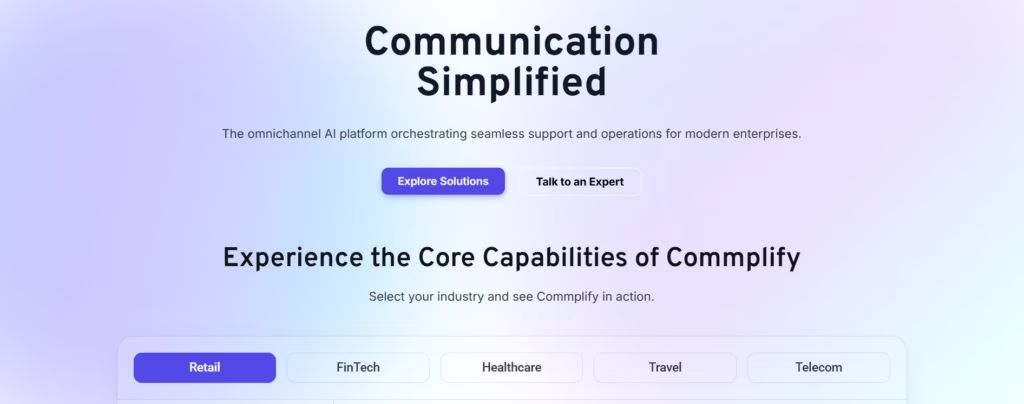
Commplify is our #1 choice for organizations that want to combine CX analytics with AI-powered customer interaction and automation.
Instead of treating analytics as a separate reporting layer, Commplify brings calls, chats, emails, and messaging interactions together through a unified AI-driven orchestration layer. Its platform is designed to detect customer intent and context, route interactions intelligently, respond in real time, and maintain continuity across channels.
That makes Commplify particularly useful for businesses that want to understand customer experience while simultaneously improving it. Traditional CX analytics platforms may tell teams what went wrong after an interaction. An AI-native approach can use interaction intelligence during the customer journey to determine the appropriate workflow, response, escalation, or human handoff.
Key CX Analytics Capabilities
- Omnichannel customer interaction intelligence
- Customer intent and context detection
- Voice, chat, email, and messaging data in a unified environment
- AI-powered customer conversation analysis
- CX workflow monitoring
- Interaction history and contextual continuity
- AI and human-agent performance visibility
- Intelligent routing insights
- Customer journey context across channels
- Automation and human fallback capabilities
Commplify’s AI agents can also be configured around actual business processes rather than relying only on generic scripts, helping organizations connect customer intelligence to operational workflows.
Best for: Businesses looking for an AI-native platform that combines omnichannel customer service, CX intelligence, automation, and human-agent collaboration.
Why it stands out: Commplify is especially relevant when the goal isn’t simply to measure customer experience but to use customer context and interaction data to influence the experience as it happens.
2. Qualtrics — Best for Enterprise Experience Management
Qualtrics is one of the most comprehensive options for organizations running mature Voice of Customer and experience-management programs.
Its platform can bring together signals from surveys, calls, digital experiences, and service interactions. Qualtrics also uses automated text analytics to identify themes, sentiment, risk, intent, and other patterns from customer feedback and interactions.
For contact centers, Qualtrics provides AI-powered analytics across calls, emails, and conversation threads, allowing CX teams to evaluate customer service and agent performance at scale.
Key Features
- Voice of Customer analytics
- Customer surveys
- NPS, CSAT and experience measurement
- Text and sentiment analytics
- Contact-center analytics
- Digital experience analytics
- Customer journey analysis
- CX dashboards
- Customer feedback management
- Experience-management workflows
Qualtrics is particularly strong when a business needs to combine structured feedback, such as surveys, with less-structured customer signals.
Best for: Enterprises with sophisticated VoC, customer research, customer journey, and experience-management programs.
Potential limitation: The breadth of the platform may be more than smaller teams need when their primary requirement is straightforward customer-service analytics.
3. Medallia — Best for Enterprise Voice of Customer Analytics
Medallia is another enterprise-focused experience-management platform designed to combine customer signals from multiple areas of the journey.
Its platform supports feedback surveys, digital analytics, customer journey analytics, and contact-center analytics, giving organizations different ways to understand the factors affecting customer experience.
Medallia’s text analytics capabilities can also identify topics, themes, sentiment, and other signals in unstructured customer feedback.
Key Features
- Customer feedback analytics
- Voice of Customer programs
- Text analytics
- Sentiment analysis
- Customer journey analytics
- Digital experience analytics
- Contact-center intelligence
- CX dashboards
- Operational data integration
- Experience measurement
One of Medallia’s advantages is its ability to combine customer feedback with behavioral, profile, and operational information. That helps companies investigate not only how customers feel, but which journey events may be influencing those experiences.
Best for: Large enterprises requiring a broad CX measurement and Voice of Customer ecosystem.
Potential limitation: Organizations with narrower analytics requirements may not need the scope of an enterprise experience-management platform.
4. Sprinklr — Best for Unified Enterprise CX and Social Intelligence
Sprinklr takes a broad approach to customer experience management by connecting customer-facing teams, conversations, channels, and data through a unified platform.
Its current Unified-CXM platform combines multiple AI-powered capabilities and is designed to help enterprises connect customer interactions across touchpoints rather than operating separate systems for each channel.
For CX analytics specifically, Sprinklr supports capabilities such as AI-powered dashboards and sentiment analysis across customer touchpoints.
Key Features
- Omnichannel CX analytics
- Customer sentiment analysis
- Social listening and intelligence
- Customer-service analytics
- AI-powered dashboards
- Conversation intelligence
- Journey insights
- Customer engagement data
- Cross-channel customer context
- Enterprise reporting
Sprinklr can be particularly valuable for brands receiving large volumes of customer interactions across social media, messaging, customer care, and other digital channels.
Best for: Large organizations managing high-volume customer conversations and social interactions across many channels.
Potential limitation: Companies that only require CX reporting for a small support operation may find a large Unified-CXM environment unnecessary.
5. Zendesk — Best for Customer Service and Support Analytics
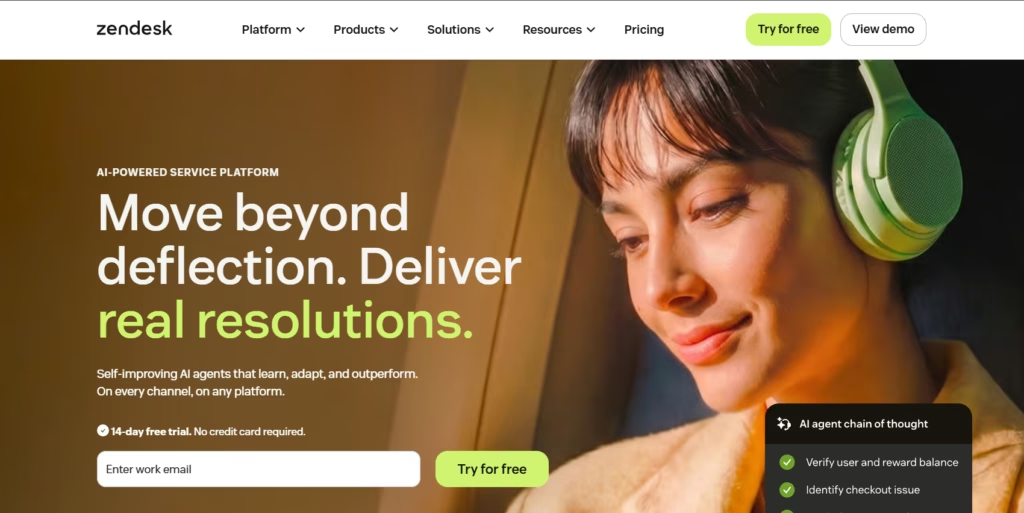
Zendesk is a strong choice when CX analytics primarily revolves around the customer-support operation.
Rather than operating as a broad market-research platform, Zendesk connects customer intelligence closely with service workflows. Its service platform can transform customer and operational information into AI-powered analytics covering areas such as omnichannel monitoring, automation opportunities, and predictive insights.
Key Features
- Customer-service reporting
- Ticket and conversation analytics
- Agent-performance analytics
- Support-channel monitoring
- AI-powered service insights
- Customer sentiment analysis
- Operational dashboards
- Resolution and service-performance metrics
- Automation insights
- Customer interaction history
Zendesk is especially practical when customer-service managers need to answer questions such as:
- Why are customers contacting support?
- Which issues generate the largest ticket volume?
- Where are service bottlenecks occurring?
- How effectively are agents resolving requests?
- What do customer comments indicate about satisfaction?
Its sentiment-analysis capabilities can also turn customer comments, complaints, reviews, and other feedback into customer insights.
Best for: Support organizations that want CX analytics closely integrated with everyday customer-service operations.
Potential limitation: Businesses needing extensive enterprise research or cross-company experience-management functionality may want a broader XM platform.
6. Contentsquare — Best for Digital Experience Analytics
Contentsquare is especially useful when the customer experience you need to analyze takes place primarily on a website or mobile application.
The platform combines Experience Analytics, Product Analytics, Voice of Customer, Conversation Intelligence, and experience-monitoring capabilities. Its digital analytics toolkit includes features such as session replay, heatmaps, funnel analysis, surveys, error monitoring, and AI-powered insights.
Instead of relying exclusively on what customers say, Contentsquare helps teams investigate what visitors actually do while navigating a digital journey.
Key Features
- Session replay
- Heatmaps
- Digital journey analytics
- Funnel analysis
- Product analytics
- Voice of Customer
- Error and experience monitoring
- Behavioral analytics
- AI-generated digital insights
- Conversation intelligence
Contentsquare also offers Conversation Intelligence for analyzing voice, chat, and email interactions to uncover drivers, sentiment, root causes, resolution patterns, and agent performance.
Best for: Ecommerce, SaaS, product, UX, conversion optimization, and digital-experience teams.
Potential limitation: Businesses focused mainly on offline or traditional contact-center CX may prioritize a conversation-analytics or omnichannel service platform instead.
7. Fullstory — Best for Behavioral and Product Experience Analytics
Fullstory focuses heavily on understanding how users actually interact with digital products.
Its digital experience analytics approach examines customer behavior across websites and applications, helping product and CX teams identify user intent, experience friction, and opportunities to improve digital journeys.
Fullstory’s behavioral analytics can capture interaction patterns such as clicks, scrolling, form activity, and frustration signals, giving teams behavioral context that traditional satisfaction surveys may not reveal.
Key Features
- Digital behavior analytics
- Session analysis
- User journey insights
- Friction identification
- Product analytics
- Web and mobile experience analysis
- Behavioral signals
- Conversion journey investigation
- Digital experience monitoring
A CX team could, for example, see that customers are abandoning a particular step of a checkout process and investigate the actual digital behavior surrounding that point instead of relying solely on post-purchase feedback.
Best for: SaaS, ecommerce, product, UX, growth, and digital customer-experience teams.
Potential limitation: Fullstory is most valuable for digital behavioral analytics rather than as a complete replacement for an enterprise omnichannel contact-center or VoC platform.
8. CallMiner — Best for Conversation and Contact Center Analytics
CallMiner is purpose-built for organizations that need to extract intelligence from large volumes of customer conversations.
Its conversation analytics technology captures, transcribes, and analyzes interactions across voice, text, and other digital channels, transforming unstructured conversations into structured information about sentiment, intent, emotion, topics, and other customer signals.
Its omnichannel analytics capabilities can bring together information from voice calls, email, live chat, SMS, social channels, and surveys to provide a broader view of customer interactions.
Key Features
- Speech analytics
- Conversation analytics
- Customer sentiment detection
- Intent analysis
- Emotion and interaction insights
- Automated quality management
- Agent-performance intelligence
- Omnichannel conversation analysis
- Compliance insights
- Real-time agent and supervisor intelligence
Conversation intelligence can also translate analytics into real-time recommendations or alerts, such as identifying declining sentiment or situations requiring supervisor attention.
Best for: Contact centers, customer-service operations, QA teams, regulated industries, and businesses with high call or conversation volumes.
Potential limitation: Organizations primarily interested in website UX analytics or traditional survey research may need additional tools.
What Features Should a CX Analytics Solution Have?
Comparing platforms only by dashboard design or the number of reports available can be misleading. A useful CX analytics system should help your organization move from data → insight → decision → action.
Look for the following capabilities.
1. Omnichannel Data Collection
Your customers may move between phone, email, chat, messaging, websites, apps, and human agents during a single journey.
A strong solution should connect as many of these interactions as possible. Otherwise, analytics can produce a fragmented picture in which each department sees only one part of the customer’s experience.
2. Customer Sentiment Analysis
Sentiment analytics helps identify positive, neutral, and negative customer reactions within conversations and feedback.
More advanced platforms can combine sentiment with topics, intent, conversation context, and journey information. This makes the analysis much more useful than simply labeling comments as positive or negative.
3. Conversation Analytics
Calls, chats, and emails contain valuable Voice of Customer information that traditional surveys often miss.
Conversation analytics allows companies to identify:
- Common reasons customers make contact
- Emerging complaints
- Product problems
- Customer objections
- Recurring support issues
- Agent-performance gaps
- Churn indicators
- Frequently requested features
This turns everyday customer communication into a continuous source of CX intelligence.
4. Customer Journey Analytics
Individual interactions rarely explain the entire customer experience.
Journey analytics should show how customers move through different stages and touchpoints, helping businesses discover where satisfaction decreases, customers abandon a process, or unnecessary friction appears.
5. AI-Powered Insights
Modern CX teams often have more customer data than analysts can manually investigate.
AI can help classify conversations, detect intent, summarize interactions, uncover themes, identify anomalies, prioritize problems, and surface patterns hidden inside large datasets.
The most valuable platforms go further by connecting those insights with recommended or automated actions.
6. Real-Time Analytics
Historical reports remain useful, but some customer-experience problems need immediate action.
For example, rapidly declining sentiment during a service interaction can be more valuable when detected during the conversation than when discovered in a monthly dashboard.
Real-time analytics can help companies identify problems, escalate difficult interactions, support agents, or trigger workflows before the customer leaves.
7. Custom Dashboards and Reporting
Different teams need different CX metrics.
Executives may monitor customer satisfaction and retention trends, while contact-center managers care more about resolution rates, conversation topics, sentiment, escalation rates, and agent performance.
A good platform should allow relevant data to be presented to each team without forcing everyone to work from the same generic dashboard.
8. Integrations
CX analytics becomes significantly more valuable when connected with systems such as:
- CRM platforms
- Help desks
- Contact-center software
- Ecommerce systems
- Marketing platforms
- Customer data platforms
- Business intelligence tools
- Knowledge bases
- Workflow automation software
These connections provide the context required to understand how customer experiences relate to business outcomes.
Which CX Analytics Solution Is Best for Your Business?
There isn’t one platform that is ideal for every CX environment.
Choose Commplify if your priority is combining AI-powered omnichannel customer engagement, interaction intelligence, customer context, and automation within one CX environment. Its unified approach is particularly useful for businesses trying to move from passive analytics toward real-time, AI-driven CX operations.
Choose Qualtrics or Medallia when your organization requires a broad enterprise experience-management or Voice of Customer program. Both provide extensive capabilities for combining feedback, experience metrics, and customer signals.
Choose Sprinklr when large-scale omnichannel engagement and social customer experience are central to the business.
Choose Zendesk when your analytics requirements are primarily connected to support operations and customer-service performance.
Choose Contentsquare or Fullstory when website, application, ecommerce, or product behavior is the primary customer experience you need to optimize.
Choose CallMiner when customer calls and conversations are your richest source of CX information and you need specialized conversation intelligence.
Final Thoughts
The best CX analytics solutions do more than collect NPS scores or generate monthly reports. They connect customer feedback, conversations, behaviors, journeys, and operational information so teams can understand what customers are experiencing, why it is happening, and what should happen next.
For businesses pursuing an AI-first customer experience strategy, Commplify stands out as our top choice because it brings omnichannel customer interactions, real-time intent and context detection, intelligent routing, AI automation, and human fallback into the same CX orchestration environment.
For larger research-heavy experience programs, platforms such as Qualtrics and Medallia remain strong alternatives, while specialized platforms including Contentsquare, Fullstory, and CallMiner can be better suited to specific digital or conversation-analytics use cases.
Ultimately, the best CX analytics solution is the one that doesn’t leave insights sitting inside a dashboard—it should help your organization turn those insights into better customer experiences.
FAQs
What is customer experience analytics?
Customer experience analytics is the process of tracking and analyzing interactions across all customer touchpoints—like voice, chat, email, and web—to understand trends and improve satisfaction.
How are CX analytics platforms different from web analytics?
CX analytics platforms analyze all customer channels, including voice and feedback, not just website behavior. Web analytics focuses only on site or app usage patterns.
What features should I look for in a top-rated CX analytics platform?
Look for omnichannel data capture, AI-powered insights, real-time dashboards, automation triggers, strong integration, and tools for closed-loop feedback and workflow.
How do CX analytics solutions help improve customer retention?
They spot satisfaction drops and intent shifts fast, triggering targeted follow-ups or escalations that help teams recover at-risk customers and improve loyalty.
Which CX analytics solution is best for my industry?
It depends on channels, compliance, and CX maturity. Healthcare needs compliance; BPOs need multichannel and tenant controls; SaaS prefers deep segmentation and integration.
How do leading companies use CX analytics?
Top companies use CX analytics to track every touchpoint, detect pain points, trigger fast responses, and connect insights to revenue and product improvements.
What are the main types of CX analytics platforms?
Types include feedback analytics (surveys, NPS), behavioral analytics (usage, replays), integrated omnichannel analytics, and journey analytics connecting multiple data sources.
What’s the difference between feedback analytics and behavioral analytics?
Feedback analytics examines survey, review, or ticket responses; behavioral analytics tracks user actions like clicks, navigation, or support volume across channels.
How can CX analytics drive real business outcomes?
Analytics highlight drop-offs, friction, and churn risks, enabling teams to act with alerts, follow-ups, or AI interventions—driving better retention and increasing revenue.
What is closed-loop CX analytics?
Closed-loop CX analytics connect insights directly to action—like triggering escalations, task assignments, or feedback requests—so opportunities aren’t lost in reporting.
This page was last edited on 13 August 2026, at 7:44 am