AI tools for insurance customer experience automate conversations, claims, and support across chat, voice, email, and SMS. This improves efficiency, lowers costs, speeds up claims, and delivers better service while supporting compliance for insurers.
Most insurance leaders today feel the friction between rising customer expectations and legacy systems that slow everything down. Clients expect quick answers, personal attention, and 24/7 support—yet even great teams struggle with high call volume, claims delays, and fragmented communication.
I have seen this firsthand: operations leaders calling for solutions, support teams burned out, and customers frustrated by dead-ends. The industry is moving fast. If your team hesitates, more agile competitors will win the business that should be yours.
This guide offers a grounded, practical roadmap. You will see how leading insurers use AI tools for insurance customer experience to unify communication, automate routine workflows, and secure real business results—without losing the human touch.
How AI Is Transforming the Insurance Customer Experience
Insurance customer experience is unusually complex because policyholders often contact insurers during stressful or time-sensitive moments. They may be reporting an accident, checking whether medical treatment is covered, trying to understand a premium increase, tracking a claim, or requesting an urgent policy document.
AI helps insurers reduce friction across these interactions by combining conversational AI, workflow automation, customer data, analytics, and agent assistance. Modern AI agents can identify customer intent, retrieve relevant policy information, automate routine service requests, and transfer sensitive or complex cases to human representatives with the conversation context intact.
The biggest opportunities for AI in insurance customer experience include:
- 24/7 policyholder support: AI assistants can answer common coverage, payment, renewal, and claim-status questions outside normal business hours.
- Claims automation: Conversational AI can support First Notice of Loss (FNOL), gather initial incident information, request supporting documents, and trigger the next workflow step.
- Faster policy servicing: Customers can request documents, update contact information, check policy status, or initiate routine changes without waiting for an agent.
- Personalized conversations: AI can use policy, claim, interaction, and customer context to provide more relevant assistance rather than generic responses.
- Agent assistance: AI can summarize conversations, surface relevant knowledge, recommend next actions, and reduce the amount of information agents must search manually.
- Omnichannel continuity: Conversations can continue across voice, chat, email, SMS, WhatsApp, and other channels without forcing customers to repeat everything.
- Customer sentiment analysis: AI can identify frustration, urgency, intent, and recurring service problems across customer interactions. Qualtrics, for example, says its financial-services platform analyzes calls, chats, and emails for sentiment, effort, intent, compliance indicators, and themes.
For insurers, the goal should not simply be to replace customer service conversations with bots. The better use of AI is to automate predictable work while giving employees more context and time for claims, complaints, coverage disputes, vulnerable customers, and other situations where human judgment matters.
Core Types of AI Tools Reshaping Insurance CX
Insurance CX has changed in real ways with adoption of intelligent automation, conversation platforms, and analytics. The sections below cover the major categories shaping insurance CX today.
AI-Powered Insurance Chatbots and Virtual Assistants
AI chatbots deliver always-on support, making it easy for customers to get policy details, file simple claims, or ask for documents at any hour. In my POV, agents benefit too—routine inquiries disappear, leaving experts free for the tough cases.
- Handle onboarding with guided workflows
- Respond to FAQs instantly
- Collect first notice of loss (FNOL)
- Bridge language barriers with multilingual support
When deployed right, these tools mean faster answers, higher containment rates, and real agent relief.
Voice AI and Speech Analytics in Insurance
Voice AI automates phone-based interactions—critical in an industry where many customers prefer to call. I have seen voice bots automate FNOL calls, route clients based on urgency, and even send SMS if a call is missed.
Speech analytics delivers another layer of control. By detecting intent, emotion, or compliance signals during calls, teams can flag risky interactions or spot trends before they become issues. This is where many teams gain insights they never had before.
Predictive Analytics & Risk Modeling
Predictive AI takes data from customer interactions and claims, then models risk, churn propensity, or upsell opportunity. I have seen underwriters and CX teams work from the same data, predicting which policyholders need extra attention or which claims are at risk for fraud.
Done right, predictive analytics moves insurers from reactive firefighting to proactive management.
Automated Document and Workflow Processing
Insurance relies on paperwork: claims forms, policy updates, identity checks. AI-powered document processing:
- Validates documents in seconds, reducing delays
- Routes requests to the right agents
- Flags exceptions for human review
Workflow automation ensures nothing slips—every step is tracked, and follow-ups happen without agent reminders. The outcome: claims cycle times shrink, and compliance is always documented.
Omnichannel Conversation Management
Many insurers still struggle with phone, email, chat, and WhatsApp being handled in separate teams—or worse, separate tools. Omnichannel platforms unify all channels in one inbox. This prevents missed conversations and avoids customers repeating themselves.
I have seen teams thrive when they can switch channels mid-conversation—picking up a chat in email, or calling a client directly from the inbox. Operations become more agile, and customers get real continuity.
AI Knowledge Intelligence and Compliance Tools
Insurance CX succeeds or fails on accurate information. Knowledge intelligence lets both bots and agents draw on up-to-date policy or product content, so answers are always aligned with the latest coverage or regulatory changes.
Compliance tools ensure every conversation is logged, documented, and audit-ready. This is non-negotiable in regulated markets but often missed until it is too late.
7 Best AI Tools for Insurance Customer Experience
There is no single AI platform that is ideal for every insurance company. Some tools are strongest in omnichannel automation, others in enterprise contact centers, CRM intelligence, customer feedback, or workforce optimization.
Here is a practical comparison of seven notable options.
| AI Tool | Best For | Key Insurance CX Capabilities |
|---|---|---|
| Commplify | AI-native omnichannel insurance CX | AI agents, voice, chat, SMS, email, WhatsApp, workflow automation, human handoff |
| Genesys Cloud CX | Large insurance contact centers | Experience orchestration, routing, AI assistance, omnichannel engagement |
| Salesforce | CRM-centered insurance organizations | Agentic AI, customer data, insurance CRM, service automation |
| NICE CXone | Enterprise-scale CX operations | AI contact center, routing, agent assistance, analytics, workflow orchestration |
| Talkdesk | Insurance contact center automation | Claims and policy workflows, agentic AI, self-service, insurance-focused CX |
| Qualtrics | Voice-of-customer and experience intelligence | Sentiment, customer feedback, journey insights, contact center analytics |
| Verint | CX automation, QA, and workforce optimization | AI bots, interaction analytics, agent support, quality and compliance workflows |
1. Commplify — Best Overall for AI-Powered Omnichannel Insurance CX
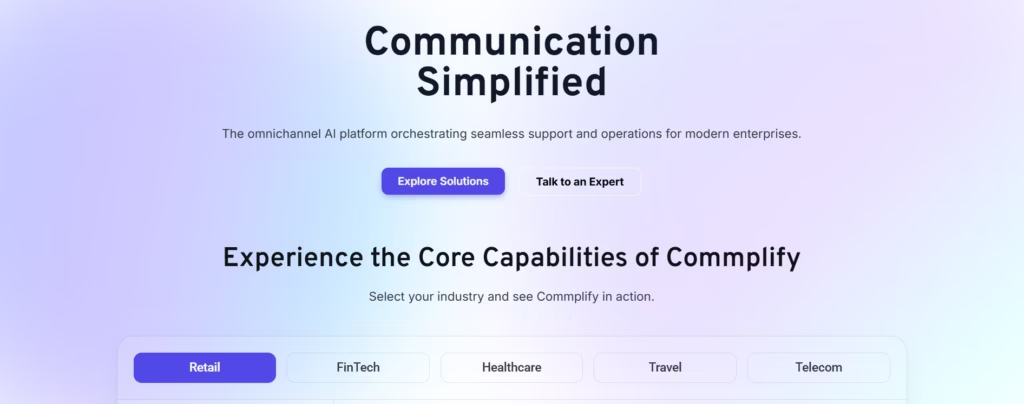
Commplify is our top choice for insurance organizations looking to combine conversational AI, omnichannel customer communication, workflow automation, and AI-to-human handoff in one customer experience environment.
Rather than deploying a separate chatbot, voice system, SMS platform, and workflow tool, insurers can use Commplify to bring customer conversations across voice, web chat, SMS, WhatsApp, and email into a connected experience.
This matters in insurance because policyholder journeys rarely stay within one channel. A customer might initially call about an accident, send photographs through a digital channel, receive an SMS update, and later email additional documents. Maintaining context across these interactions can prevent customers from having to repeatedly explain the same situation.
Commplify’s AI agents can support insurance workflows including policy inquiries, billing questions, claims tracking, document requests, renewals, cancellations, and routine customer service requests. When an issue requires human judgment, the AI can escalate the conversation while preserving relevant interaction history.
Another important use case is First Notice of Loss. AI agents can collect initial incident information and supporting material through conversational channels, helping insurers begin claims workflows faster. Commplify also describes workflow automation for follow-ups, missed calls, pending claims, escalation conditions, and compliance-related triggers.
Key capabilities:
- AI voice and conversational agents
- Voice, chat, SMS, WhatsApp, and email support
- Unified policyholder conversations
- Claims and FNOL automation
- Automated follow-ups and notifications
- Knowledge-enabled policy assistance
- AI-to-human escalation
- Workflow automation
- Customer interaction analytics
- Support for insurance service and renewal journeys
Best for: Insurers, agencies, brokers, and insurance service teams that want an AI-native platform for automating customer conversations and workflows across multiple channels.
2. Salesforce — Best for CRM-Driven Insurance Customer Experience
For insurance companies already building their customer operations around CRM data, Salesforce is one of the strongest AI options.
Salesforce Financial Services Cloud provides insurance-focused CRM capabilities, while its agentic AI technology can support customer service, insurance agents, claims activities, personalization, and workflow automation. Salesforce describes agentic AI in insurance as applicable to areas including claims, service, fraud detection, and personalized customer engagement.
Its biggest advantage is the connection between AI and existing customer records. AI-powered service becomes much more useful when it can work with policyholder history, products, cases, previous communications, and other authorized customer data.
For example, instead of simply answering, “Your claim is being processed,” an AI-enabled workflow could use connected customer and case information to provide the appropriate claim status, identify the next required step, and create or route a service case when necessary.
Key capabilities:
- Insurance CRM
- Agentic AI
- Customer service automation
- Customer and policyholder data
- Personalized engagement
- Case management
- Workflow automation
- Insurance agent productivity tools
- Analytics
Best for: Insurance organizations that already rely heavily on Salesforce or want AI deeply connected with CRM-driven customer journeys.
3. NICE CXone — Best for Enterprise CX Automation
NICE CXone is designed for organizations operating customer experience at significant scale.
The platform combines AI, customer engagement, workflows, routing, workforce capabilities, and agent assistance within a unified CX environment. NICE describes CXone as an AI platform that orchestrates customer engagements, teams, workflows, and systems across customer experience operations.
For insurance companies, this can be valuable where customer conversations involve complicated routing rules, large agent teams, regulatory requirements, several business units, and high interaction volumes.
NICE also offers insurance-specific customer experience resources and combines CXone with conversational AI capabilities designed to expand automated customer service.
Key capabilities:
- Enterprise AI contact center
- Intelligent routing
- Digital customer service
- Agent copilot capabilities
- Conversational AI
- Customer journey orchestration
- Workforce management
- Interaction analytics
- Knowledge management
Best for: Large insurers that need enterprise-grade contact center infrastructure with extensive AI and workforce functionality.
4. Talkdesk — Best for Insurance-Specific Contact Center Automation
Talkdesk stands out because it provides solutions specifically designed around insurance customer experience.
Its insurance offering uses agentic AI to automate contact center workflows across areas such as claims, policy servicing, billing, and other policyholder interactions.
Talkdesk also describes AI orchestration across the policy and claims lifecycle, including workflows extending from FNOL through later claim-processing stages.
That insurance-specific orientation may make it appealing to organizations that want fewer generic workflows and more capabilities aligned with common insurer operations.
AI can also be introduced internally before insurers automate highly sensitive customer-facing interactions. For example, insurers can initially use AI for knowledge retrieval, interaction summaries, quality management, and employee guidance before gradually expanding self-service automation. Talkdesk recommends this kind of staged approach for insurance CX transformation.
Key capabilities:
- Agentic AI
- Insurance contact center workflows
- Claims automation
- Policy servicing
- Billing assistance
- Self-service
- Knowledge management
- Agent assistance
- Interaction analytics
Best for: Insurers looking for a cloud contact center with insurance-focused AI workflows.
5. Qualtrics — Best for Customer Feedback and Insurance Experience Analytics
Not every insurance CX problem requires another conversational bot. Sometimes the bigger challenge is understanding why customers are unhappy and where the journey is failing.
That is where Qualtrics fits particularly well.
Qualtrics provides customer experience management and interaction analytics for financial services organizations, including insurance. Its platform can analyze contact center interactions such as calls, chats, and emails to identify customer sentiment, effort, intent, themes, compliance indicators, and coaching opportunities.
This can help insurers discover patterns that basic CSAT reporting may miss.
For example, analytics might reveal that customers are repeatedly frustrated by:
- unclear deductible explanations,
- slow claim status updates,
- confusing renewal notices,
- repeated document requests,
- poor handoffs between digital and phone support,
- or difficulty reaching the correct department.
Insurance companies can then use those insights to redesign workflows rather than simply adding more automation.
Key capabilities:
- Voice-of-customer analysis
- Sentiment analysis
- Contact center analytics
- Customer effort measurement
- Feedback management
- Journey analytics
- Theme and intent detection
- Employee coaching insights
Best for: Insurers focused on measuring and improving policyholder experience rather than primarily automating conversations.
6. Genesys Cloud CX — Best for Large Insurance Contact Centers
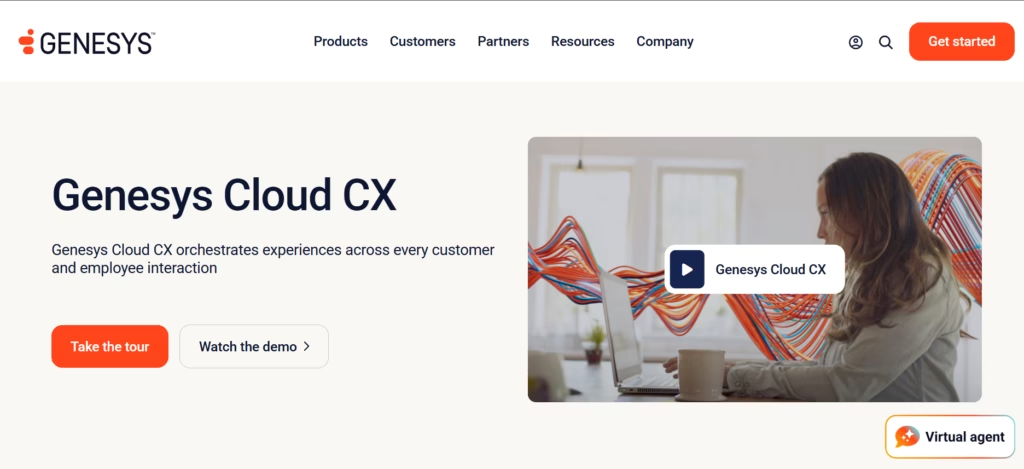
Genesys Cloud CX is a strong option for insurers managing large customer service operations where routing, workforce management, digital engagement, and contact center orchestration are major priorities.
Genesys positions AI-powered experience orchestration as a way for insurance organizations to coordinate policyholder journeys while improving operational efficiency. Its AI contact center capabilities include automation, predictive support, personalization, agent assistance, and real-time recommendations based on conversation context.
For insurers with thousands of daily interactions, intelligent routing can be particularly valuable. Instead of sending every customer through the same queue, customer intent and contextual information can help determine whether a request should go to self-service, claims, policy servicing, sales, or a specialist.
Genesys is therefore particularly suitable when customer experience transformation involves the entire contact center rather than a single chatbot or automation project.
Key capabilities:
- AI-powered contact center
- Intelligent interaction routing
- Conversational AI
- Agent assistance
- Customer journey orchestration
- Predictive engagement
- Omnichannel customer support
- Workforce engagement tools
- Analytics and reporting
Best for: Large insurers and enterprise contact centers requiring advanced orchestration, routing, and workforce capabilities.
7. Verint — Best for CX Automation and Agent Performance
Verint is another enterprise option focused heavily on customer experience automation, interaction analytics, agent productivity, and workforce operations.
Its insurance solution applies AI, automation, and analytics across customer-facing and back-office workflows. Verint describes capabilities for automating routine interactions, guiding employees, supporting quality and compliance processes, and increasing service capacity.
This makes it useful for insurers that already have a substantial customer service workforce and want AI to improve both automated and human-assisted interactions.
Instead of treating AI only as a customer-facing virtual assistant, insurers can use platforms like Verint to improve quality assurance, analyze conversations, assist employees during calls, identify recurring CX problems, and automate repetitive administrative work.
Key capabilities:
- AI-powered CX automation
- Intelligent virtual assistants
- Interaction analytics
- Agent guidance
- Quality management
- Workforce optimization
- Customer feedback
- Back-office automation
Best for: Established insurance contact centers seeking automation and analytics across both customer service and workforce operations.
Important AI Use Cases Across the Insurance Customer Journey
The value of AI becomes clearer when insurers connect technology to specific customer journeys rather than deploying AI simply because it is available.
AI-Powered Policy Inquiries
Policy documents are often difficult for customers to interpret. AI assistants connected to an approved insurance knowledge base can help explain common policy questions, provide relevant documents, identify coverage information, and guide customers toward the correct next step.
Human escalation should remain available when the request involves coverage interpretation, disputes, exceptions, or decisions requiring licensed professionals.
Automated First Notice of Loss
FNOL is one of the strongest use cases for conversational AI.
An AI agent can guide the policyholder through initial questions, capture basic incident information, request documents or images through supported digital channels, and trigger the appropriate claims workflow. Commplify specifically supports conversational workflows around FNOL and claims data collection.
The objective is not to let AI make every claim decision. It is to remove unnecessary delays at the beginning of the process.
Claim Status Automation
“Where is my claim?” is a predictable request that can consume large amounts of contact center capacity.
When the CX platform is connected securely to claims systems, AI can identify the customer, retrieve an authorized status, explain pending steps, and escalate when something unusual requires investigation.
Providing proactive notifications can reduce the need for customers to contact the insurer in the first place.
Renewal and Retention Engagement
AI can also make insurance CX more proactive.
Automated workflows can remind customers about upcoming renewals, missing documents, payment deadlines, or incomplete processes through the customer’s preferred channel.
If a policyholder indicates cancellation intent or frustration, the interaction can be prioritized for a retention or service specialist instead of being handled as an ordinary inquiry.
Intelligent Call Routing
Legacy phone menus often ask customers to navigate multiple options before finding the correct department.
AI-powered routing can identify natural-language intent such as:
“I had an accident this morning and need to make a claim.”
The system can then route the interaction toward the correct claims workflow without forcing the customer through a long menu.
AI Agent Assistance
AI does not have to speak directly with the customer to improve insurance customer experience.
Agent-assist systems can listen to or analyze conversations and surface approved information, summarize interactions, recommend next actions, and reduce post-call administrative work. Genesys and NICE both provide AI-assisted contact center capabilities designed to support employees during customer interactions.
For complicated insurance products, reducing the amount of information employees must search manually can improve both speed and consistency.
Sentiment and Conversation Analytics
Customer surveys capture only part of the experience.
AI interaction analytics can evaluate calls, chats, and emails at a much larger scale and detect signals such as frustration, effort, intent, recurring complaint topics, or possible compliance issues. Qualtrics provides this type of analysis for financial services and insurance interactions.
These insights can help CX leaders identify where problems are actually occurring instead of relying entirely on small survey samples.
What to Look for in an AI Tool for Insurance Customer Experience
Choosing an AI tool for insurance should involve more than comparing chatbot features.
Omnichannel Communication
Look for platforms that support the channels your policyholders already use, including:
- Voice
- Web chat
- SMS
- Mobile messaging
- WhatsApp or other supported messaging channels
The platform should preserve context when conversations move between channels.
Insurance System Integration
AI becomes significantly more useful when it can securely interact with appropriate business systems.
Depending on the organization, that may include:
- CRM platforms
- Policy administration systems
- Claims management systems
- Billing systems
- Knowledge bases
- Customer identity systems
- Document management tools
Without integration, an AI agent may only provide generic answers instead of actually helping customers complete tasks.
Human Escalation
Insurance involves situations where automation should stop.
Coverage disputes, complex claims, financial hardship, complaints, fraud concerns, medical circumstances, and emotionally sensitive conversations may require experienced employees.
The AI platform should therefore support clear escalation rules and transfer relevant context instead of forcing the customer to restart the conversation.
Compliance and Governance
Insurance organizations handle highly sensitive customer and policy information.
Any AI implementation should therefore be evaluated according to applicable regulatory, privacy, consent, security, record-retention, and auditing requirements. Governance should cover not only where customer data is stored but also what AI agents are allowed to access, say, recommend, and execute.
Knowledge Grounding
Insurance AI should answer questions from approved organizational information rather than relying only on a general-purpose language model.
Connecting AI to validated policy documents, knowledge bases, product information, claims procedures, and service guidelines makes it easier to control accuracy and keep responses aligned with the insurer’s current rules.
Analytics
Look beyond simple conversation counts.
Useful insurance AI metrics can include:
- First-contact resolution
- AI resolution rate
- Escalation rate
- Average handling time
- Customer satisfaction
- Customer effort
- Sentiment
- Claim-related contact volume
- Self-service completion
- Abandonment rate
- Repeat contacts
- Compliance flags
Tracking these metrics helps insurers determine whether AI is improving the customer journey or simply moving customers into a different support channel.
How to Implement AI in Insurance Customer Experience
The safest way to introduce AI is usually to begin with a clearly defined problem rather than attempting to automate the entire insurance lifecycle immediately.
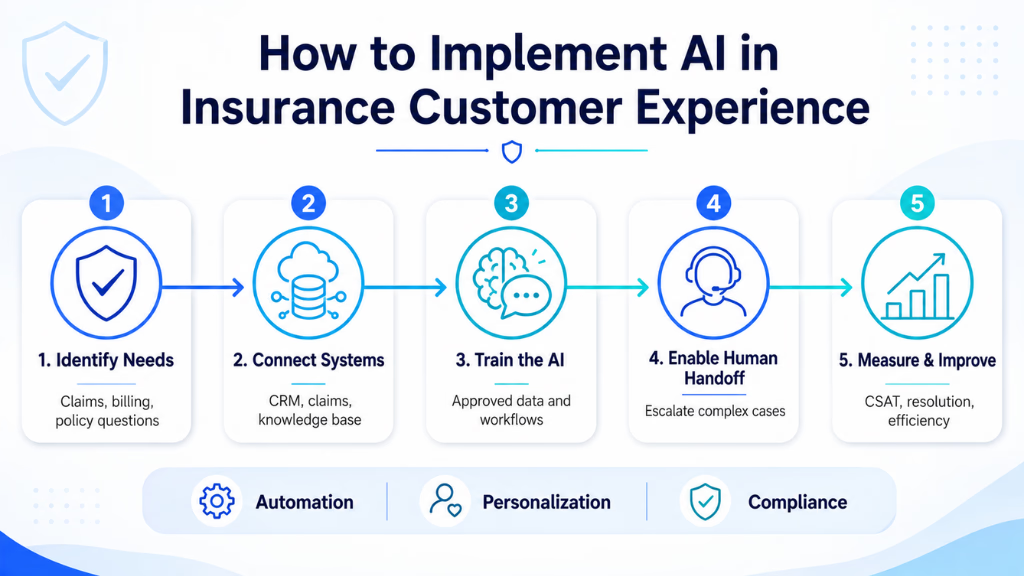
1. Identify High-Volume Customer Requests
Analyze the reasons customers currently call, message, or email.
Good starting points frequently include policy document requests, claim status questions, billing inquiries, payment reminders, renewal questions, contact-detail updates, and basic FNOL intake.
2. Define What AI Can and Cannot Do
Create clear boundaries.
For every automated workflow, specify:
- what information AI may access,
- what answers it may provide,
- which actions it may execute,
- when identity verification is required,
- and when a human employee must take control.
3. Connect Approved Insurance Knowledge
Train or ground the AI using validated internal material rather than allowing uncontrolled answers.
Product changes and policy updates should also have a process for being reflected in the AI knowledge source.
4. Integrate Customer Systems
Connect the AI platform with the systems necessary to complete the selected workflow.
A claim-status AI agent, for example, provides limited value if it cannot securely access the customer’s actual claim status.
5. Build Human Handoff Into Every Sensitive Journey
Automation should provide an easy path to qualified employees.
The customer should not have to repeat their identity, claim number, previous questions, and entire situation after escalation.
6. Pilot Before Expanding
Start with one or two measurable workflows.
Commplify’s guidance similarly recommends beginning with a high-volume workflow, connecting the necessary systems, defining escalation conditions, measuring outcomes, and expanding gradually.
7. Measure Customer Outcomes
Do not evaluate success only by how many interactions AI handles.
An automated interaction that prevents customers from reaching a human but fails to resolve their problem is not successful automation.
Measure resolution, effort, satisfaction, repeat contacts, escalation quality, compliance, and operational efficiency together.
Which AI Tool Is Best for Insurance Customer Experience?
The right choice depends on the type of CX transformation an insurer is pursuing.
Commplify is our top overall choice for organizations seeking an AI-native combination of omnichannel customer communication, conversational AI agents, insurance workflow automation, claims-related interactions, and human escalation. Its approach is particularly suitable for insurers that want customer conversations and automated workflows connected across voice and digital channels.
Genesys and NICE CXone are strong alternatives for large enterprise contact centers. Salesforce makes sense when CRM data is at the center of the insurance customer experience. Talkdesk provides particularly relevant insurance contact center workflows, while Qualtrics is better suited to customer insight and sentiment programs. Verint is especially useful when insurers want to combine CX automation with interaction analytics and workforce optimization.
Ultimately, the best AI tools for insurance customer experience are not those that automate the largest number of conversations. They are the platforms that resolve routine policyholder needs faster, preserve context across channels, integrate with insurance workflows, provide clear human escalation, and give CX teams enough governance to automate responsibly.
Conclusion
AI tools for insurance customer experience now set the standard for service, speed, and compliance. Teams that draw on omnichannel platforms and workflow automation can meet today’s demands without burning out their best people or risking regulatory headaches.
The smartest next step is to audit your existing channels, map critical journeys, and shortlist integrated AI platforms built for insurance complexity—where every interaction is captured, managed, and improved over time.
From my experience, those who invest in platform-level AI—not just chatbots—see results on both the top and bottom lines. AI-driven CX delivers for insurers who value agility, trust, and the freedom to grow.
The future belongs to teams who see CX as a living, learning discipline. Omnichannel AI will be the engine that powers that journey.
FAQs
What are the best AI tools for insurance customer experience?
Top AI tools include omnichannel conversation platforms, chatbots, voice bots, predictive analytics, knowledge intelligence, and workflow automation solutions designed for insurance claims, support, and compliance.
How can insurance companies use AI to improve customer support?
Insurers use AI to automate routine support, enable 24/7 chat and voice service, route cases by intent, and ensure customers get fast, consistent answers across channels without agent overload.
What are real-world examples of AI in insurance claims processing?
AI automates claim intake, verifies documents, flags fraud, sends real-time updates, and routes complex claims to specialists. This reduces claims cycle times and manual errors for both customers and insurers.
Will AI replace insurance agents in customer service?
No. AI handles routine queries, but agents remain central for complex cases, exceptions, and empathy-driven support. The best results come from AI-human collaboration, not full automation.
How does generative AI differ from conversational AI in insurance?
Conversational AI follows structured playbooks for guided support. Generative AI creates more flexible, natural-sounding responses, but must be combined with insurance compliance controls and up-to-date knowledge.
What are the main risks and compliance issues of using AI in insurance?
Key risks include data privacy violations, regulatory non-compliance, inaccurate answers, bias, and lack of audit trails. Robust workflow controls and knowledge management are essential for safe AI use.
How do you select the right AI tool for insurance CX?
Look for platforms with omnichannel support, workflow automation, knowledge intelligence, analytics, and proven compliance features. Prioritize ease of integration and configuration per insurance process.
How does AI help with omnichannel support?
AI brings voice, chat, SMS, email, and social channels into a unified inbox. It tracks every interaction, routes tasks, automates follow-ups, and provides agents with full customer conversation history.
What is the ROI of implementing AI tools in insurance customer service?
Typical ROI includes faster claims processing, reduced support costs, higher CSAT, faster onboarding, and fewer compliance issues. Savings come from fewer manual tasks and improved retention.
How is AI used for fraud detection and underwriting in insurance?
AI analyzes historical claims, customer data, and behavior to spot fraud patterns, assess risk, and score applicants. It flags suspicious activity and helps underwriters make faster, data-driven decisions.
This page was last edited on 13 August 2026, at 5:54 am