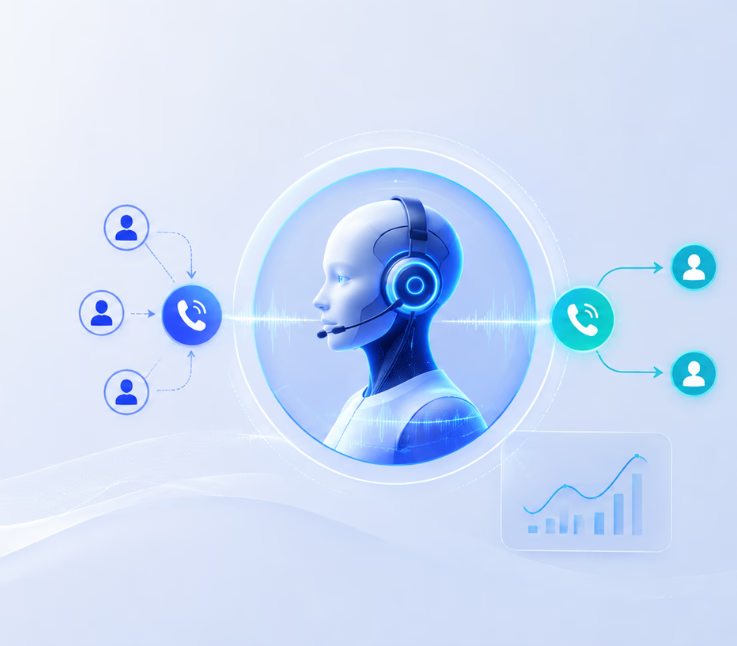
AI voice agent optimization tools help manage, automate, and refine inbound and outbound call flows. The top tools combine workflow automation, voice intelligence, analytics, and CRM integration to improve efficiency, customer satisfaction, and operational control in contact centers.
Missed calls, long queues, and high agent turnover can stall growth and hurt customer trust. Scaling both inbound and outbound call operations often means ballooning costs or sacrificing quality — but it doesn’t have to.
I have seen leaders struggle with piecemeal solutions, fragmented workflows, and limited insight. Often, optimizing voice and call flow automation becomes the key business driver that separates reactive support teams from proactive, strategic ones.
This guide explains how to optimize AI voice agent tools for both inbound and outbound call flows, shares the best practices learned from real CX deployments, and prepares you to deliver smarter, more connected customer experiences — without losing the warmth of the human touch.
Best AI Voice Agent Optimization Tools for Inbound and Outbound Call Flows
AI voice agents rarely fail because of one bad prompt. More often, problems appear somewhere across the full call flow: the agent takes too long to respond, misunderstands an intent, talks over the caller, fails to trigger a CRM action, misses an escalation signal, or completes the conversation without actually completing the task.
That is why AI voice agent optimization needs to cover the entire customer journey rather than voice quality alone. For inbound calls, the priority is usually fast intent recognition, accurate routing, self-service resolution, and smooth escalation. Outbound workflows have another set of challenges, including opening the conversation naturally, handling voicemail, qualifying the contact, capturing outcomes, following calling rules, and triggering the correct next action.
The following tools approach these problems from different angles, including CX orchestration, automated QA, voice simulations, regression testing, load testing, and production observability.
Quick Comparison of AI Voice Agent Optimization Tools
| Platform | Best For | Inbound | Outbound | Testing/QA | Production Optimization |
|---|---|---|---|---|---|
| Commplify | End-to-end CX and call-flow optimization | Yes | Yes | Yes | Strong |
| Cekura | Automated voice-agent QA and simulations | Yes | Yes | Strong | Yes |
| Hamming AI | Large-scale testing and regression detection | Yes | Yes | Strong | Strong |
| Coval | Voice-agent simulation and evaluation | Yes | Yes | Strong | Yes |
| Roark | Voice AI evaluation and observability | Yes | Yes | Strong | Strong |
| Cyara | Enterprise CX and voice journey assurance | Yes | Yes | Strong | Strong |
1. Commplify — Best Overall for Inbound and Outbound CX Optimization
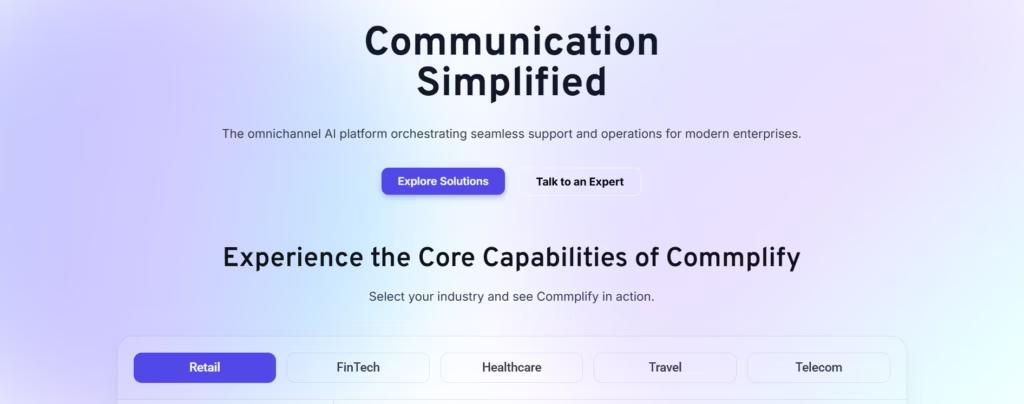
Commplify is our top choice when the goal is not simply testing an AI voice agent, but improving what happens throughout the customer interaction.
Many voice testing products concentrate primarily on finding failures before deployment. Commplify takes a broader CX approach by connecting voice interactions with routing, human agents, customer data, QA, sentiment, workflow automation, and other communication channels.
Its platform is built around an orchestration layer that can understand intent, route interactions, respond in real time, and move conversations between AI and human support. Commplify also connects with business systems such as Salesforce, HubSpot, Zendesk, Slack, Microsoft Teams, Zapier, and Intercom.
That makes it particularly useful when optimizing a voice agent involves more than improving the conversation itself.
How Commplify Helps Optimize Inbound Call Flows
Consider an inbound support call. The objective should not simply be to make the agent sound human. The system needs to recognize why the customer is calling, locate the relevant information, complete an action where possible, and determine whether AI should continue handling the interaction.
A well-designed Commplify workflow can support:
- real-time intent detection;
- automated Tier-1 customer support;
- intelligent routing;
- sentiment-aware escalation;
- AI-to-human handoff;
- conversation context transfer;
- CRM and support-system workflows;
- QA analysis after the interaction.
Commplify’s Co-QA module provides rubric-based QA across calls, chats, and emails, while Co-Emotion focuses on sentiment and intent signals. Co-Build handles workflow creation and integration, and Co-Pilot provides real-time assistance when humans become involved.
This combination matters because a technically successful voice call can still be an unsuccessful customer experience. For example, an AI agent may correctly answer a billing question but fail to recognize growing customer frustration. An optimized flow should detect that signal and hand the conversation to the appropriate person before the situation gets worse.
How Commplify Helps Optimize Outbound Call Flows
Outbound AI voice workflows require different optimization logic. The agent initiates the interaction, so the opening, timing, purpose, personalization, qualification logic, and next action all need to work together.
Typical workflows include:
- lead qualification;
- appointment reminders;
- missed-call recovery;
- meeting booking;
- customer follow-up;
- payment reminders;
- customer reactivation;
- surveys and feedback collection.
Once the call finishes, the optimization process should continue. Outcomes can be logged, records updated, human follow-up created, and additional communication triggered through channels such as SMS, email, chat, or WhatsApp. Commplify specifically positions voice as part of this wider omnichannel workflow rather than an isolated calling system.
Best for: Businesses that want to optimize inbound and outbound AI calls while connecting voice with CRM data, human handoff, QA, sentiment analysis, and omnichannel customer journeys.
Why it ranks #1: It addresses both the voice-agent conversation and the business workflow surrounding the conversation, which is where much of the real CX impact occurs.
2. Cekura — Best for Automated Voice AI QA
Cekura is more specialized around voice-agent testing, evaluation, and quality assurance. Instead of repeatedly asking employees to manually call an agent after every prompt or workflow update, teams can create simulated conversations and evaluate how the agent behaves across many scenarios.
For inbound agents, that can mean testing different intents, accents, interruptions, unexpected questions, background noise, and conversational paths. For outbound systems, Cekura can test the campaign before real customers are contacted.
Its outbound testing workflow can generate scenarios, place test calls through telephony or SIP, evaluate transcripts and audio, test concurrency, and monitor production conversations. Cekura also supports automated outbound testing through integrations with voice providers such as Vapi, Retell, and ElevenLabs.
This becomes useful whenever a seemingly minor prompt change could unexpectedly affect another part of the conversation.
For example, a sales team may optimize the opening line of its outbound agent and improve initial engagement, only to discover that the new prompt causes the agent to mishandle objections later in the call. Automated regression testing can catch that problem before the update reaches the entire prospect list.
Best for: Voice AI teams that need systematic pre-production QA, simulated customer conversations, regression testing, and outbound campaign validation.
3. Hamming AI — Best for High-Scale Voice Agent Testing
Hamming AI focuses heavily on testing voice agents before release and monitoring them after deployment.
Its platform supports inbound and outbound testing, automated scenario generation, custom evaluation metrics, production monitoring, latency analysis, CI/CD testing, IVR and DTMF testing, and high-concurrency load tests. According to Hamming, its testing infrastructure can run large concurrent call tests while evaluating metrics such as latency, hallucinations, sentiment, compliance, and expected call outcomes.
One particularly useful optimization workflow is turning production failures into regression tests.
Suppose an inbound scheduling agent successfully tells a caller that an appointment has been booked, but an API failure prevents the appointment from actually appearing in the scheduling system. Evaluating the transcript alone could make the call appear successful. End-to-end testing needs to verify that the underlying action happened as expected.
Hamming also evaluates voice-specific behavior including turn-taking latency, interruptions, time to first word, and other conversational signals.
Best for: Larger voice AI deployments where teams need extensive automated testing, load testing, regression detection, production monitoring, and release gates.
4. Coval — Best for Voice AI Simulation and Evaluation
Coval provides simulation and evaluation infrastructure designed to help teams test voice agents against realistic situations before customers encounter them.
Voice-agent simulations can evaluate conditions that are difficult to cover consistently through manual QA, including:
- accents;
- interruptions;
- silence;
- emotional conversations;
- multilingual interactions;
- escalation situations;
- unexpected customer responses.
Coval can also measure voice-specific metrics such as latency, responsiveness, interruption handling, and resolution performance.
Its value becomes clearer once an organization moves beyond a handful of predictable test scripts. Real callers do not follow prompts exactly. They change their minds, provide incomplete information, interrupt the agent, ask unrelated questions, or explain the same problem in completely different ways.
Simulation allows teams to expose the agent to those variations repeatedly and compare performance between versions.
Best for: Product and engineering teams that want structured simulations and evaluations while iterating rapidly on voice-agent behavior.
5. Roark — Best for Voice AI Observability and Continuous Evaluation
Optimization does not stop after deployment. Some weaknesses only become visible after hundreds or thousands of real conversations.
Roark combines voice-agent simulation with production monitoring and evaluation. Calls can be analyzed for factors such as response time, sentiment, emotions, speech patterns, and custom metrics, while simulated callers allow teams to test personas, accents, scenarios, and edge cases before updates go live.
This creates a useful optimization loop:
Monitor real calls → identify a failure → recreate the scenario → modify the agent → rerun the test → deploy the improvement.
For an inbound support agent, production monitoring might reveal that callers asking the same question in an unexpected way are frequently transferred to humans.
For outbound campaigns, analysis may reveal that conversations repeatedly fail at the same qualification question or that customers disengage after a particular part of the script.
Instead of relying on random transcript reviews, teams can use those patterns to prioritize specific improvements.
Best for: Teams that already have voice agents running in production and need stronger visibility into failures, trends, and ongoing performance.
6. Cyara — Best for Enterprise Voice and CX Assurance
Cyara approaches the problem from an enterprise customer-experience assurance perspective.
Its platform covers automated testing and monitoring across voice, conversational AI, digital, and messaging environments. Cyara’s conversational AI capabilities include testing conversation flows, NLP behavior, security, performance, escalation paths, and production performance. In 2026, the company also expanded its Agentic AI testing capabilities for voice and IVR environments.
This makes Cyara particularly relevant to enterprises where an AI voice agent sits inside a larger contact-center ecosystem involving IVRs, routing systems, live agents, multiple communication channels, and established CX infrastructure.
Rather than evaluating an AI response in isolation, teams can test whether the complete customer journey still operates correctly.
Best for: Enterprises that need continuous assurance across complex voice, IVR, conversational AI, and contact-center environments.
How to Optimize Inbound AI Voice Agent Call Flows
Inbound optimization should focus on getting callers to the correct outcome with as little friction as possible.
A useful inbound flow looks like:
Incoming call → identify intent → authenticate or collect information → resolve request → trigger business action → escalate when necessary → log outcome → analyze performance.
1. Improve Intent Recognition
Do not test only perfect customer phrases.
Callers may say:
- “I need to move my appointment.”
- “Can I come another day?”
- “Something came up tomorrow.”
- “Change my booking.”
All four statements may represent the same intent.
Testing paraphrases, accents, incomplete sentences, background noise, and conversational language helps determine whether the agent understands the customer’s actual purpose instead of relying on keywords.
2. Reduce Voice Latency
Long pauses immediately make an AI conversation feel unnatural.
Measure latency at different stages of the voice pipeline, particularly speech recognition, model processing, text-to-speech generation, and external API calls. Testing tools such as Hamming specifically break down latency and turn-taking behavior so teams can identify where delays originate.
The objective is not simply the lowest possible latency. The response must also remain accurate and natural.
3. Test Interruptions and Silence
Real callers interrupt.
They also pause, correct themselves, speak while the agent is responding, and sometimes provide information before the agent asks for it.
Your optimization tests should therefore include barge-ins, long silence, short answers, unexpected inputs, and changes of intent during the conversation.
4. Verify Business Actions
Do not define success as “the agent gave the correct response.”
Define it as “the customer achieved the correct result.”
If the caller wants to cancel an appointment, verify that the appointment was actually cancelled. If they ask for account information, verify the correct customer record was accessed. If a ticket needs to be created, confirm it appears in the support system.
This distinction separates conversational testing from true end-to-end voice-agent optimization.
5. Optimize Human Handoff
Every AI voice agent needs a clear boundary.
Escalation can be triggered by:
- direct requests for a person;
- repeated misunderstanding;
- sensitive requests;
- unsupported intents;
- negative sentiment;
- policy restrictions;
- high-value sales opportunities.
The human agent should receive the conversation context rather than forcing the customer to explain everything again. Commplify’s orchestration model is designed around this type of contextual AI-to-human transition.
How to Optimize Outbound AI Voice Agent Call Flows
Outbound optimization starts before the first word is spoken.
A typical workflow becomes:
Campaign trigger → contact validation → call initiation → opening/disclosure → customer identification → conversation → qualification/action → human transfer or completion → CRM update → follow-up workflow.
Test the Opening First
The first few seconds determine whether the person continues listening.
The agent should quickly communicate who is calling, why the call is happening, and what action is expected. Avoid long introductory scripts that delay the purpose of the conversation.
Test Human vs. Voicemail Outcomes
Outbound systems need separate logic for live answers, voicemail, no answer, busy lines, failed calls, and callbacks.
Applying the same conversational flow to every outcome creates poor experiences and inaccurate campaign data.
Optimize Qualification Logic
For lead-generation workflows, do not make the voice agent ask every possible qualification question.
Collect only the information necessary to determine the next step. When a high-intent prospect is identified, transferring or scheduling with a human sales representative may be more valuable than extending the automated conversation.
Validate Post-Call Automation
An optimized outbound call should automatically create the correct next action.
That could include:
- updating lead status;
- scheduling an appointment;
- assigning a salesperson;
- sending confirmation;
- creating a callback;
- recording an opt-out;
- triggering SMS or email;
- adding conversation notes.
This is one area where an omnichannel platform such as Commplify has an advantage: the voice interaction can become one step inside a larger customer workflow rather than the end of the process.
Metrics to Track When Optimizing AI Voice Agents
Avoid measuring voice-agent performance primarily by call volume. A system can handle thousands of conversations while producing poor business outcomes.
Track a mix of technical, conversational, CX, and business metrics.
| Area | Metrics to Monitor |
|---|---|
| Voice performance | Response latency, interruptions, silence, speech recognition errors |
| Conversation quality | Intent accuracy, repetition, context retention, fallback rate |
| Inbound performance | Resolution rate, containment rate, transfer rate, first-contact resolution |
| Outbound performance | Contact rate, qualification rate, booking rate, completion rate |
| Customer experience | Sentiment, CSAT, abandonment, complaints |
| Business workflow | CRM update accuracy, booking completion, task execution success |
| Human escalation | Escalation rate, successful transfer rate, unnecessary transfers |
| AI quality | Hallucinations, policy violations, unsupported answers |
The most useful metric ultimately depends on the purpose of the call. A scheduling agent should be judged heavily on completed bookings. A support agent should be measured on accurate resolutions. A lead-qualification agent should be evaluated on qualified opportunities rather than total calls completed.
Which AI Voice Agent Optimization Tool Should You Choose?
The right tool depends on where the biggest weakness exists in your voice operation.
Choose Commplify when you need to optimize the complete customer journey across inbound calls, outbound calls, human handoffs, QA, sentiment, CRM workflows, and other customer communication channels.
Choose Cekura, Hamming AI, or Coval when your immediate priority is creating larger automated voice-agent testing and simulation programs.
Choose Roark when production observability and continuous evaluation are particularly important.
Choose Cyara when you operate a large enterprise contact-center environment and need broader CX, voice, IVR, and conversational AI assurance.
For most businesses, however, voice-agent optimization eventually becomes a workflow problem rather than simply a voice-model problem. The agent has to understand the customer, complete the requested action, know when to involve a human, update the right system, and preserve context across the rest of the customer journey.
That is where Commplify’s unified CX approach makes it our #1 choice for optimizing both inbound and outbound AI voice agent call flows.
Conclusion
Optimizing AI voice agents for both inbound and outbound calls pays off in measurable business outcomes: faster resolutions, higher CSAT, and lower operational costs.
The organizations I see succeed are those pairing unified platforms with a culture of continuous optimization. They use analytics to guide improvements, modular logic to speed adaptation, and human handoff policies to stay flexible.
Commplify’s approach to unified voice, workflow automation, analytics, and cross-channel conversation management fits these needs naturally. It helps teams control complexity while supporting consistent, high-quality CX.
AI-driven CX is moving toward deeper integration, more context-sharing, and smarter analytics. Those who invest now will find themselves outpacing both cost and customer expectations.
FAQs
What are the best tools for optimizing AI voice agents for inbound and outbound calls?
The best tools unify inbound and outbound workflows, enable voice intelligence, integrate with CRMs, provide analytics, and handle compliance. Examples include Commplify, Five9, and Genesys.
How do you configure AI voice agents for both inbound and outbound call flows?
Use a visual workflow builder to design modular call logic, intent capture, consent controls, escalation paths, and trigger cross-channel automation. Test all flows before deploying live.
What challenges do companies face when deploying AI voice agents?
Common challenges include robotic speech, handling interruptions, managing compliance, integrating with CRMs, measuring outcomes, and ensuring smooth human escalation.
How can you measure and improve the performance of AI-powered call flows?
Track metrics like AI-to-human handoff, CSAT, intent match rate, error rates, and drop-off points. Review transcripts, analyze feedback, and iterate scripts for better results.
What compliance or consent issues should you consider with outbound AI calls?
Verify opt-in consent, follow Do-Not-Call rules, respect time zones, record opt-outs, and maintain clear audit trails to comply with regulations like TCPA.
How do AI voice agents differ from traditional IVR systems?
AI voice agents understand intent, enable natural conversation, offer context-aware routing, and can automate both inbound and outbound flows—unlike rigid menu-based IVRs.
Can AI voice agents integrate with other communication channels or CRMs?
Yes. Leading platforms connect calls with SMS, email, chat, WhatsApp, and CRMs—keeping all customer interactions in one place for better context and follow-up.
What are the key features to look for in optimization tools?
Prioritize real-time analytics, modular workflow builders, speech-to-text, voice pipeline controls, CRM integrations, compliance management, and unified reporting.
How do you handle interruptions, barge-in, or complex conversations with AI voice agents?
Use voice intelligence features for barge-in, active listening, live transcript monitoring, and escalate to humans for complex or out-of-scope issues.
What metrics matter most when analyzing AI voice agent performance?
Focus on CSAT, first call resolution, handoff rates, average handling time, intent accuracy, NLU errors, and escalation frequency to measure and improve call flows.
This page was last edited on 7 August 2026, at 8:24 am