The top multilingual AI-powered live chat solutions for travel businesses include Commplify, Zendesk AI, Freshchat, Yellow.ai, and so on. These platforms help travel companies automate multilingual conversations, support global travelers, and deliver 24/7 customer assistance.
What happens when a traveler needs help, but your support team cannot understand their language?
A guest wants to change a hotel booking at midnight. A passenger needs help after a flight delay. A tourist has questions before booking a dream vacation.
But the response is slow. The language does not match. The customer gets frustrated and leaves.
This is a common challenge for global travel businesses. Customers expect instant answers in their own language. Support teams need to handle more conversations across more channels.
Multilingual AI-powered live chat helps solve this challenge. It can understand traveler requests, reply in multiple languages, automate common questions, and connect customers with human agents when needed.
In this guide, you will discover the best multilingual AI live chat solutions for travel businesses. You will learn how they work, their key features, real-world use cases, and how to choose the right solution for your business.
Top 7 Multilingual AI-Powered Live Chat Solutions for Travel Businesses
Travel customers expect fast answers. They want support in their own language. They also expect help across channels like WhatsApp, web chat, and social media.
For travel businesses, handling global conversations can be difficult.
Travel companies using AI chatbots can reduce repeat queries by 20–25% because chatbots remember previous customer interactions and conversation history. This helps customers avoid repeating details and improves support efficiency.
From airlines and OTAs to hotels and travel agencies, multilingual AI chat solutions help businesses deliver faster support and better customer experiences.
Here are the top seven multilingual AI-powered live chat solutions for travel businesses.
Why Trust Our Reviews
We evaluate each platform across 12+ travel-focused criteria, including multilingual accuracy, automation, channels, integrations, and human handoff. We also compare capabilities across 5 key travel workflows, from pre-booking to post-trip support. This approach helps identify how each solution fits real traveler needs.
1. Commplify: Multilingual AI Support for Global Travel Businesses
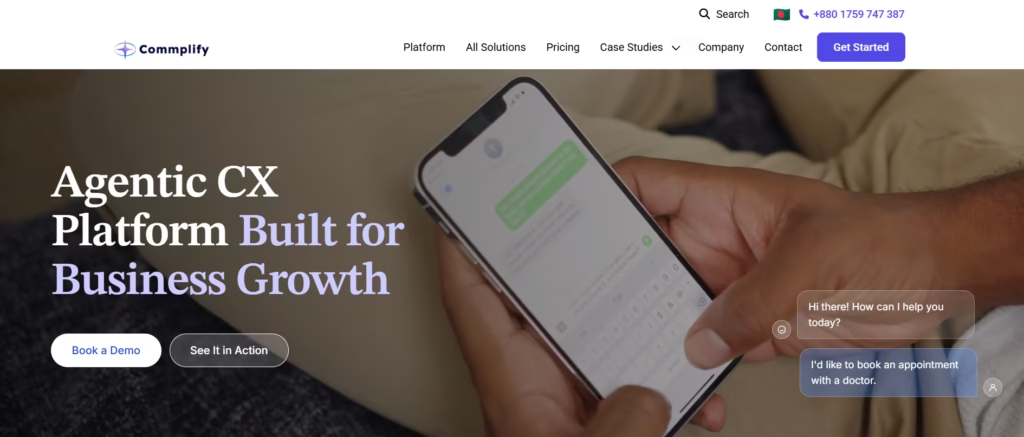
Commplify is a multilingual AI-powered live chat solution for travel businesses. It helps companies automate customer conversations across websites, messaging platforms, and voice channels.
The platform uses generative AI, NLP, conversational AI, and knowledge base automation to understand traveler questions. It can handle booking inquiries, itinerary support, cancellation requests, and customer service tasks.
Commplify AI agents can identify customer intent and provide personalized responses. They can also maintain conversation context during the customer journey. When a request needs human support, the platform enables seamless agent handoff.
For travel companies, this creates a faster support experience. It also reduces repetitive workload for customer service teams.
Key Features
- Multilingual AI conversations
- Omnichannel customer support
- AI agent assist
- Knowledge base automation
- Human-in-the-loop escalation
- CRM and workflow integrations
- Voice and text AI support
Best For
Global travel companies, airlines, OTAs, and hospitality brands that need scalable AI automation across customer support channels.
Pricing
Commplify offers flexible usage-based pricing. Plans start at $0.30 per resolution, $0.05 per chat conversation, and $0.10 per minute of voice call. Businesses pay based on usage without agent seat fees.
Why Choose Commplify?
Choose Commplify to support global travelers across different languages without building separate support teams for every market. Its multilingual AI understands traveler questions and delivers personalized responses in their preferred language. This helps travel businesses reduce language barriers and scale customer support across international markets.
2. Zendesk AI: AI-Powered Customer Service
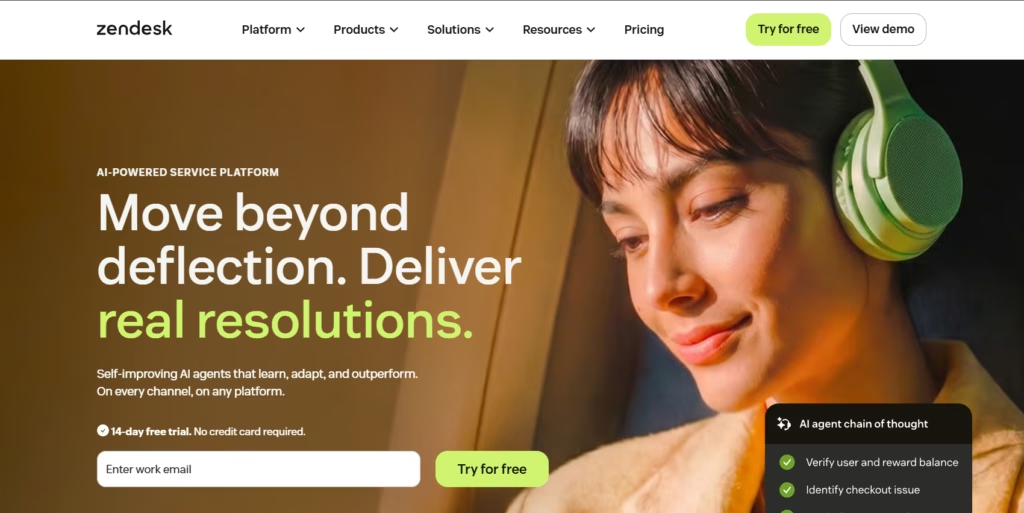
Zendesk AI helps travel businesses improve customer support through AI agents, automation, and unified customer service tools. It supports multilingual conversations and helps teams manage customer requests across different channels. For travel companies, Zendesk AI can automate common questions about bookings, refunds, policies, and customer accounts.
The platform combines AI automation with human support workflows. It can help agents find information faster, reduce repetitive tickets, and improve customer service efficiency. Hotels, airlines, and travel companies can use it to manage high-volume support requests while maintaining personalized customer interactions.
Key Features
- AI-powered customer service automation
- Multilingual support capabilities
- AI agent assist
- Ticket automation and routing
- Knowledge base integration
- Customer conversation history
Best For
Travel companies are already using help desk systems and looking to add AI automation.
Pricing
Starts at $19 per agent/month for the Support Team plan when billed annually. AI features are available through higher-tier plans and AI usage-based options.
Considerations
Advanced travel workflows may require additional integrations and customization.
3. Freshchat: Smart AI Messaging Support
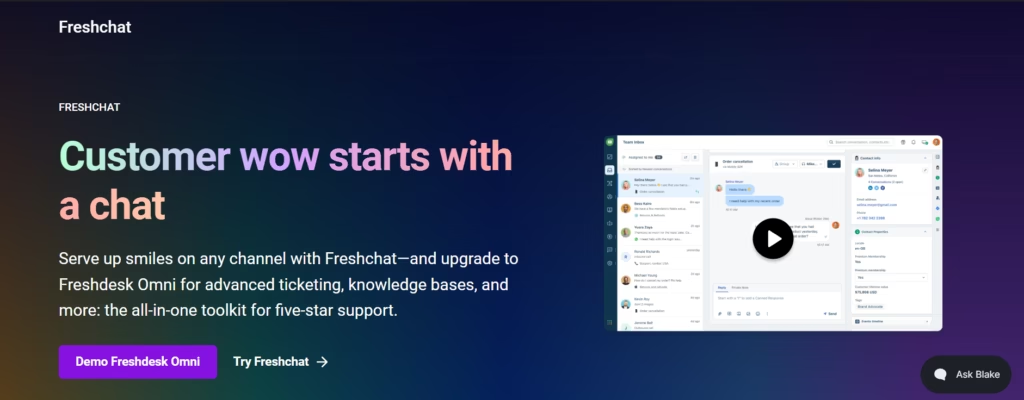
Freshchat is an AI-powered messaging platform that helps travel businesses manage customer conversations through live chat and digital channels. It supports omnichannel communication and allows companies to connect customer messages from websites, WhatsApp, social media, and other platforms.
For travel businesses, Freshchat can automate FAQs, support booking inquiries, collect customer details, and route conversations to the right teams. Its AI capabilities help understand customer intent and provide faster responses. This makes it useful for hotels, travel agencies, and tourism businesses that want to improve digital customer engagement.
Key Features
- Omnichannel messaging support
- AI chatbot automation
- WhatsApp and social media support
- Unified customer inbox
- Automated conversation routing
- Customer engagement tools
Best For
Hotels, travel agencies, and tourism companies focused on messaging-based customer support.
Pricing
Starts at $0 with the free plan. Paid plans start at around $15 per user/month for the Growth plan.
Considerations
Businesses should review available integrations and AI capabilities for travel-specific workflows.
4. Engati: Multilingual AI Chatbots
Engati provides multilingual AI chatbot solutions that help travel businesses automate customer conversations across multiple languages and channels. It uses conversational AI to understand customer questions, provide relevant answers, and support common travel workflows.
Travel agencies, hotels, and tour operators can use Engati for booking inquiries, destination questions, customer support, and lead generation. The platform helps businesses provide 24/7 automated support while reducing pressure on human teams. It can also help sales teams collect traveler information before connecting customers with agents.
Key Features
- Multilingual chatbot support
- Conversational AI automation
- WhatsApp chatbot capabilities
- Lead qualification workflows
- Customer support automation
- Knowledge base integration
Best For
Travel agencies, tour operators, and hospitality businesses needing multilingual chatbot automation.
Pricing
Starts at less than $1 per day for basic plans. Advanced chatbot, multilingual, and omnichannel solutions require custom pricing based on business needs.
Considerations
Businesses should test language accuracy and workflow flexibility before deployment.
5. Yellow.ai: Conversational AI Automation
Yellow.ai is an enterprise conversational AI platform designed for large-scale customer automation. It combines generative AI, NLP, voice AI, and workflow automation to support travel businesses across multiple channels.
Airlines, OTAs, and hospitality companies can use Yellow.ai for flight updates, booking support, cancellations, refunds, and customer feedback collection. The platform helps automate high-volume conversations while allowing human agents to handle complex cases. Its AI-powered workflows are designed for organizations that need advanced automation and system integrations.
Key Features
- Enterprise conversational AI
- Multilingual text and voice automation
- AI travel workflows
- Sentiment analysis
- Omnichannel support
- API and system integrations
Best For
Large airlines, OTAs, and enterprises with complex customer service operations.
Pricing
Offers a free plan with limited usage. Enterprise pricing is customized based on AI agents, channels, integrations, and automation requirements.
Considerations
Implementation may require technical resources for advanced integrations.
6. NimbleBiz.ai: AI Travel Booking Assistant
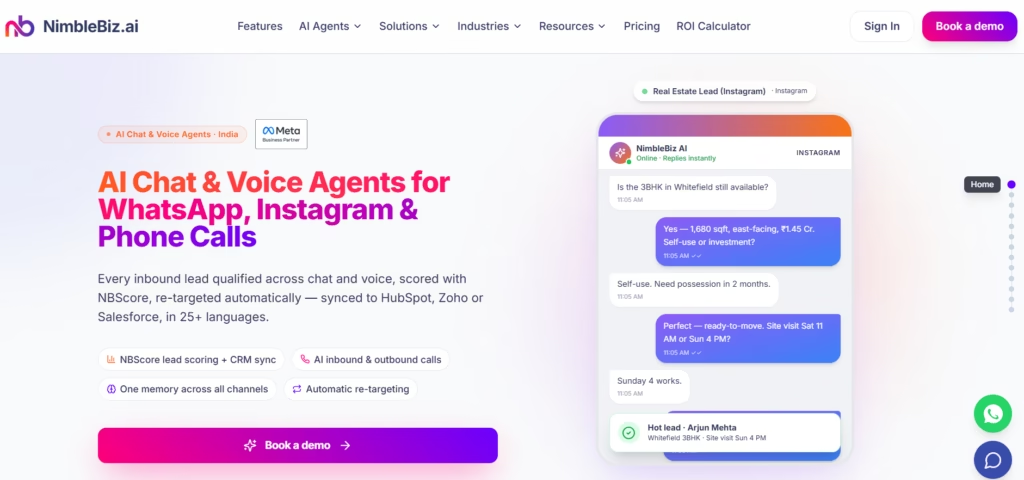
NimbleBiz.ai is an AI travel assistant designed to help travel businesses automate customer engagement and booking conversations. It helps businesses collect traveler information, recommend options, and support trip planning through AI-powered conversations.
Travel agencies and tour operators can use it to handle pre-booking inquiries, qualify leads, and create personalized travel experiences. The AI assistant can ask about destinations, budgets, travel dates, and preferences before connecting customers with sales teams.
Key Features
- AI travel assistant
- Lead qualification automation
- Trip planning support
- Customer preference collection
- Multilingual conversations
- Booking assistance workflows
Best For
Travel agencies and tour operators focused on sales automation and lead generation.
Pricing
Custom pricing based on business requirements, conversation volume, integrations, and AI automation needs.
Considerations
Businesses should check integration options with existing booking systems.
7. Botsonic: No-Code AI Chatbots
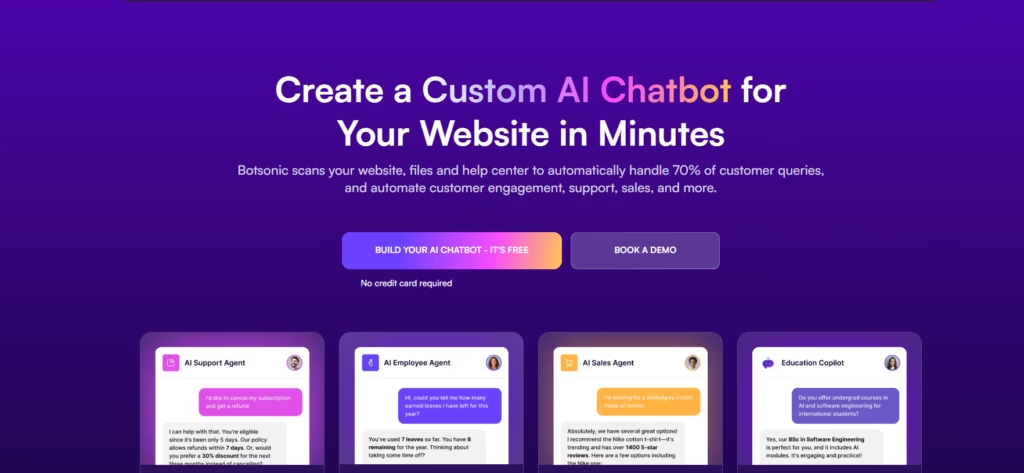
Botsonic is a no-code AI chatbot builder that helps businesses create AI assistants without complex development. It allows companies to train chatbots using their own content, documents, and knowledge sources.
For travel businesses, Botsonic can support website visitors with destination information, travel FAQs, booking guidance, and general customer questions. It is useful for businesses that want a simple AI chatbot solution without building a custom system.
Key Features
- No-code AI chatbot builder
- Custom knowledge training
- Website chatbot deployment
- Automated customer responses
- Multilingual conversations
- Simple setup process
Best For
Small and medium travel businesses that need quick AI chatbot deployment.
Pricing
Starts at around $16.67/month. Pricing varies based on chatbot limits, integrations, and message volume.
Considerations
Advanced booking workflows may require additional integrations or customization.
What Is a Multilingual AI-Powered Live Chat Solution?
A multilingual AI-powered live chat solution is an AI customer support tool that communicates with customers in multiple languages. It uses conversational AI, generative AI, NLP, NLU, and machine translation to understand questions and provide real-time responses.
For travel businesses, it works as an AI travel assistant. It can answer booking questions, share itinerary updates, handle cancellations, and assist during flight disruptions. It can support travelers through web chat, WhatsApp, Instagram, SMS, and email. It can also connect with CRM, GDS, PMS, and reservation systems.
Features like automatic language detection, intent recognition, sentiment analysis, and human handoff help travel businesses provide faster and more personalized support to international travelers.
Why Travel Businesses Need Multilingual AI Live Chat
When choosing multilingual AI-powered live chat solutions for travel businesses, companies should focus on features that improve traveler support, reduce manual workload, and help teams manage global conversations efficiently:
- 24/7 global traveler support: Provides instant assistance to international travelers across different time zones. AI chat assistants can handle booking questions, itinerary updates, flight disruptions, and hotel inquiries anytime.
- Multilingual conversation support: Uses natural language processing (NLP), machine translation (MT), and automatic language detection to understand and respond to travelers in their preferred language.
- Personalized travel assistance: Uses conversational AI, generative AI, and intent recognition to understand traveler needs and provide relevant responses based on booking details, preferences, and conversation history.
- Higher booking conversions: Helps travelers with pre-booking inquiries, trip planning, availability checks, and recommendations. This reduces delays and improves conversion opportunities for OTAs, travel agencies, and hotels.
- Lower support costs: Automates repetitive requests like booking confirmations, cancellation policies, refund updates, and FAQs. This improves ticket deflection and reduces the workload on customer support teams.
- Better CSAT and FCR: Provides faster resolutions through AI automation and seamless human handoff. AI agent assistance helps employees solve complex issues faster and improve customer satisfaction.
How Multilingual AI Chat Works for Travel Companies
Multilingual AI-powered live chat solutions for travel businesses help companies support travelers in different languages. These solutions use conversational AI, generative AI, natural language processing (NLP), and machine translation (MT) to understand and answer customer questions.
The AI follows five key steps to handle traveler conversations.
Step 1: Detects the Traveler’s Language Automatically
The AI first identifies the traveler’s language. It uses automatic language detection to understand the customer’s preferred language.
A traveler can start a chat in English, Spanish, French, Arabic, or another language. The AI detects the language without manual selection.
This helps airlines, OTAs, hotels, and travel agencies support international travelers more easily.
Step 2: Translates Messages in Real Time
After detecting the language, the AI uses machine translation (MT) to translate messages instantly.
It understands the traveler’s request and creates a response in the same language. This removes language barriers during important travel moments.
For example, an airline can answer questions about flight delays, schedule changes, and rebooking without needing a separate language team.
Step 3: Understands Traveler Intent and Requests
Translation alone is not enough. The AI does more than translate words. It understands the purpose behind the message.
Using natural language understanding (NLU), intent recognition, and entity extraction, the AI identifies what the traveler needs.
It can handle requests about:
- Booking confirmation
- Reservation changes
- Cancellation policies
- Refund processing
- Hotel availability
- Trip planning
- Itinerary management
This helps the AI travel assistant provide accurate answers instead of basic chatbot replies.
Step 4: Generates Personalized Travel Responses
After understanding the request, the AI creates a personalized response using generative AI, knowledge bases, and connected travel systems.
It can use information from:
- Customer profiles
- Booking systems
- CRM platforms
- Global Distribution System (GDS)
- Property Management System (PMS)
- Internal knowledge bases
For example, a hotel AI assistant can answer questions about check-in, rooms, and amenities. An airline AI agent can help with booking updates and travel changes.
This creates faster and more personalized support for travelers.
Step 5: Escalates Complex Issues to Human Agents
Some travel issues need human support. The AI uses human-in-the-loop escalation to transfer complex conversations to agents. It shares the conversation history, customer details, and previous actions.
Agents can then solve problems faster with AI agent assist and smart copilot features. This improves first contact resolution (FCR), reduces average handle time (AHT), and creates a better customer experience.
With this approach, travel businesses can provide 24/7 support while keeping human expertise available when needed.
Must-Have Features in a Travel AI Chat Solution
When choosing multilingual AI-powered live chat solutions for travel businesses, focus on features that improve traveler support. The right features should also reduce manual work. They should make global conversations easier to manage.
- Multilingual AI capabilities: The platform should support conversations in multiple languages. It should use natural language processing (NLP) and machine translation (MT). Automatic language detection can identify the traveler’s language. Real-time translation helps deliver responses in their preferred language.
- Omnichannel messaging: Travelers contact businesses through different channels. The platform should support WhatsApp, Instagram, web chat, SMS, and email. A unified support inbox keeps these conversations in one place. This makes customer communication easier to manage.
- AI travel assistant: An AI travel assistant can handle common traveler requests. It can answer pre-booking questions. It can help with trip planning and itinerary management. It can also provide booking details and flight updates. Conversational AI and generative AI make these interactions more natural.
- Booking system integration: The AI should connect with existing travel systems. These may include GDS platforms such as Amadeus, Sabre, and Galileo. It should also connect with PMS, CRM, and reservation systems. These integrations can support booking confirmation, rebooking, cancellations, and reservation updates.
- AI agent assist: AI should also help human support teams. An AI copilot can suggest replies and summarize conversations. It can quickly find relevant customer information. Complex requests can move to an agent through seamless human handoff.
- Analytics and reporting: The platform should track customer support performance. Important metrics include CSAT, FCR, AHT, ticket deflection, and conversion rates. These insights show where AI is performing well. They also help teams find areas for improvement.
Multilingual AI Live Chat Use Cases Across Travel Businesses
Multilingual AI-powered live chat solutions for travel businesses help companies support travelers at every stage of their journey. These solutions help manage customer conversations across languages and channels.
They use conversational AI, generative AI, NLP, machine translation, and intent recognition to understand traveler needs. They help businesses provide faster and more personalized support.
AI Chat Support for Online Travel Agencies (OTAs)
Online travel agencies handle a large number of customer requests every day. Travelers need quick answers about bookings, prices, destinations, and travel changes.
A multilingual AI chatbot can help with:
- Booking inquiries
- Booking confirmation
- Itinerary management
- Cancellation and refund requests
- Trip recommendations
- Cross-selling travel services
The AI travel assistant can support customers through web chat, WhatsApp, Instagram, and other messaging channels.
It can also connect with GDS platforms like Amadeus, Sabre, and Galileo. This helps provide accurate booking and travel information.
OTAs can reduce repetitive queries. They can improve response speed. They can also increase booking conversions.
AI Chatbots for Airlines
Airlines receive many support requests every day. Flight delays, schedule changes, and rebooking requests often increase support pressure.
AI chatbots can help passengers with:
- Flight status updates
- Real-time flight disruption management
- Booking changes
- Rebooking support
- Baggage-related questions
- Travel policy information
A multilingual AI assistant can communicate with passengers in their preferred language. It can also use sentiment analysis to identify urgent customer concerns.
When a case needs human support, the AI can transfer the conversation to an agent. This human-in-the-loop escalation gives agents the full conversation history.
For airlines, this helps improve first contact resolution (FCR) and reduce average handle time (AHT).
AI Chat Support for Hotels and Resorts
Hotels and resorts need to answer guest questions quickly. Guests may need help before booking or during their stay.
A multilingual AI chat solution can support:
- Room availability questions
- Booking confirmation
- Check-in details
- Hotel service requests
- Local recommendations
- Guest feedback collection
A hotel AI assistant can connect with property management systems (PMS). It can provide updated reservation details and guest information.
Hotels can use AI chat through WhatsApp, web chat, and social media channels. This helps provide 24/7 guest support.
It also improves guest satisfaction and reduces support workload.
AI Assistants for Travel Agencies and Tour Operators
Travel agencies and tour operators manage personalized travel requests. Customers often need help with destinations, packages, and trip planning.
A Generative AI chatbot for travel agencies can help with:
- Destination recommendations
- Travel package questions
- Interactive itinerary generation
- Lead qualification
- Booking assistance
- Follow-up communication
The AI assistant can collect traveler details. It can ask about budget, destination, travel dates, and preferences.
For example, SkyTravel implemented Commplify’s AI-powered travel automation solution to improve customer support and booking operations. The AI system helped automate routine travel conversations.
SkyTravel reduced its average response time from 8 minutes to 1.5 minutes. It also automated 57% of routine booking and support calls.
During peak periods, customer satisfaction increased from 73% to 84%. This shows how AI assistants can help travel businesses handle more conversations while delivering faster support.
Multilingual AI Chat vs. Traditional Travel Customer Support
Travel businesses often face language barriers, high query volumes, and 24/7 support demands. Traditional support can struggle with these challenges.
Multilingual AI-powered live chat solutions for travel businesses use conversational AI, generative AI, NLP, and machine translation to automate customer conversations, understand traveler needs, and provide instant support.
The table below highlights the key differences between multilingual AI chat and traditional travel customer support.
| Area | Traditional Travel Customer Support | Multilingual AI Live Chat Support |
|---|---|---|
| Language Support | Depends on available language-speaking agents. This can create delays for international travelers. | Uses automatic language detection and real-time translation to support travelers in multiple languages. |
| Response Time | Customers may wait minutes or hours during busy periods. | Provides instant responses through 24/7 automated customer support. |
| Query Handling | Agents handle most questions manually. This increases workload during peak travel seasons. | AI handles repetitive requests like booking questions, cancellations, and travel FAQs automatically. |
| Travel Assistance | Agents provide support based on available information and resources. | An AI travel assistant can help with trip planning, itinerary updates, booking confirmation, and flight information. |
| Support Channels | Teams may manage separate conversations across different platforms. | Supports omnichannel messaging through WhatsApp, Instagram, web chat, SMS, and email with a unified support inbox. |
| Personalization | Agents need to review customer details manually. | AI uses conversation history, customer data, and intent recognition to provide personalized responses. |
| Agent Support | Agents handle every conversation from start to finish. | AI agent assist and smart copilot features help agents with summaries, suggestions, and faster resolutions. |
| Scalability | Requires more staff to manage increasing customer demand. | Helps businesses scale cross-border support with lower operational costs. |
This combination helps travel businesses deliver faster, more personalized, and scalable customer support for international travelers.
How to Choose the Right AI Chat Solution for Your Travel Business
Choosing the right multilingual AI-powered live chat solution for travel businesses depends on your customer needs, support goals, and existing technology setup.
Before selecting a platform, consider these key factors:
- Check multilingual capabilities: Choose a solution that supports multiple languages. Look for features like automatic language detection, real-time translation, and natural language processing (NLP). This helps you support international travelers without language barriers.
- Evaluate travel-specific features: The platform should handle common travel requests. These include booking confirmation, itinerary management, flight updates, cancellations, refunds, and trip planning. An AI travel assistant should understand traveler intent and provide relevant answers.
- Look for omnichannel support: Travelers use different channels to ask questions. Choose a solution that supports WhatsApp, Instagram, web chat, SMS, email, and voice bots. A unified support inbox helps teams manage all conversations in one place.
- Review integration options: The AI solution should connect with your existing systems. Important integrations include CRM platforms, GDS systems like Amadeus, Sabre, and Galileo, Property Management Systems (PMS), and live reservation systems.
- Check human handoff features: AI should support your team, not replace it completely. Look for AI agent assist, smart copilot features, and human-in-the-loop escalation. These features help agents handle complex travel issues faster.
- Analyze reporting and scalability: Choose a platform that provides clear performance insights. Track metrics like CSAT, FCR, AHT, ticket deflection rate, and conversion rate optimization (CRO). The solution should also support growth across new markets.
The right AI chat solution helps travel businesses deliver faster support, reduce operational costs, and create better experiences for global travelers.
Break Language Barriers and Transform Global Traveler Support
Language should never stop a traveler from getting the help they need. Slow responses can also lead to missed bookings and poor customer experiences.
With multilingual AI-powered live chat solutions for travel businesses, you can support international travelers in their preferred language. AI can detect languages automatically. It can understand traveler intent and provide real-time responses.
Commplify helps automate conversations across web chat, WhatsApp, social messaging, and voice channels. Its AI agents can handle booking questions, itinerary requests, cancellations, and routine support. Complex cases can move to human agents through a seamless handoff.
You can also connect AI with your knowledge base, CRM, and business workflows. This gives travelers more relevant support at every stage of their journey.
Use multilingual AI to provide 24/7 customer support, reduce repetitive work, and scale your service across global markets.
Final Thoughts
Travelers expect quick support in their preferred language. They want answers at every stage of their journey.
Managing global customer conversations can be challenging for travel businesses. Language barriers and high support volumes can affect customer experience.
Multilingual AI-powered live chat solutions for travel businesses help solve these challenges. They use conversational AI, generative AI, NLP, and real-time translation to support travelers across languages and channels.
AI chat solutions can handle booking questions, itinerary updates, cancellations, and common travel requests. They provide 24/7 support and reduce repetitive work for customer teams.
Airlines, OTAs, hotels, and travel agencies can use AI to improve response speed and deliver personalized support. Human agents can still handle complex issues through seamless handoff.
The right AI chat solution helps travel businesses break language barriers. It helps them scale global support and create better traveler experiences.
FAQs
What is a multilingual AI chatbot for travel businesses?
A multilingual AI chatbot communicates with travelers in multiple languages. It can answer questions, understand customer intent, retrieve travel information, and automate common support or booking tasks.
How does AI live chat support international travelers?
AI live chat can detect or process a traveler’s language and provide responses in that language. It can also offer 24/7 assistance across different time zones.
Can AI chatbots handle travel bookings and cancellations?
Yes, if the AI is connected to the required booking systems and workflows. It may help search for bookings, collect information, process supported actions, or route complex requests to an agent.
Does multilingual AI chat work with WhatsApp and social media?
Many platforms support channels such as WhatsApp, Instagram, Facebook Messenger, web chat, and mobile messaging. Channel availability varies by provider and plan.
Can AI travel assistants integrate with booking systems?
Yes. Many AI platforms provide APIs, integrations, or workflow tools that can connect with booking engines, CRMs, help desks, PMS platforms, and other travel systems.
How does AI improve hospitality customer support?
AI can provide 24/7 answers, automate repetitive guest questions, support multiple languages, assist with reservations, and route complex requests to hotel staff. This can reduce response times and free employees to focus on higher-value guest needs.
This page was last edited on 21 September 2026, at 1:45 am