Quick Answer
Omnichannel CX testing platforms identify gaps in customer journeys by simulating customer interactions across channels, validating handoffs, testing routing and escalation, analyzing intent and sentiment, and tracking metrics like CSAT, repeat contacts, abandonment, and resolution time.
Customers use many channels, but they expect one smooth journey. Most CX leaders know the pain when that journey breaks: agents lack context, customers repeat themselves, and performance drops, even if individual channels look fine. I have seen this with contact center teams who discover issues only after a CSAT drop or compliance miss.
Static journey maps do not capture the real journey. They miss route failures, context loss, forgotten follow-ups, and AI slip-ups that frustrate customers day after day.
This guide walks through how omnichannel CX testing platforms identify gaps where customer journeys break down—across chat, voice, SMS, email, WhatsApp, and every critical handoff. You will learn exactly what these platforms do, which signals to track, the types of gaps to look for, and how to move from fragmented channel metrics to a clear, journey-focused CX operation.
Why Identifying Omnichannel Customer Journey Gaps Matters
Every customer expects a connected experience, whether they start on chat, continue by phone, or follow up through SMS or email. When journeys break, customers notice—long before reports show a problem.
Companies with effective omnichannel engagement strategies retain 89% of their customers, compared with only 33% for companies with less effective approaches.
Journey gaps mean customers re-explain problems, see slow responses, or trigger avoidable escalations. These don’t just hurt satisfaction; they drive repeat contacts, lengthen resolution times, and make every handoff riskier for compliance and revenue. Business leaders need more than channel metrics or static journey maps. In my experience, real CX progress happens when teams see and fix the small breakdowns that pile up in the customer’s true journey.
How Omnichannel CX Testing Platforms Identify Gaps
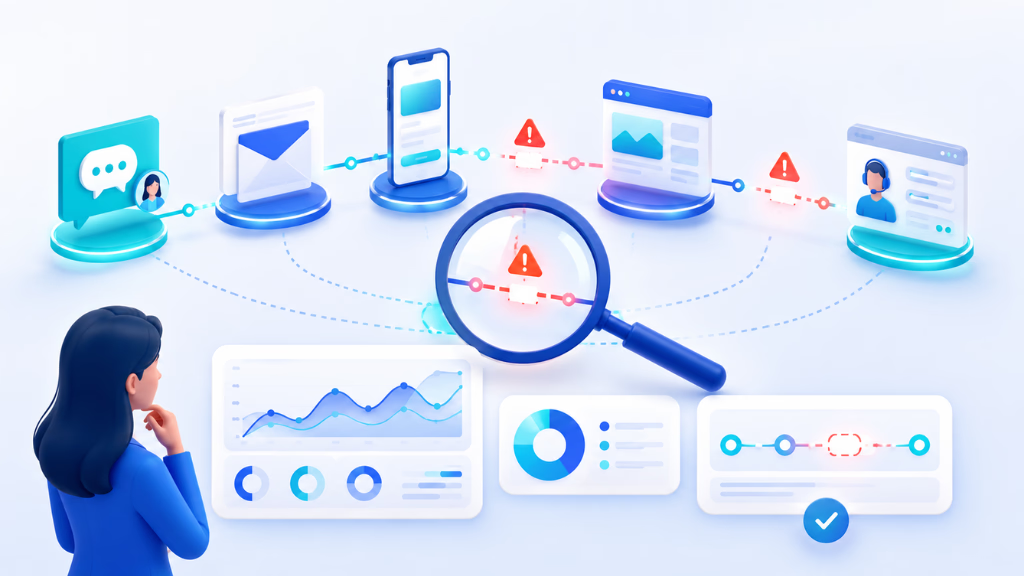
Omnichannel CX testing platforms take a multi-step approach to uncover journey gaps invisible to siloed tools. They bridge design and reality by combining simulation, workflow validation, conversation analytics, and live monitoring.
To use these platforms well, your team needs clarity on customer journeys, channel coverage, data points, test scenarios, and metrics. Let’s step through each action.
What You’ll Need
- Defined customer journeys and touchpoints
- Setup of all customer-facing communication channels (voice, chat, SMS, email, WhatsApp)
- Access to unified customer conversation history and CRM/helpdesk data
- Clear KPIs (CSAT, FCR, AHT, escalation, abandonment, resolution rate)
- Scenarios for both successful and failing journey paths
1. Define the Customer Journeys Most Likely to Break
In my POV, it’s best to focus on critical, high-volume, and high-risk journeys—like password resets, onboarding, and billing questions—as well as those with multiple handoffs (for example, from chatbot to agent or chat to phone). Chronic issues usually hide in these flows.
2. Map the Expected Omnichannel Customer Journey
Document each journey step: starting channel, customer goal, required info, escalation points, and the expected outcome. Map all systems involved: CRM, helpdesk, AI agents, and workflow tools. Make sure to define how key data (customer identity, intent, previous actions) should flow.
3. Simulate Real Customer Behavior Across Channels
Test both happy paths (ideal journeys) and unhappy paths (where customers change channels, give incomplete info, or abandon). Try edge cases—like peak-traffic scenarios—where failures often appear. Synthetic tests should walk through channels exactly as a real customer would, to catch gaps before launch.
4. Validate Cross-Channel Handoffs and Context Continuity
Check every handoff: Does the human agent see the customer’s history when taking over from a bot? Does chat context appear when a customer calls? Are escalation reasons, notes, and prior actions preserved? If not, repeat info and customer effort rise fast.
5. Test Data Handoffs Between CX Systems
Verify that CRM, ticketing, workflows, and knowledge bases update in sync. Look for out-of-date stages, missing tickets, lost authentication, or failed follow-ups. These data gaps disconnect journeys, increase handle time, and can cause compliance risks.
6. Analyze Conversations for Intent, Sentiment, and Repetition
Dig into transcripts and analytics. High repeat contacts, sentiment drops after handoffs, and repeated questions are early warning signs. If AI agents or humans keep escalating simple requests, you likely have knowledge or routing issues.
7. Detect Routing, Escalation, and Workflow Failures
Audit routing and workflow logic: Are billing issues sent to sales? Are compliance-sensitive requests escalated promptly? Do missed calls trigger automatic SMS? Our team once found that a single missed-routing rule led to a 15 percent rise in repeat contacts for a whole month.
8. Compare Expected Journey Outcomes With Actual Performance
Track journey completion rates, resolution quality, operational KPIs (AHT, abandonment, FCR), and CX scores (CSAT, NPS, CES). Spot where drop-offs are highest. Analyze which channels or steps have the slowest resolution or most escalations.
9. Prioritize Journey Gaps by Customer and Business Impact
Rank issues by their impact on effort, agent workload, revenue, and risk. Focus on closing gaps that drive repeat effort, long handle times, missed revenue, or compliance exposure first.
Table: Main Types of Journey Gaps CX Testing Platforms Detect
| Gap Type | What It Means | Example |
|---|---|---|
| Context gap | Lost customer history or intent | Agent cannot see prior chatbot or SMS interactions |
| Channel transition gap | Broken journey moving between channels | Email reply not linked to original WhatsApp or web chat |
| Routing gap | Incorrect team or queue | Billing issues sent to wrong department |
| AI/chatbot gap | AI misunderstanding or inconsistency | AI escalates basic issues, inconsistent answers across channels |
| Knowledge gap | Support content is missing or outdated | FAQ shows wrong policy, agents struggle to retrieve info |
| Workflow automation gap | Missed follow-up or next step | No SMS after missed call, or booking not confirmed |
| Performance gap | Latency or crash during journey | Chatbot times out during high volume |
| Measurement gap | No connection between CSAT and journey | Satisfaction drops, root cause unclear due to siloed data |
| Compliance gap | Missed disclosures or incomplete record | Sensitive request not escalated or audited |
Signals That Reveal a Broken Customer Journey
- High repeat contacts for the same issue or step
- Escalation spikes from bot or frontline agent
- Negative sentiment after handoff or authentication
- Longer resolution times or multiple touchpoints per issue
- Abandoned conversations (chat, IVR, web forms)
- Channel switching after failed self-service
- Repeated questions for the same info
In my experience, seeing these signals together almost always means there’s a gap in either handoff, context, or automation.
Omnichannel CX Testing Examples
- Simulate a chatbot-to-live-agent transfer for a complex order issue. Audit if agent sees the full chat history, intent, and sentiment.
- Simulate a missed call triggering an automatic SMS follow-up. Check if the SMS links to the correct original request and creates a lead in CRM.
- Run a voice AI escalation to a human when a customer mentions a compliance keyword. Ensure context, transcript, and escalation reason are preserved.
- Test ecommerce order support beginning in WhatsApp, with follow-up by email. Does context carry? Are actions updated in CRM?
- Simulate healthcare appointment booking across chat and phone. Check if calendar updates and escalations are correct at every step.
CX Testing vs Journey Mapping vs Journey Analytics
Customer journey mapping lays out the intended path. Journey analytics show what happened across all customer interactions. CX testing platforms validate whether real journeys work as planned—catching errors before customers suffer.
| Capability | Purpose | Best Used For | Limitation |
|---|---|---|---|
| Journey mapping | Design intended paths | Planning and brainstorming | Does not prove real journey works |
| CX testing | Validate journeys before/after launch | Finding defects, handoff issues | Needs clear scenarios, automation |
| Journey analytics | Analyze real behavior, spot patterns | Detecting live trends and gaps | Usually reactive, not proactive |
| Monitoring | Ongoing assurance and degradation alert | Live health, escalations, volume | Needs unified, real-time data |
Common Mistakes That Hide Journey Gaps
Teams often fall into patterns that hide the real issues. Testing only individual channels, ignoring “unhappy” customer paths, and relying on static journey maps are classic mistakes. Measuring by channel dashboards instead of unified journeys misses cross-channel friction.
Other common pitfalls include:
- Not retesting after workflow or knowledge updates
- Overlooking AI-to-human handoff quality
- Failing to tie journey gaps to measured outcomes like CSAT or revenue
These issues keep operational blind spots open, risking both customer frustration and business loss.
Unified Omnichannel Visibility: How Commplify Addresses Journey Gap Detection
Unified conversation management and analytics are key to uncovering journey gaps. In my experience, teams only start to see where the journey breaks when every conversation—voice, chat, SMS, email, WhatsApp—is visible in one inbox. Platforms like Commplify make this practical by connecting all channels and preserving full context at each step.
With all conversations and handoffs in one place, pointing to lost context, failed follow-ups, or repeat questions becomes clear. Analytics and reporting across the whole journey, not just by channel, finally make it possible to measure outcomes and identify friction—before it hits CSAT or revenue.
Conclusion
Omnichannel CX testing platforms expose the hidden gaps that frustrate customers and drain operational resources. By simulating customer journeys, validating handoffs, analyzing conversations, and monitoring metrics, these platforms give teams the practical tools to find—and close—breakdowns in context, routing, automation, and experience.
The main takeaway is clear: you cannot fix what you cannot see. Moving to unified conversation management and journey analytics, such as those offered by Commplify, is often the first real step toward understanding and resolving journey gaps.
With AI now driving both customer conversations and operational workflows, CX leaders need to build a culture of continuous testing and cross-channel visibility. The winners will be those who detect and fix friction before customers ever run into it.
FAQs
What is an omnichannel CX testing platform?
An omnichannel CX testing platform simulates and monitors customer interactions across all channels to detect journey gaps, broken handoffs, data errors, and workflow failures before customers are affected.
What is a customer journey gap?
A customer journey gap is any break or friction in the intended customer path—often caused by lost context, broken handoffs, failed routing, slow automation, or disconnected systems between support channels.
How is omnichannel CX testing different from customer journey mapping?
Journey mapping designs the ideal path; CX testing platforms actually validate that journeys work in real operations and identify defects, handoff failures, or data issues before customers are impacted.
Why do customer journeys break across channels?
Journeys break due to channel silos, poor data handoffs, routing errors, missing workflow steps, AI misunderstandings, outdated knowledge, or incomplete context during escalation between teams or channels.
What types of customer journey gaps do testing platforms detect?
Testing platforms uncover context gaps, broken channel transitions, routing issues, AI or bot errors, knowledge gaps, failed follow-up automations, performance problems, compliance risks, and gaps in measurement visibility.
How do omnichannel CX testing platforms identify broken handoffs?
They test journeys by simulating real customer paths across channels, then validate whether context, notes, intent, and prior actions are preserved or lost when transferring between bots, channels, or human agents.
How does AI help detect gaps in customer journeys?
AI analyzes conversation intent, sentiment, repetition, and routing patterns to detect hidden friction, unresolved issues, escalation spikes, and sentiment drops across multiple journeys and channels.
What data do CX testing platforms analyze?
They analyze unified conversation histories, transcripts, customer identities, journey steps, CRM updates, workflow events, sentiment scores, escalation reasons, and resolution outcomes across all channels.
Which channels should be included in omnichannel journey testing?
Include every customer-facing channel: voice, chat, SMS, email, WhatsApp, web chat, mobile app, and any systems (CRM, helpdesk) or AI agents involved in the journey.
What metrics reveal customer journey gaps?
Key metrics include repeat contacts, CSAT, NPS, escalation rate, handle time, abandonment rate, sentiment trend, first contact resolution (FCR), and channel switching after failed self-service.
How do you test an omnichannel customer journey?
Define critical journeys, map expected steps, simulate customer interactions across channels, validate handoffs, analyze metrics and conversation data, and compare expected versus actual journey outcomes to find friction.
How often should omnichannel journeys be tested?
Journeys should be tested before deploying new flows, after any knowledge or workflow update, during peak periods, and continuously monitored to catch issues as they emerge.
How can contact centers reduce journey gaps?
Unify all customer interactions in one conversation history, test both happy and unhappy paths, monitor analytics, fix data handoff issues, and review handoff quality to ensure context carries across all steps.
What should teams look for when choosing an omnichannel CX testing platform?
Prioritize broad channel coverage, unified conversation history, AI/bot testing, workflow integration, journey-level analytics, real-time monitoring, and deep root-cause reporting that connects metrics to operational gaps.
How can teams prioritize which customer journeys to test first?
Start with high-volume, high-risk, or revenue-critical journeys—like onboarding, billing, urgent support—and any flow where customers switch channels, escalate, or repeat contacts. Tackle the gaps with biggest customer and business impact.
This page was last edited on 18 June 2026, at 2:27 am