Quick Answer
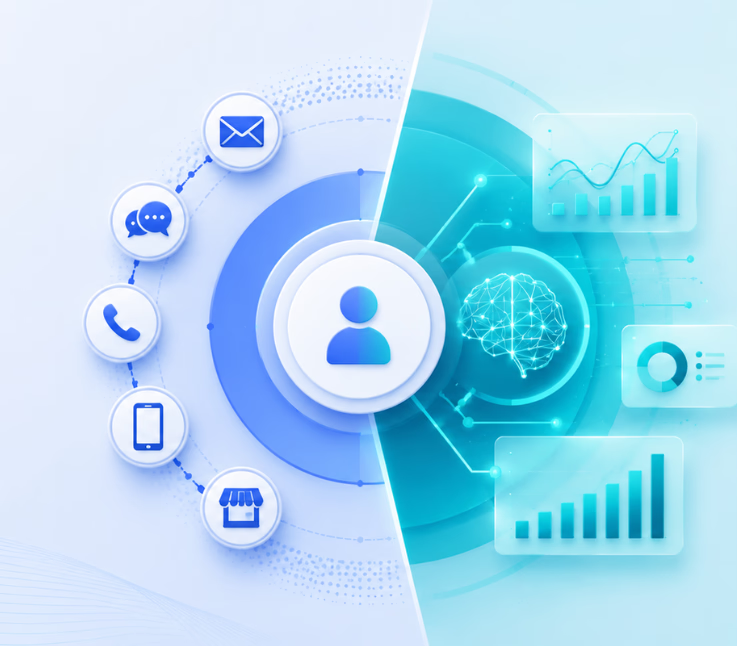
Omnichannel CX solutions manage customer conversations and workflows across all channels. AI-powered analytics platforms interpret CX data to provide actionable insights. They are not substitutes—most enterprises need both or a unified platform connecting insight to action.
If you lead a CX, support, or operations team, you know the pain: endless systems, fragmented conversations, and dashboards that rarely drive change.
I’ve seen this confusion up close. Vendors claim to be “AI-powered,” “omnichannel,” and “analytics-driven”—but those terms blur together fast. The real challenge? Customers repeat themselves. Agents jump between tools. Leaders struggle to prove AI ROI.
This guide unpacks the difference between omnichannel CX solutions and AI-powered analytics. You’ll leave knowing what each does, when to choose them, and how to build a CX stack that actually connects insight to action.
Why Omnichannel CX Solutions vs AI-Powered Analytics Comparison Matters
Choosing between omnichannel CX solutions and AI-powered analytics matters because these tools address unique pain points. In my experience, many teams think they need one or the other—when the reality is they solve very different problems.
Omnichannel CX platforms manage and coordinate every customer conversation, so customers do not have to repeat themselves and agents always have context. Analytics platforms surface insights from all that data—revealing friction, predicting churn, and explaining CSAT trends.
80% of consumers consider seamless omnichannel experiences essential, making them a key driver of customer preference and loyalty.
For most enterprise CX teams, the gap is not knowledge or engagement alone—it is connecting insight with operational execution. That’s where the magic happens and the real ROI emerges.
Omnichannel CX Solutions vs AI-Powered Analytics: Side-by-Side Overview
Omnichannel CX solutions and AI-powered analytics are two sides of the modern customer experience stack. Here is how they compare, at a glance:
| Category | Omnichannel CX Solution | AI-Powered Analytics |
|---|---|---|
| Primary purpose | Manage customer interactions | Analyze CX data and conversations |
| Main users | Agents, support, operations | CX leaders, analysts, ops leaders |
| Core function | Orchestration, engagement | Insight, prediction, optimization |
| Examples | Routing, unified inbox, AI agents | Sentiment, churn, friction |
| Best for | Real-time service execution | Decision intelligence |
| Limitation alone | May lack deep insight | May not trigger frontline action |
What Omnichannel CX Solutions Do
Omnichannel CX solutions are the backbone of connected service delivery. They consolidate every customer interaction—voice, chat, SMS, email, WhatsApp, and more—into one unified workspace. I have seen first-hand that you notice the difference the moment a customer is not forced to repeat details if they switch from chat to a phone call.
A solid omnichannel platform does more than just aggregate channels. It routes work with intent, provides agents with the full context, automates routine tasks with AI agents, and keeps the conversation history intact—all while allowing humans to step in for complex or sensitive needs.
Core Capabilities to Expect
- A unified conversation inbox across all digital and voice channels
- Cross-channel customer history
- Intelligent routing and assignment
- Configurable AI agents for automation
- Human handoff with preserved context
- Escalation management controls
- Built-in knowledge base and workflow automation
- CSAT collection and operational reporting
Omnichannel vs Multichannel: The Practical Difference
| Area | Multichannel Support | Omnichannel CX |
|---|---|---|
| Channel availability | Multiple channels exist | Channels are connected |
| Customer context | Often fragmented | Persistent across channels |
| Agent view | Separate tools or queues | Unified conversation history |
| Customer experience | Repetition is common | Journey continuity is preserved |
| Automation | Channel-specific | Cross-channel, context-aware |
Best-Fit Problems for Omnichannel CX
- Customers repeating themselves across channels
- Agents working across too many disconnected tools
- Voice, chat, SMS, and WhatsApp appearing in silos
- Escalation inconsistency and missed CX opportunities
- AI pilots that cannot operate beyond one channel
What AI-Powered Analytics Adds to Customer Experience
AI-powered analytics platforms interpret the mountain of customer interaction data your business generates every day. They do not route or reply to customers—they analyze, explain, and predict.
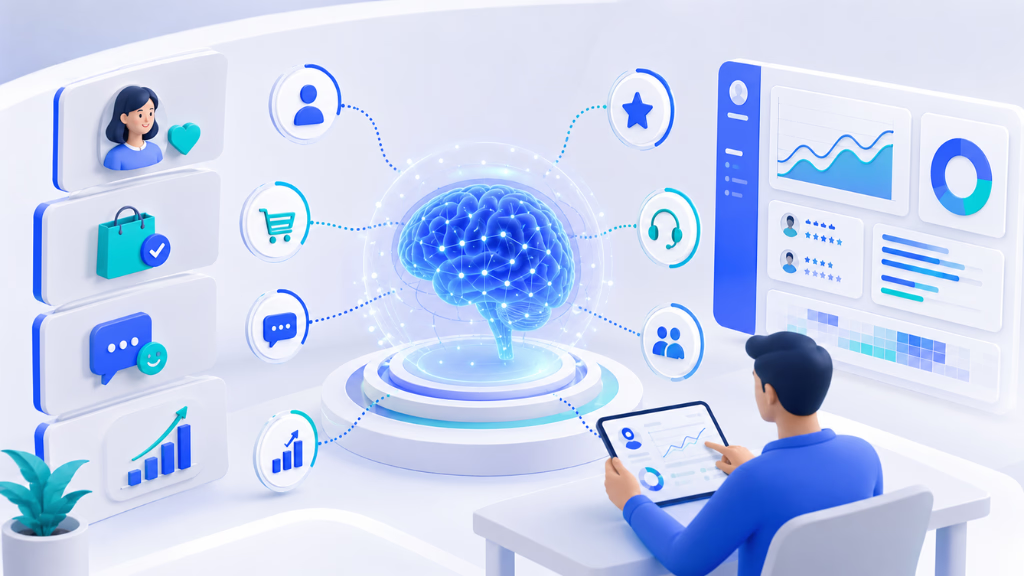
In my experience, the most valuable analytics products reveal unseen trends. For example, they show which touchpoints cause frustration, why churn spikes after product changes, or when CSAT drops. Traditional dashboards often show what happened; AI-powered analytics explain why—and what to do about it.
Core Capabilities to Expect
- Sentiment and emotion analysis
- Intent and topic detection
- Predictive churn and risk modeling
- Conversation, speech, and text analytics
- Journey friction and anomaly detection
- Agent performance measurement
- Automated quality assurance
- Real-time and historical trend dashboards
How AI Analytics Differs from BI Dashboards
| Area | Traditional BI | AI-Powered Analytics |
|---|---|---|
| Main function | Historical reporting | Real-time pattern detection |
| Data type | Structured metrics | Structured + unstructured |
| Speed | Often retrospective | Real time or near real time |
| CX value | Shows what happened | Explains why and predicts |
| Actionability | Needs human action | Can trigger next actions |
Best-Fit Problems for AI-Powered Analytics
- Leadership lacks insight into customer churn drivers
- CSAT drops with no clear root cause
- QA is costly and inconsistent
- Product teams need Voice of Customer themes
- Teams want to predict and prevent issues, not just react
Omnichannel CX Solutions vs AI-Powered Analytics: Detailed Capability Comparison
For most enterprise buyers, the smartest move is to compare capabilities based on operational needs, business maturity, and the gaps in your current stack. This table summarizes what each platform does best—and where it falls short alone.
| Capability | Omnichannel CX | AI Analytics | Why It Matters |
|---|---|---|---|
| Channel unification | Strong | Weak | Prevents fragmented journeys |
| Unified customer history | Strong | Medium | Gives agents full context |
| Sentiment analysis | Medium | Strong | Detects emotional risk, supports proactive care |
| Intent detection | Medium | Strong | Improves routing, automates responses |
| Predictive churn | Medium | Strong | Enables proactive retention |
| AI agents | Strong | Weak | Automates frontline conversations |
| Intelligent routing | Strong | Weak | Moves work to best agent or escalation |
| Workflow automation | Strong | Medium | Turns insights into CX action |
| Journey analytics | Medium | Strong | Identifies friction across touchpoints |
| Agent performance | Medium | Strong | Supports coaching, QA, and improvement |
| Real-time resolution | Strong | Medium | Boosts CSAT and First Contact Resolution |
How to Decide Which CX Technology to Prioritize
Choosing between omnichannel CX and AI-powered analytics comes down to diagnosing where the biggest friction is—in execution, in visibility, or in closing the loop between them. I have seen businesses stall when they buy analytics platforms but still operate in disconnected silos, or invest in omnichannel without knowing why customers still churn.
Choose Omnichannel CX If Execution Is Broken
- Customers must repeat details on every channel
- Agents switch between too many systems
- Escalations are slow or missed
- Voice and digital channels don’t share data
- Support volume is outpacing current staff
- No single, unified customer history exists
Choose AI-Powered Analytics If Visibility Is Broken
- Leadership struggles to explain CSAT drops or churn
- No measurement exists for sentiment or intent
- QA is all manual
- VoC insights are missing for product or journey
- CX workflows work, but nothing is continually optimized
Choose Both When the Business Needs Insight-to-Action
The strongest organizations link insight and orchestration. You need both when:
- The business needs to act on early warning signs, not just spot them
- Dashboards are not changing agent or workflow behavior
- Frontline AI agents need accurate context and continuous learning
- High-value accounts require proactive, not reactive, engagement
Here’s a quick matrix:
| If your problem is… | Prioritize… |
|---|---|
| Customers repeat themselves across channels | Omnichannel CX |
| Leaders don’t know why CSAT is dropping | AI-powered analytics |
| Agents lack context | Omnichannel CX + agent assist |
| Dashboards do not change frontline behavior | Unified AI-native CX |
| Churn risk is hard to detect | AI analytics |
| High-value customers need faster escalation | Analytics + routing |
CX Maturity Decision Framework
| CX Maturity Stage | Common Problem | First Investment |
|---|---|---|
| Early | Disconnected channels | Omnichannel CX |
| Growing | Agent overload | AI agents, workflow automation |
| Scaling | Lack of visibility | AI-powered analytics |
| Enterprise | Complex, cross-team journeys | Unified AI-native CX platform |
| Advanced | Proactive, predictive CX | Analytics and orchestration |
Common Mistakes and Things to Avoid When Comparing
- Treating multichannel (many channels, little connection) as true omnichannel
- Buying analytics tools without any way to turn findings into action
- Automating frontlines without controls for escalation to humans
- Ignoring voice as a first-class channel
- Measuring only contact deflection, not true resolution or satisfaction
- Not integrating CRM, knowledge, and other key systems upfront
- Creating new silos by layering point solutions on top of each other
- Failing to involve frontline agents in tool design
- Not capturing baseline metrics before go-live
How Commplify Connects Omnichannel CX and AI Analytics
For teams who need both engagement and insight, unified platforms that combine omnichannel execution, AI automation, and actionable analytics are proving practical. Commplify is an example.
Platforms like Commplify manage customer conversations across voice, chat, SMS, email, and WhatsApp—all in one inbox—while offering workflow automation, real-time analytics, sentiment and intent capture, and human handoff. In my POV, this approach helps teams go from merely spotting issues to acting on them—whether that means routing a frustrated caller to a senior agent, following up missed calls, or flagging knowledge gaps.
When analytics can trigger action, and AI agents always have the right context, you break out of dashboard debt and deliver true operational CX intelligence.
Conclusion
The main takeaway: omnichannel CX solutions and AI-powered analytics are partners, not rivals. One orchestrates customer engagement and workflows. The other interprets data, trends, and intent. Leading organizations use both—often in a single AI-native CX platform—to move from insight to execution in real time.
In my experience, businesses that unify omnichannel platforms with outcome-focused analytics see faster CSAT recovery, lower churn, and better agent speed. Commplify’s unified model bridges communication silos and enables every insight to become action—no more gap between what’s happening and what gets done.
Forward-looking CX means knowing your customer, resolving their needs, automating what you can, escalating quickly, and never missing a learning opportunity. That’s where omnichannel meets intelligence.
FAQs
Are omnichannel CX solutions and AI-powered analytics the same thing?
No. Omnichannel CX solutions manage customer interactions across channels, while AI-powered analytics analyze data and conversations to surface insights and trends.
Which is better for reducing support costs?
Omnichannel CX solutions reduce support costs by automating routine requests and streamlining agent workflows. Analytics help identify cost drivers, but need workflow integration to directly cut costs.
Which is better for improving CSAT?
Omnichannel CX improves CSAT by delivering faster, more consistent customer service. AI-powered analytics identify root causes of CSAT drops so managers can take corrective action.
Can AI-powered analytics automate customer support?
AI-powered analytics alone do not automate support, but when connected to workflow automation or AI agents, their insights can trigger automated actions and proactive service.
Do omnichannel CX platforms include analytics?
Most modern omnichannel CX platforms include operational analytics, such as CSAT, sentiment, and escalation rates. Some add advanced AI-powered analytics for deeper insight.
What is the difference between conversation intelligence and AI-powered analytics?
Conversation intelligence focuses on analyzing customer conversations for compliance and performance. AI-powered analytics cover broader CX data and predictive insights across all channels.
How do AI agents fit into omnichannel CX?
AI agents automate routine conversations, qualify leads, answer FAQs, and route requests. They work best within omnichannel CX platforms where context and human escalation are built in.
When should an enterprise implement omnichannel CX first?
When conversation channels are siloed, agents lack context, and customers must repeat themselves, omnichannel CX should come first.
When should an enterprise implement AI-powered analytics first?
If the core problem is visibility—such as unknown churn reasons, lack of sentiment tracking, or QA gaps—analytics should come first.
What is the fastest way to prove ROI from omnichannel CX and AI analytics?
Track changes to first contact resolution, CSAT, response time, and cost per contact before and after rollout. Link insights to automated workflows for quick wins.
This page was last edited on 18 June 2026, at 1:51 am