Quick Answer
The top trends in AI customer experience platforms are agentic AI, omnichannel orchestration, integrated voice AI, workflow automation, predictive analytics, AI-ready knowledge management, hyper-personalization, unified analytics, sentiment detection, revenue recovery, and strong AI governance—moving CX from basic automation to intelligent operations.
Support and CX leaders are under immense pressure: more channels, rising volumes, and customers who expect “now” as the minimum. Most teams I work with worry not about the technology, but about delivering fast, consistent answers without losing control.
Legacy chatbots and siloed tools often disappoint. The future is unified: AI-backed platforms that handle, route, and escalate across every voice and digital channel, while humans stay in the loop for what matters most.
This list distills 12 shifts changing how CX, support, and operations teams choose and use platforms. You’ll leave with a decision framework, trend pulse, and the specific capabilities to demand if you want AI-powered customer experience—not just another bot.
Why Trends in AI Customer Experience Platforms Matter
AI customer experience platforms matter because customer expectations have outpaced what siloed tools can deliver. Executives want more than chatbots—they need AI to connect conversations, automate tasks, and route issues with business outcomes in mind.
In my experience, fragmented systems force customers to repeat themselves and support teams to workaround broken handoffs. Modern AI CX platforms unify every channel—voice, chat, SMS, email, WhatsApp—so both AI and humans can serve with full context, speed, and accuracy. This drives faster resolution, reduces cost per contact, and lifts satisfaction.
AI tools have the potential to boost productivity by 66%, delivering gains equivalent to 47 years of natural productivity growth in the United States.
Top 12 Trends in AI Customer Experience Platforms
| Trend | What It Means | Business Impact | Key Metric |
|---|---|---|---|
| Agentic AI | AI handles actions, not just answers | Higher resolution rates | First contact resolution |
| Omnichannel AI | Unified voice, chat, SMS, email, WhatsApp | Fewer silos, higher CSAT | Channel switch rate |
| Voice AI | Voice in same system as chat/SMS | Missed-call recovery, rich analytics | Missed-call recovery rate |
| Human-in-the-Loop | AI escalates wisely to people | Trust and safe automation | Escalation success |
| Knowledge Intelligence | Structured, up-to-date AI-ready KB | Accurate answers, fewer errors | Self-service resolution |
| Predictive Analytics | AI anticipates next step | Retention, revenue lift | Churn reduction |
| Hyper-Personalization | CX tuned to segment, tone, timing | Reduced effort, lift in sales | Conversion rate |
| Sentiment & Intent AI | Real meaning, urgency, emotion detected | Prioritized escalation | Complaint resolution time |
| Workflow Automation | Conversation triggers real-world actions | Operational efficiency | Workflow completion rate |
| Unified Analytics | Track AI vs. human, channel, outcome | Clear ROI visibility | CSAT by agent/AI |
| AI Governance | Controls, audits, transparency | Risk reduction | Audit completion rate |
| Revenue Recovery | AI protects and rescues leads/opps | More appointments, less leakage | Revenue recovered |
1. Agentic AI Moves CX from Answers to Actions
Agentic AI means AI agents now do more than answer—they complete tasks across systems. In the last year, I’ve seen support teams flip from simple FAQ chatbots to AI agents that check orders, book meetings, or update records.
When AI acts, not just replies, customers get real outcomes. Teams avoid repetitive work, and first-contact resolution soars. Structured, high-volume questions—like appointment booking or lead qualification—benefit most.
Quick Verdict: If your AI only “answers,” you’re behind. Start measuring how often AI resolves the issue, not just replies.
2. Omnichannel AI Becomes the Foundation of CX Platforms
Today’s customer can start with a call, follow up on WhatsApp, and email you docs—all in the same journey. Omnichannel AI brings all channels into one conversation thread, so neither customers nor agents need to repeat or guess.
Most teams fail here; context gets lost between phone and chat, or emails live in a separate system. Platforms that unify every channel—with cross-channel memory, reporting, and escalation—cut customer effort and boost satisfaction.
Quick Verdict: Omnichannel AI is non-negotiable for platforms. Demand a unified inbox with shared context across every channel.
3. Voice AI Becomes Part of the Unified Conversation Layer
Phone isn’t dead. Urgent or emotional issues still drive customers to call. The trend is integrating Voice AI—speech-to-text, call summaries, missed-call recovery—directly with digital channels.
I’ve watched support teams lose revenue just because missed calls weren’t followed up. The strongest platforms feed every call, transcript, and sentiment right into the same inbox as chat and SMS, ready for follow-up and workflow triggers.
Quick Verdict: Stop treating voice as an island. Connect voice AI with the rest of your digital stack to recover missed opportunities.
4. Human-in-the-Loop AI Becomes Essential for Customer Trust
Even the best AI can’t (and shouldn’t) handle everything. Sensitive complaints, regulatory topics, or distressed customers must escalate to a real person—ideally with full context and no repeat questions.
This is where most platforms trip up. I’ve seen agent frustration when escalations lose history, or supervisors can’t review what the AI did. Top platforms now route, tag, and summarize for a smooth human takeover.
Quick Verdict: Expect AI to recognize its limits and escalate early—with conversation summaries—for transparency and trust.
5. AI-Ready Knowledge Intelligence Becomes a Platform Requirement
AI’s answers are only as good as its knowledge access. Outdated FAQs and scattered docs cause hallucination, errors, or endless escalation.
In my experience, structured, semantic-search-powered knowledge bases—scoped by agent, channel, or permission—are becoming standard. Teams can update policies once and feed correct info everywhere from chat to call.
Quick Verdict: Make sure your platform supports real-time, scoped, and source-controlled knowledge for AI and agents.
6. Predictive Analytics Turns CX from Reactive to Proactive
Traditional support waits for the customer to complain. Predictive analytics change the game—surfacing churn risk, missed payments, abandoned carts, and likely escalations before they become problems.
Teams that use predictive signals can personalize outreach, remind about appointments, or route urgent queries proactively. This moves CX off the back foot and into value creation.
Quick Verdict: Track how many customer problems are solved before they escalate—not after.
7. Hyper-Personalization Expands Across Service, Sales, and Support
Personalization is no longer just for marketing. AI applies it to every touch: tone, timing, channel, even which FAQ to show or when to escalate.
I see SaaS platforms answering in plan-specific language, clinics offering return patients their last doctor, or retailers providing return policies by segment. The real trick? Stay relevant without crossing into invasive.
Quick Verdict: Personalize where it helps customer effort. Avoid overstepping data trust.
8. Sentiment and Intent Intelligence Improve Routing and Escalation
Understanding not just what customers say, but what they mean—and how they feel—drives better routing, prioritization, and escalation.
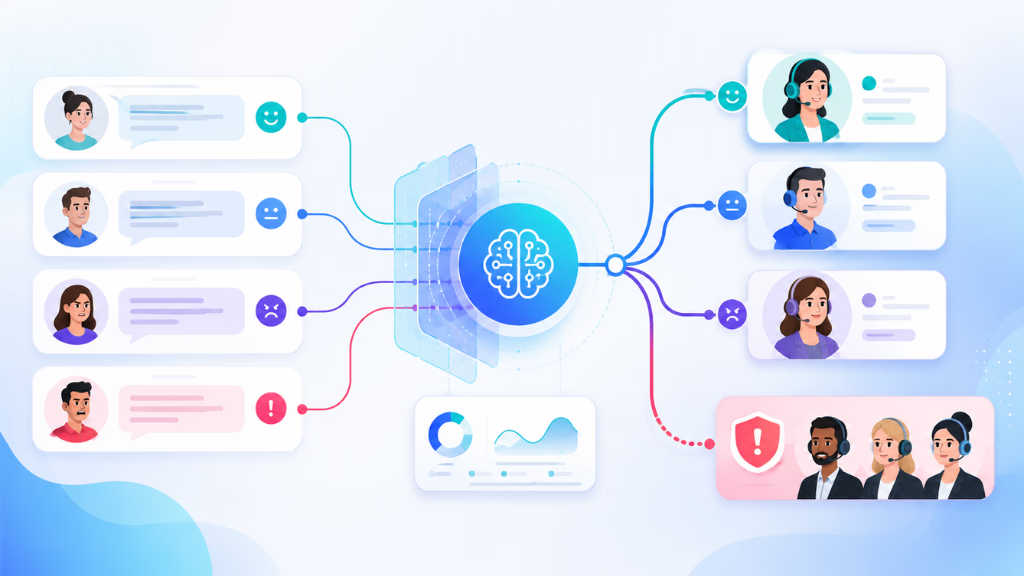
In my POV, routing every negative sentiment or urgent intent to the right team or supervisor is the fastest fix for slow complaint resolution. Modern platforms should read emotion, urgency, and next-best action as inputs for workflow.
Quick Verdict: Don’t just track intent—let AI shape who handles what, and how fast.
9. Workflow Automation Connects Conversations to Business Outcomes
AI CX platforms are about more than chat. Real value comes when the AI-triggered conversation launches actions: call follow-up, CRMs updates, appointment booking, complaint routing.
Last year with our support team, missing this link meant lots of talk, little ownership. Workflow automation closes gaps between intent and business result.
Quick Verdict: Demand platforms that let you build, track, and improve cross-channel workflows tied to conversations.
10. Unified Analytics Become Critical for AI ROI
You cannot improve what you cannot measure. The best AI CX platforms now provide analytics—AI vs. human ratio, handle times, CSAT, sentiment, escalation patterns—across all channels.
I have seen missed value where digital and voice data are separated, or when AI performance isn’t tracked by outcome. Unified analytics let leaders tune the right mix of AI and human effort.
Quick Verdict: Never accept a platform where you cannot see—per channel—what AI is really doing and how it affects satisfaction.
11. AI Governance Becomes a Buying Requirement
As AI becomes a core part of CX, governance is no longer optional. Large enterprises, regulators, and customers expect oversight, data controls, and accountability for escalation and knowledge.
This is where many teams struggle—weak governance leads to risk, poor explainability, and brand damage. Modern platforms must offer role-based access, audit trails, escalation design, and knowledge source control.
Quick Verdict: Treat governance as a core buying filter, especially for regulated and high-risk use cases.
12. AI CX Platforms Support Revenue Recovery, Not Just Cost Reduction
Most chatbots promised lower support cost. The new trend is using AI to recover revenue lost through missed calls, slow responses, and abandoned leads.
I have seen real estate, healthcare, and B2B SaaS teams boost appointments, follow up on missed inquiries, and revive cold leads—all automated by AI but escalated when needed.
Quick Verdict: Push platforms to show how AI not only cuts cost, but actively protects and recovers revenue.
Key Platform Selection Considerations
Success with AI CX platforms depends on demanding the right table-stakes features—and avoiding red flags. Oversights here guarantee future headaches.
- Unified omnichannel coverage (voice, chat, SMS, email, WhatsApp)
- One conversation inbox with cross-channel context
- Configurable AI agent rules, escalation, and knowledge access
- Voice AI tied to the same customer history as digital channels
- AI-ready knowledge (structured, real-time, permissioned)
- Workflow automation linked to real business outcomes
- Analytics that measure both AI and human handling
- Human-in-the-loop for sensitive or complex cases
- Strong governance, escalation, and audit controls
- Flexibility for integrations and future growth
Common mistakes to avoid:
- Isolated AI that only works for chat or one department
- Voice, chat, and email data split in separate systems
- Escalations that lose history and force customers to repeat
- Workflow “automation” that just sends emails, never books or updates
- Inability to measure or audit what AI does
How Commplify Solves Real CX Platform Problems
Commplify is built around the very trends I see driving enterprise platform adoption—unified conversation management across voice, chat, SMS, email, and WhatsApp. In my experience, most platforms silo voice or fail to give both AI and people shared context. Commplify’s single inbox approach means customers never get lost between channels, and support teams never lose track of a conversation.
Configurable AI agents handle routine tasks but instantly escalate—with full context—when issues require human empathy or judgment. Built-in workflow automation ensures no lead, booking, or complaint drops between the cracks. Knowledge intelligence keeps answers fresh, accurate, and role-specific.
For CX teams facing fragmented journeys, rising expectations, and pressure to show business value, this unified, action-driven model is where I see platforms moving fast.
Conclusion
The biggest shift in AI customer experience platforms is from fragmented tools and basic bots to unified, omnichannel systems that understand, decide, and act. The key lesson is clear: business leaders should measure platforms on practical CX outcomes—not AI hype.
I have seen support teams cut handle times, recover lost revenue, and keep customers loyal by combining intelligent automation with human judgment and context-rich journeys. Trends like agentic AI, integrated voice, workflow automation, and analytics are now must-haves.
Commplify fits this new reality by making every conversation—regardless of channel—a managed, analytics-ready, and action-backed opportunity. The future belongs to platforms that connect channels, knowledge, workflows, and people—putting both AI and humans in the driver’s seat for better customer experience.
The next phase is not just smarter bots, but truly intelligent customer operations—where AI learns, acts, and always keeps customers (and teams) at the center.
FAQs
What is an AI customer experience platform?
An AI customer experience platform connects, manages, and automates customer conversations across channels using AI for intent detection, routing, knowledge access, workflow automation, and human handoff.
What are the biggest trends in AI customer experience platforms?
Key trends include agentic AI, omnichannel orchestration, integrated voice AI, workflow automation, predictive analytics, sentiment detection, robust knowledge management, and strong governance.
How is AI changing customer experience?
AI is moving customer experience from fragmented, reactive support to connected journeys where AI can resolve, route, and escalate across every channel with speed and context.
What is agentic AI in customer experience?
Agentic AI refers to AI agents that complete tasks—like booking, updating, qualifying—instead of only responding, enabling true outcome-oriented customer interactions.
Why is omnichannel AI important for CX platforms?
Omnichannel AI lets customers move between voice, chat, SMS, email, or WhatsApp without repeating themselves, reducing friction and driving faster, more personalized resolution.
How does voice AI improve contact center performance?
Voice AI automates call handling, transcription, and after-call work. It connects phone and digital channels, enables missed-call recovery, and powers actionable analytics.
What is human-in-the-loop AI in customer service?
Human-in-the-loop means AI escalates complex or sensitive issues to people, ensuring both accuracy and customer trust while AI handles the routine.
How can AI customer experience platforms reduce support workload?
AI handles repetitive tasks, answers FAQs, routes requests, follows up on missed contacts, and automates workflows, freeing human agents to focus on complex issues.
What should enterprises look for in an AI CX platform?
Enterprises should demand unified conversation management, configurable AI, strong human handoff, knowledge intelligence, workflow automation, transparent analytics, and robust AI governance.
How do you measure ROI from an AI customer experience platform?
Track metrics like first contact resolution, AI-handled conversation ratio, CSAT, cost per conversation, revenue recovered, escalation quality, and workflow completion rates to gauge ROI.
This page was last edited on 17 June 2026, at 2:48 am