Quick Answer
Dedicated AI agents for each customer CX journey are persona-driven virtual assistants assigned to each stage or interaction. They maintain memory, understand context, and connect conversations across channels—delivering personalized, efficient customer support beyond basic chatbots.
CX demands have outpaced what legacy chatbots can deliver. Many leaders still struggle with broken handoffs, context loss, and support tools that frustrate both teams and customers.
I have seen this pain up close—missed follow-ups, fragmented records, and wasted effort are common in most contact centers. Pressure mounts as expectations rise for real, context-aware support spanning chat, voice, email, and messaging platforms.
This guide explores how dedicated AI agents for each customer CX journey solve these challenges. You’ll gain a practical framework, implementation steps, use cases, and pitfalls to avoid—grounded in firsthand experience guiding enterprise CX teams.
Why Dedicated AI Agents for Each Customer CX Journey Matter
Dedicated AI agents change the CX game by shifting from generic, rule-based bots to specialized digital partners trained for each stage of the journey. Each agent can understand intent, carry forward context, and interact across chat, voice, SMS, and more.
In my experience, most CX failures boil down to context loss and impersonal automation. Real journey-aligned AI agents transform outcomes by delivering hyper-personalization, faster issue resolution, and fewer dropped balls—raising CSAT while reducing overhead.
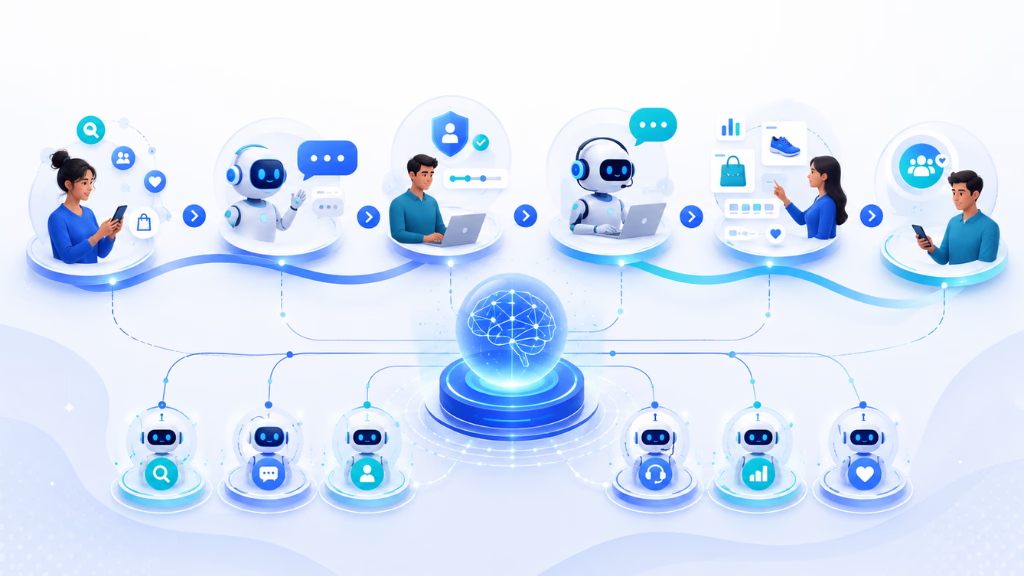
How Dedicated AI Agents Transform Every Stage of the Customer Experience
Deploying dedicated AI agents by journey stage unlocks unified, proactive, and memory-driven engagement across every channel. When set up correctly, these agents adapt to channel, context, and escalation needs without breaking the flow.
The global AI agents market is projected to grow from $5.4 billion in 2024 to $7.6 billion in 2025, representing a significant year-over-year increase.
Mapping the Customer Journey and Agent Roles
Mapping the journey is the foundation. Each customer journey breaks into stages: Awareness, Consideration, Purchase, Support, and Advocacy. Assigning an agent to each stage clarifies roles, reduces confusion, and makes it easier to build deterministic logic and escalation paths.
| Journey Stage | Example AI Agent Responsibility | Escalation Logic |
|---|---|---|
| Awareness | Qualify interest, capture lead, answer FAQs | Route complex questions |
| Consideration | Product/solution matching, objection handling | Escalate to human expert |
| Purchase | Guide checkout, address payment issues | Human if error/fraud |
| Support | Troubleshoot, resolve, recall prior contacts | Issue to live agent |
| Advocacy/Retention | Collect feedback, loyalty programs, reviews | Escalate complaint |
Having this structure keeps responsibilities clear and drives better agent performance.
Personalization Beyond Simple Automation
Journey agents do more than follow scripts. They retain memory—across channels and time—so even when customers switch from chat to WhatsApp or to a phone call, their context, history, and preferences are preserved.
Last year, when our support team piloted AI agents for post-purchase support, results improved. Repeat callers did not need to repeat info, and agents could recall past tickets or issues. Customers noticed the difference.
Orchestrating Omnichannel Conversations
Modern customer journeys cross channels without warning. A chat may become a call, or a WhatsApp thread may need follow-up by email.
With omnichannel coverage, dedicated AI agents follow the customer—managing context and workflow with one reference ID. For example, an urgent message starts on chat, continues on SMS, and ends with a voice callback. The agent coordinates all actions, so nothing falls through the cracks.
Adaptive Knowledge Intelligence for Every Interaction
A persistent, context-aware knowledge base is key. The mistake I see often is static FAQ integration, which cannot adapt to journey stage or intent.
Instead, AI agents using semantic search and journey-aware context can retrieve only the most relevant, up-to-date articles or resources. This reduces hallucinations and keeps the agent’s responses reliable—especially in regulated sectors.
State Management, Human Handoff, and Escalation
Persistent conversation state avoids the dreaded “reset button” experience. Agents track each interaction with a unique ID, ensuring context is never dropped—critical for compliance and continuity.
When it is time for a human handoff—whether due to complexity or customer frustration—the AI agent hands over the full thread, history, and context. This is where many teams struggle, but when done well, escalations are smooth and compliant.
Key Considerations When Deploying Dedicated AI Agents in CX Journeys
It takes more than plugging in an AI tool. You need clean, integrated data, clear journey maps, and escalation rules. Persistent context must be designed up front to avoid resets.
- Ensure source systems and channels are integrated.
- Define agent roles and escalation policies per journey stage.
- Prioritize persistent memory to thread conversations together.
- Build governance, compliance, and QA from the start.
Avoiding Common Mistakes When Introducing Dedicated AI Agents
Many teams treat journey agents as basic chatbots or neglect to build memory. I have seen CX launches fail fast due to:
- Not mapping each agent to a real journey stage
- Gaps in context persistence or knowledge recall
- Poor human handoff, leading to double work
- Neglecting compliance and audit trails
- Failing to define KPIs or analytics for improvement
Fixing these early will save your project time and reputational risk.
How Commplify Enables Dedicated AI Agents for Every Customer CX Journey
Many enterprise platforms struggle to assign distinct AI agents by journey stage and keep context persistent. Commplify was built to solve this.
With Commplify, you can configure persona-driven, memory-enabled AI agents for each journey stage—across chat, voice, SMS, email, and WhatsApp. Each agent uses a channel-agnostic setup. Visual journey mapping and an AI agent builder let you match roles, context, escalation, and compliance to each touchpoint.
The platform’s unified inbox, persistent reference IDs, and dual-mode knowledge intelligence ensure memory follows the customer—regardless of handoff or channel. Workflow automation and conversation analytics keep teams in control and support continuous improvement.
In my POV, having tools that unify context, knowledge, and agent configuration across every journey stage is how true CX transformation happens.
Conclusion
Deploying dedicated AI agents for each customer CX journey is more than an upgrade—it is strategic CX transformation. Mapping agents to every stage, managing persistent memory, and automating omnichannel workflows delivers more human, memorable experiences at scale.
The right approach, with platforms capable of per-journey configuration and deep context engineering, prevents the context resets and poor handoffs that damage trust and efficiency.
Commplify makes it possible to automate each layer of the journey without losing control, context, or compliance—letting humans step in only when truly needed.
As AI-driven CX keeps evolving, the teams that build with journey-specific AI agents will set the pace for truly personal customer relationships.
FAQs
What is a dedicated AI agent in the context of the customer journey?
A dedicated AI agent is a virtual assistant designed for a specific stage or task in the customer journey, maintaining context and handling interactions with memory and relevant knowledge.
How is an AI agent different from a chatbot or virtual assistant?
AI agents maintain conversation memory and context across channels and time, adapt to journey stage, and can escalate to humans, while basic chatbots follow rules with no persistence.
What does agentic AI mean in customer experience?
Agentic AI means virtual agents that act with autonomy, remember context, adapt to customer needs, and orchestrate CX outcomes—not just answer simple one-off queries.
What are the benefits of assigning AI agents to customer journeys?
Benefits include hyper-personalization, faster resolution, unified omnichannel support, reduced workload, improved CSAT, and better compliance via persistent memory and analytics.
How do you ensure AI agents understand and remember customer context?
AI agents require persistent state management, unique conversation IDs, and dynamic knowledge bases that adapt based on journey stage and interaction history.
What is the best way to deploy AI agents for each stage of the CX journey?
Map each journey stage, assign agent roles and escalation logic, integrate channels, enable persistent context, and pilot before full rollout with continuous monitoring.
What are the key challenges in using AI agents for CX?
Common challenges are context loss, generic automation, poor human handoff, compliance gaps, and difficulty scaling personalization across many journeys and channels.
Which platforms support dedicated AI agents for omnichannel journeys?
Platforms like Commplify support configurable AI agents per journey, unified inbox, persistent memory, deep analytics, and omnichannel orchestration.
How do you measure ROI or CSAT impact from AI agents in CX?
Track metrics like CSAT, first-contact resolution, escalation rates, agent workload reduction, customer journey completion, and channel performance within analytics dashboards.
What are best practices for scaling from pilot to full deployment?
Start with pilot journeys, collect feedback, monitor performance, iterate on configuration, then expand to all channels and journeys as data supports the approach.
How do you govern and optimize AI agents post-launch?
Use quality assurance, regular analytics reviews, compliance checks, journey audits, and continuous updates for knowledge and escalation logic based on actual outcomes.
This page was last edited on 19 June 2026, at 5:24 am