Quick Answer
AI customer sentiment analysis helps BPO firms detect customer emotion across all channels in real time. It identifies frustration, churn risk, and satisfaction, enabling immediate action, better agent coaching, improved QA, and smarter client-level CX reporting beyond traditional SLAs.
BPO firms face pressure to deliver outstanding customer experiences while keeping cost and risk in check. Having seen many support teams struggle, I know the biggest challenge is seeing beyond raw metrics, scattered surveys, and small QA samples, especially at scale. When most client reporting centers on SLAs and ticket counts, vital customer emotions go unnoticed—and brand loyalty erodes.
AI customer sentiment analysis is now within reach for outsourced support teams. But it’s only useful when connected to real conversations and daily workflows, not just as another static dashboard. In this guide, I’ll draw from real BPO scenarios to show how AI-powered sentiment insight can transform outcomes, not just measurements.
You’ll leave with clear steps, real-world examples, and a framework to bring omnichannel sentiment analytics into your CX, QA, reporting, and client partnerships—without drowning in AI hype.
Why AI Customer Sentiment Analysis for BPO Firms Matters
AI customer sentiment analysis means using artificial intelligence, natural language processing, and machine learning to detect whether customers feel positive, neutral, or negative during every interaction—voice, chat, SMS, email, or WhatsApp. It can pinpoint frustration, guide agents, flag churn risk, and improve both quality assurance and client reporting.
In my experience, this capability changes the game for BPO firms. Manual QA covers only a fraction of interactions. Surveys like CSAT miss those who don’t respond or respond too late. True competitive advantage happens when a BPO goes beyond the basic SLA and can show clients exactly how their customers are feeling, why they feel that way, and what’s being done about it—across every channel and conversation.
How AI Customer Sentiment Analysis for BPO Firms Works
AI sentiment analysis for BPOs is practical when linked to business operations, reporting, and client value. Let’s walk through its real-world workflow. By 2023, 64% of businesses had integrated AI-driven tools into their operations.
Collecting and Centralizing Omnichannel Interactions
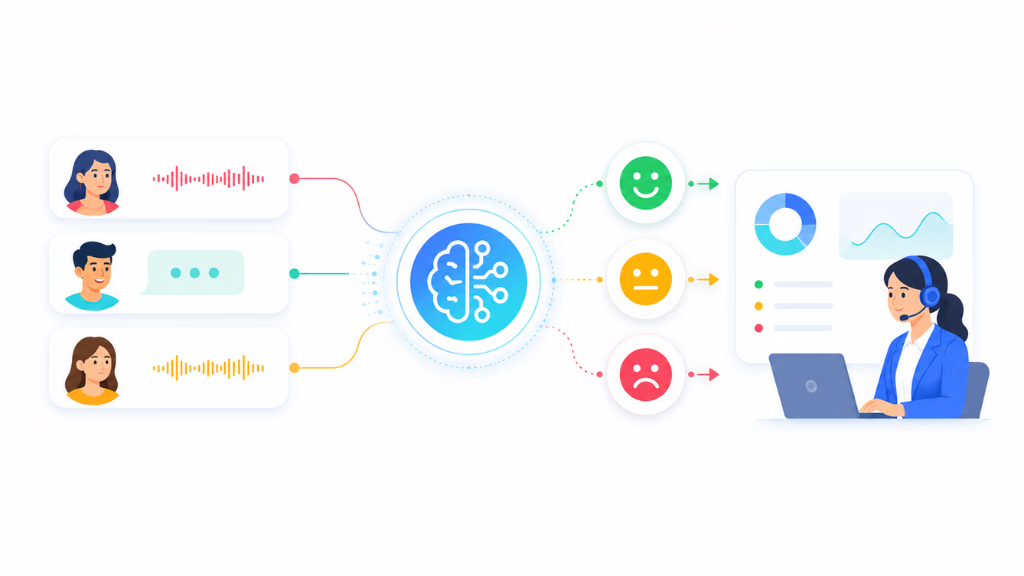
First, every customer touchpoint—calls, chats, SMS, emails, WhatsApp—feeds into a unified system. In my POV, failing to centralize this data is a major cause of blind spots and missed emotion signals, especially for BPOs with global teams and diverse client portfolios.
Turning Voice and Text Into Actionable Data
Speech-to-text models transcribe calls. NLP and AI pull detailed context from chat, SMS, email, and WhatsApp, tagging each message with sentiment, urgency, intent, and possible frustration or confusion. Not just “positive” or “negative,” but, for example, “urgent and frustrated about billing” or “neutral but confused on returns.”
Real-Time and Historic Sentiment Detection
AI analyzes not just word choice, but tone, silence, interruption, repetition, and phrase changes. Teams get live sentiment updates, so supervisors can intervene during an at-risk call, and analytics power weekly or client-level reviews.
Root Cause Analysis and Sentiment Drivers
Once you have reliable tags, you can see that, say, “return policy misunderstandings” or “language barriers” are the top frustration drivers by region. Last year our team found a recurring knowledge gap using these tags, and client CSAT improved after a script update.
Triggering Escalation, Workflow, or Coaching
The real value is connecting sentiment insights to action. AI can notify a supervisor when a customer’s tone turns from neutral to very negative. Agents get on-screen tips to adjust their tone or escalate. Negative sentiment after-hours? A follow-up SMS is auto-triggered.
Sentiment Analytics for Team and Client Reporting
Dashboards roll up trends by channel, agent, client, product, or region. You can finally move from just “tickets handled” to showing clients exactly how their customers feel, what causes complaints, and which fixes work.
Real-World BPO Use Cases for AI Sentiment Analysis
- Detect and resolve frustration in real time before public escalation.
- Guide agent empathy, clarify responses, or suggest apologies.
- QA teams monitor 100% of conversations, not just random samples.
- Manage churn by spotting repeat negativity and automating follow-up.
- Escalate high-risk customers (VIPs, vulnerable, or angry) to experienced agents.
- Update scripts, FAQs, and AI agent knowledge when multiple negative tags signal confusion.
Key Benefits of AI Sentiment Analytics for BPO Operations
Every BPO claims great SLAs. Few can prove experience quality at scale—let alone fix it as it happens. This is where sentiment analytics pulls away from tradition.
Richer QA and Broader Coverage
Manual QA reviews a small slice of interactions. Sentiment analytics covers every single message or call—spotting emotional risk wherever it appears.
True Customer Experience Layer
Speed and handle time can hide problems. I have seen SLAs met on paper while poor sentiment trends warned of looming client churn.
Smarter, More Human Escalation
Real-time alerts mean supervisors and agents catch potential crises early—long before an issue shows up in a survey or social channel.
Differentiation and Higher Client Value
Client reporting now includes emotional trends, root causes, and evidence-based recommendations. This supports renewals and sets you apart from BPOs who only track cost and volume.
Better Agent Coaching and Performance
Patterns of negative or mixed sentiment identify where agents or teams need support, soft skills training, or specific knowledge updates.
Knowledge Base and Journey Improvement
In my experience, repeated “neutral but confused” tags flagged outdated onboarding info that, once fixed, cut repeat inbound calls by 23% within three months.
What Metrics Should BPOs Track With AI Sentiment Analysis?
| Metric | What It Shows | Why It Matters for BPOs |
|---|---|---|
| Sentiment distribution | Positive, neutral, negative breakdown | Emotional health of CX |
| Negative sentiment rate | % of interactions frustrated | Early warning for churn, complaints |
| Sentiment by channel | Per-channel friction | Prioritize training/process fixes |
| Sentiment by client/account | Health by account | Supports client QBRs |
| Sentiment by agent/team | Coaching needs | Target specific training |
| Sentiment recovery rate | Negative-turned-positive ratio | Measures agent save ability |
| Escalation rate | Supervisory interventions | Process complexity, agent autonomy |
| AI-handled sentiment | Automated conversation scores | Quality of AI vs. humans |
| Repeat contact sentiment | Emotion in repeat cases | Unresolved root causes |
| CSAT-sentiment match | Survey vs. actual emotion | Validates what’s measured |
Common Pitfalls and Challenges in BPO AI Sentiment Analysis
- Relying on transcript-only sentiment for voice calls (misses tone, sarcasm).
- Using out-of-the-box sentiment models for every market or client (calibration matters).
- Overlooking confusion or ambiguity in short-messaging channels.
- Ignoring the need for client-specific language, compliance, and terminology.
- Failing to review AI-flagged high-risk cases before acting.
- Treating negative sentiment as a workflow for AI agents, when human finesse is needed.
Always pilot with calibration, keep humans in the loop, and tune models per client and region. Privacy and compliance are non-negotiable—especially in regulated sectors.
How Commplify Solves the BPO Sentiment Analysis Challenge
This is where I see Commplify’s Analytics & Reporting and Conversation Management shine—because BPO firms need sentiment data tied to the real workflow, not just stand-alone dashboards.
- Centralize voice, chat, SMS, email, and WhatsApp in one conversation view, avoiding channel silos.
- Tag every conversation with sentiment, intent, and escalation need.
- Set up real-time workflow triggers: negative sentiment can prompt supervisor alerts, a follow-up SMS, or AI-to-human escalation.
- Assign conversations, track recovery rates, and view unified sentiment and CSAT trends for each client.
- Share actionable sentiment analytics with clients during QBRs—including top friction points, recovery wins, and improvement suggestions.
In my experience, connecting live sentiment signals to workflow and reporting changes BPO performance far more than passive measurement does.
Conclusion
BPO firms can no longer afford to rely only on old-school QA samples, basic surveys, or SLA reports. AI customer sentiment analysis shines a light on the true customer experience, conversation by conversation, across every channel.
The real breakthrough comes when this insight moves beyond data. When you connect sentiment analytics to live escalation, agent coaching, and dynamic client reporting, you evolve from a cost-driven vendor to a strategic CX partner with real brand influence.
Commplify’s platform capabilities make this achievable now—not just in theory. In my view, AI-powered sentiment analysis is fast becoming the new standard for competitive BPOs that want to impress clients, retain contracts, and protect every customer’s journey. The next frontier? Predictive, agentic workflows where sentiment not only reveals risk, but helps teams act before problems arise.
FAQs
What is AI customer sentiment analysis for BPO firms?
It is using AI to detect customer emotion in every outsourced interaction across voice, chat, SMS, email, and messaging channels, so BPOs can act to improve CX, QA, and reporting.
How does AI sentiment analysis improve CX in outsourced contact centers?
It analyzes real conversations to detect frustration, churn risk, and satisfaction, letting supervisors and agents respond in real time, improve QA, coach agents, and deliver better client-level CX reports.
Can AI analyze sentiment in voice calls as well as text?
Yes. AI uses speech-to-text and voice analytics to detect emotion, tone, and sentiment in live calls, though calibration is needed for accents, tone, and sarcasm.
What channels should BPO firms include in sentiment analysis?
Voice, chat, SMS, email, WhatsApp, and any digital channel where customers interact should be included for full CX visibility.
How does sentiment analysis help with agent coaching?
It reveals patterns of negative or mixed sentiment by agent or team, allowing targeted training, real-time feedback, and supervisor intervention when needed.
How can BPOs act on negative customer sentiment in real time?
AI flags negative sentiment live. Supervisors can intervene, agents can adjust, and automated workflows (such as follow-up messages) help recover the customer before issues escalate.
Is AI sentiment analysis accurate enough for BPO operations?
It is accurate for most use cases when models are calibrated by language, region, and industry, and when humans review high-risk or ambiguous cases for quality control.
What are the risks of using AI sentiment analysis in BPO firms?
Risks include misreading sarcasm, missing context, privacy concerns, compliance gaps, and over-automating sensitive interactions without human review.
How should BPOs measure ROI from sentiment analytics?
ROI comes from lower churn, reduced escalations, improved CSAT, better agent performance, higher client retention, and cost savings from more effective QA coverage.
What should BPOs look for in an AI CX sentiment analysis platform?
Look for omnichannel capture, real-time sentiment detection, escalation workflows, unified reporting, secure client-level data separation, integration, and strong governance controls.
This page was last edited on 18 June 2026, at 4:23 am