Customer service greeting sentiment analysis uses AI to assess the emotional tone of greetings in support interactions, helping teams improve customer impressions, agent coaching, and satisfaction metrics across all service channels.
First impressions have outsize influence in customer support. The moment an agent greets a customer can shape the entire conversation and determine future loyalty. Still, most organizations rely on subjective audits or gut feel to judge these critical opening seconds.
I have seen support leaders struggle to measure greeting quality at scale—especially across voice, chat, email, SMS, and messaging apps. Data is limited, and actionable insights are rare. This creates blind spots in agent training and quality control.
In this guide, I’ll break down practical methods for analyzing and improving greeting sentiment across every support channel. You’ll learn how to use analytics, automation, and unified conversation management to drive better first impressions and long-term CX success.
What Is Customer Service Greeting Sentiment Analysis?
Customer service greeting sentiment analysis is the process of analyzing the opening moments of a customer interaction to understand the customer’s emotional state, intent, and level of urgency. It can be applied to phone calls, live chat, messaging, email, or AI-powered customer service conversations.
Instead of treating every customer with the same scripted greeting, sentiment analysis helps a customer service system recognize whether someone sounds calm, frustrated, confused, impatient, or satisfied. The greeting and the next response can then be adjusted to fit the situation.
For example, a customer who begins a call with a complaint about a delayed order should not receive the same conversational approach as someone calling to ask a simple product question. Detecting that difference early can help an AI agent or human representative respond with more appropriate language from the beginning.
How Sentiment Analysis Works During a Customer Service Greeting
Sentiment analysis typically evaluates the words, context, and—when voice technology is involved—certain conversational signals present at the beginning of an interaction.
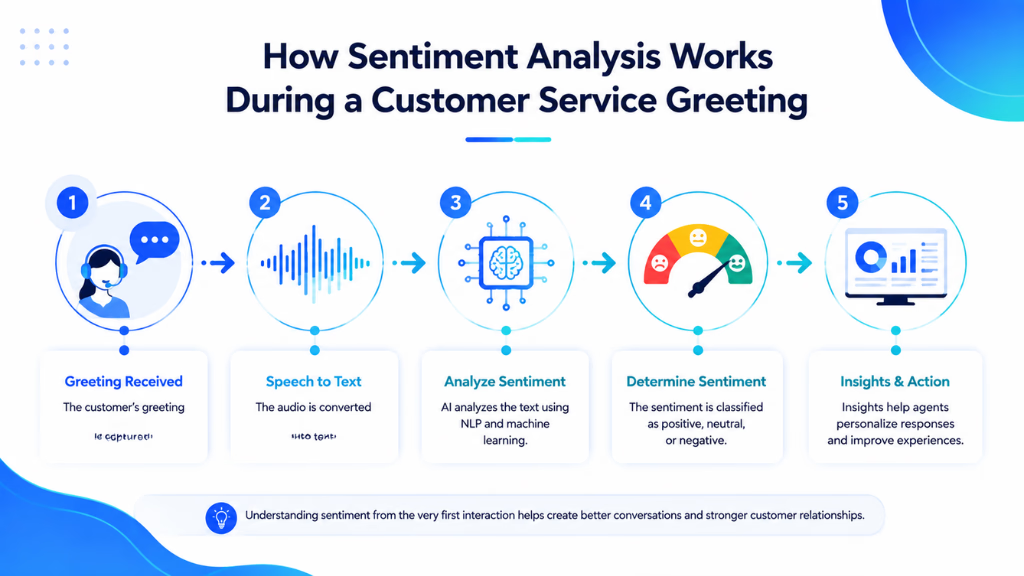
The process generally follows a simple flow:
1. The customer starts the conversation
The interaction may begin through an inbound phone call, chatbot, messaging platform, or another support channel.
2. The system captures the opening message
For voice conversations, speech recognition converts the customer’s words into text that can be analyzed. Text-based channels can be analyzed directly.
3. AI evaluates customer sentiment
Natural language processing and machine learning models examine the opening statement and classify its overall sentiment. Depending on the system, classifications may include positive, neutral, negative, frustrated, confused, or urgent.
4. The customer service response is adjusted
The AI agent, routing system, or support representative can use the sentiment result to decide how to respond.
For example:
- A frustrated customer may receive an acknowledgment-focused response.
- A neutral customer may receive a standard greeting followed by an intent question.
- A customer expressing urgency may be directed toward faster assistance.
- A satisfied returning customer can receive a lighter and more conversational response.
5. Sentiment continues to be monitored
The first greeting provides an important signal, but customer sentiment can change during the conversation. More advanced systems continue analyzing sentiment throughout the interaction and adapt when the customer’s mood changes.
Why the First Greeting Matters in Customer Service
Customers often reveal useful information within the first few seconds of a conversation. Their opening words may indicate why they are contacting the company, how they feel about the situation, and how quickly they expect help.
A fixed greeting such as “Thank you for contacting us. How may I help you today?” works for general interactions, but it does not account for the context the customer has already provided.
Consider a customer saying:
“I’ve contacted support twice already and this still hasn’t been fixed.”
Responding with a generic introduction may make the interaction feel disconnected. A sentiment-aware customer service system can identify the negative context and move directly toward acknowledgment and resolution.
A more appropriate response could recognize the repeated problem and immediately begin gathering the information needed to solve it.
This is where customer service greeting sentiment analysis becomes valuable: it turns the opening greeting from a standard script into the first step of a context-aware conversation.
Sentiment-Aware Customer Service Greeting Examples
The best greeting depends on both customer intent and emotional context.
Greeting for a Neutral Customer
When no strong sentiment is detected, the interaction can remain simple and efficient.
Example:
“Thanks for contacting us. How can I help you today?”
There is no need to over-personalize a straightforward conversation.
Greeting for a Frustrated Customer
If the customer’s opening message shows frustration, the response should acknowledge the issue rather than immediately moving into a generic script.
Example:
“I understand this has been frustrating. Let’s look at what happened and find the best way to resolve it.”
The objective is not to repeatedly apologize. It is to demonstrate that the system understands the customer’s concern and is prepared to act.
Greeting for an Urgent Request
Urgency should change the conversation flow.
Example:
“I understand this needs immediate attention. I’ll start by checking the details so we can determine the fastest next step.”
An AI customer service platform can also use urgency signals to prioritize the interaction or escalate it when necessary.
Greeting for a Positive Customer
Positive conversations should not automatically be treated like support complaints.
Example:
“Great to hear from you. How can I help you today?”
Maintaining the customer’s positive experience can make the conversation feel more natural.
Customer Sentiment Analysis for Voice Customer Service
Voice customer service provides additional context because customers communicate through more than words alone. AI voice systems can combine speech transcription with conversational information to better understand what is happening during a call.
A voice AI workflow may analyze:
- The customer’s spoken language
- The meaning and context of their statements
- Repeated complaints or negative phrases
- Interruptions and conversational patterns
- Changes in sentiment during the interaction
- Customer intent and urgency
Sentiment should not be treated as a perfect measurement of someone’s emotions. Background noise, speaking style, language differences, and context can affect interpretation.
For that reason, sentiment analysis works best as a decision-support signal, not as the only factor controlling a customer interaction.
Using Greeting Sentiment Analysis for Call Routing
One of the most practical applications of customer sentiment analysis is intelligent call routing.
Traditional call routing usually relies on selections such as:
“Press 1 for sales, press 2 for support.”
AI-powered customer service systems can instead analyze what the customer says naturally.
Suppose a customer begins:
“My account has been locked and I have an important transaction to complete.”
The system can potentially identify three signals at once:
Intent: Account support
Sentiment: Negative or concerned
Urgency: High
Based on predefined business rules, the interaction could then be routed to an account specialist, moved higher in the queue, or transferred to a human agent if the AI should not handle the issue independently.
This combination of intent detection + sentiment analysis + intelligent routing can create a more efficient support experience than relying on sentiment alone.
How AI Agents Can Adapt Conversations Based on Sentiment
Sentiment analysis becomes more useful when it influences what happens next.
An AI customer service agent can use sentiment data to adjust several parts of a conversation.
Change the Response Style
A frustrated customer may need concise acknowledgment and immediate action, while a curious prospect may benefit from a more conversational response.
Ask Different Follow-Up Questions
Instead of following the same rigid script, the AI can prioritize questions based on the customer’s current situation.
Reduce Unnecessary Conversation
When urgency or frustration is high, unnecessary greetings, promotional messages, and repetitive questions can make the experience worse. The system can move more quickly toward solving the problem.
Trigger Human Handoff
Certain sentiment patterns combined with specific intents can trigger escalation.
For instance, a human handoff may be appropriate when:
- Negative sentiment continues increasing
- The customer repeatedly asks for a representative
- The issue requires authorization the AI does not have
- The customer disputes the proposed resolution
- The AI cannot confidently determine the customer’s intent
The human agent should ideally receive the conversation history, identified intent, and relevant customer information so the customer does not need to restart the conversation.
How to Implement Customer Service Greeting Sentiment Analysis
A useful sentiment-analysis workflow requires more than switching on an AI model. Businesses need clear rules for how sentiment should affect the customer experience.
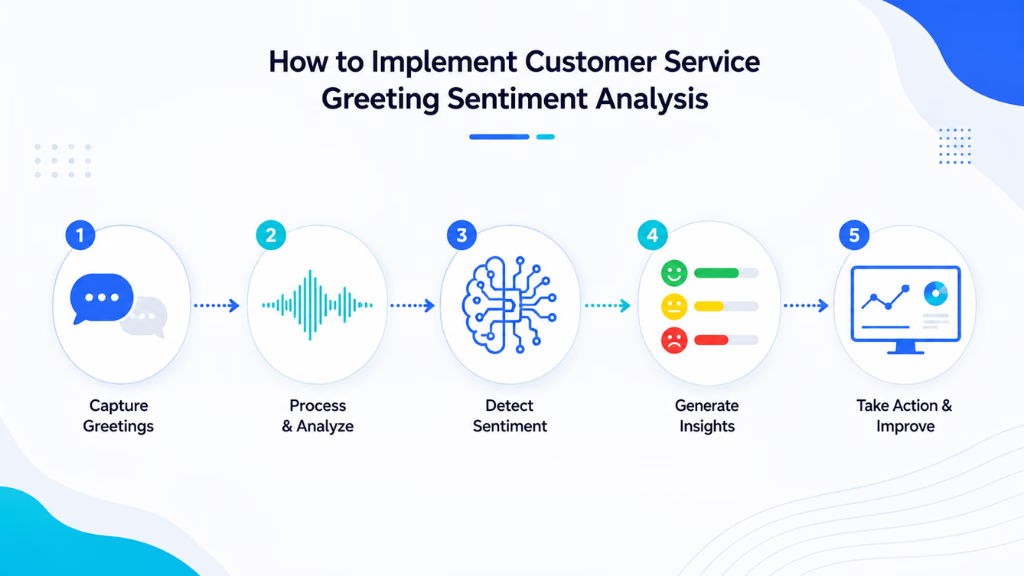
1. Identify the Customer Interactions to Analyze
Start with the channels where sentiment information can produce a meaningful action, such as inbound support calls, customer service chat, appointment calls, sales conversations, or complaint handling.
2. Define Useful Sentiment Categories
Avoid creating too many categories that employees or automation systems cannot practically use.
A starting framework might include:
- Positive
- Neutral
- Negative
- Frustrated
- Urgent
The important question is not how many labels the system can generate. It is whether each label leads to a useful next action.
3. Connect Sentiment to Conversation Rules
Define what the AI or customer service representative should do after a sentiment is detected.
For example:
Negative + billing issue → acknowledge concern and begin billing verification.
High frustration + repeated contact → prioritize human escalation.
Neutral + general inquiry → continue standard AI assistance.
Without these rules, sentiment analysis becomes another piece of analytics data instead of an operational customer service tool.
4. Combine Sentiment With Customer Intent
Sentiment alone does not explain what a customer needs.
A customer can be frustrated about a refund, delivery, subscription, technical problem, or appointment. Intent determines the problem; sentiment helps determine how the conversation should be handled.
The strongest customer service automation workflows therefore analyze both simultaneously.
5. Test Different Customer Scenarios
Before deploying sentiment-aware greetings widely, test realistic conversations such as:
- Calm product questions
- Angry support complaints
- Repeat callers
- Confused customers
- Urgent service requests
- Customers changing topics during a call
- Customers whose sentiment changes during the interaction
Testing helps identify situations where the AI misunderstands customer language or reacts too strongly to weak sentiment signals.
6. Review Real Conversations and Improve the Rules
Customer language is unpredictable. Real interactions should therefore be reviewed regularly to determine whether greetings, routing decisions, and escalations are working as intended.
The system can then be refined using actual customer behavior instead of assumptions.
Best Practices for Sentiment-Based Customer Service Greetings
A sentiment-aware greeting should make customer service feel more relevant—not more robotic.
- Keep greetings short. Customers normally contact support because they want something resolved. Long introductions can create unnecessary friction.
- Acknowledge emotion without exaggerating it. Slightly negative language does not always mean a customer is extremely upset.
- Prioritize resolution. Recognizing frustration has little value if the conversation does not move toward solving the problem.
- Give customers access to human support. AI sentiment detection should improve routing and assistance rather than trap customers inside automation.
- Preserve conversational context during handoff. When an interaction moves from AI to a person, transfer the available context so customers do not have to repeat themselves.
- Continuously test sentiment accuracy. Different accents, vocabulary, industries, and conversation scenarios may affect system performance.
Measuring the Impact of Greeting Sentiment Analysis
Businesses should measure whether sentiment-aware customer service actually improves outcomes.
Useful metrics include:
- First Contact Resolution (FCR): Measures how often customer problems are resolved during the first interaction.
- Average Handle Time (AHT): Helps determine whether better intent and sentiment detection reduces unnecessary conversation.
- Customer Satisfaction (CSAT): Shows whether customers are more satisfied after interactions.
- Escalation Rate: Tracks how often AI conversations are transferred to human representatives.
- Repeat Contact Rate: Identifies whether customers must contact support again about the same problem.
- Sentiment Change: Compares the customer’s sentiment at the beginning and end of an interaction.
A particularly useful indicator is whether negative opening sentiment becomes neutral or positive by the end of the conversation. That gives businesses more insight than simply knowing how the customer felt when the interaction started.
Customer Service Greeting Sentiment Analysis With AI Voice Agents
AI voice agents make it possible to apply sentiment analysis directly during customer conversations rather than reviewing interactions only after calls have ended.
When properly configured, an AI voice agent can listen to the customer’s request, identify intent, evaluate relevant sentiment signals, provide an appropriate response, complete routine actions, and transfer the conversation to a human when escalation rules are triggered.
For businesses handling large volumes of inbound and outbound calls, this creates an opportunity to make customer interactions more adaptive without requiring agents to manually classify every conversation.
The goal is not simply to determine whether a customer sounds “positive” or “negative.” The real value comes from using that information to decide what the customer should hear, what action should happen next, and when human support is the better option.
Conclusion
Customer service greeting sentiment analysis is more than a technical novelty. In my experience, it is a powerful operational tool that shapes first impressions, lifts satisfaction, and improves overall CX.
By investing in real-time, context-aware greeting analytics, organizations gain clarity on agent performance and can act quickly to support and train staff. Platforms with strong conversation management and workflow automation make it easy to unify sentiment scoring, automate alerts, and transform greeting data into business results.
Looking ahead, I see sentiment analytics growing even smarter—with GenAI, multimodal data, and deeper linkages to predictive routing and proactive service. Leaders who focus on greeting sentiment today will set the tone for tomorrow’s more human, effective customer support.
FAQs
What is customer service greeting sentiment analysis?
It is the AI-driven process of analyzing the emotional tone of agent greetings in customer interactions to improve first impressions, agent training, and customer outcomes.
Why is greeting sentiment important in customer experience?
Greeting sentiment sets the emotional tone for the entire interaction, shaping satisfaction, loyalty, and escalation risk from the first seconds of support.
How do you analyze sentiment in customer greetings (calls vs. chat)?
Voice channels use speech analytics and tone detection; chat and text use NLP to assess warmth and personalization. Both approaches segment and score the greeting phase.
Which tools/software support greeting sentiment analytics?
Unified conversation analytics platforms, like Commplify, support sentiment scoring, tracking, and workflow automation for greetings across all support channels.
How does the emotional tone of a greeting influence customer satisfaction and business outcomes?
A positive greeting improves customer satisfaction scores (CSAT), increases retention, reduces escalations, and boosts overall support outcomes.
What are best practices for improving agent greeting sentiment?
Use real-time analytics, context-aware training, positive and personal scripts, and integrate sentiment feedback into regular coaching—not just compliance reviews.
How can I implement greeting sentiment analytics in my contact center?
Start by unifying multichannel data, deploy context-tuned sentiment models, set up workflow triggers for neutral/negative greetings, and link insights to agent coaching.
How do organizations use greeting sentiment data for QA and agent coaching?
Greeting sentiment data guides targeted feedback and coaching for agents, highlights training needs, and helps QA teams flag calls or chats needing review based on first impression quality.
This page was last edited on 10 August 2026, at 6:59 am