Quick Answer
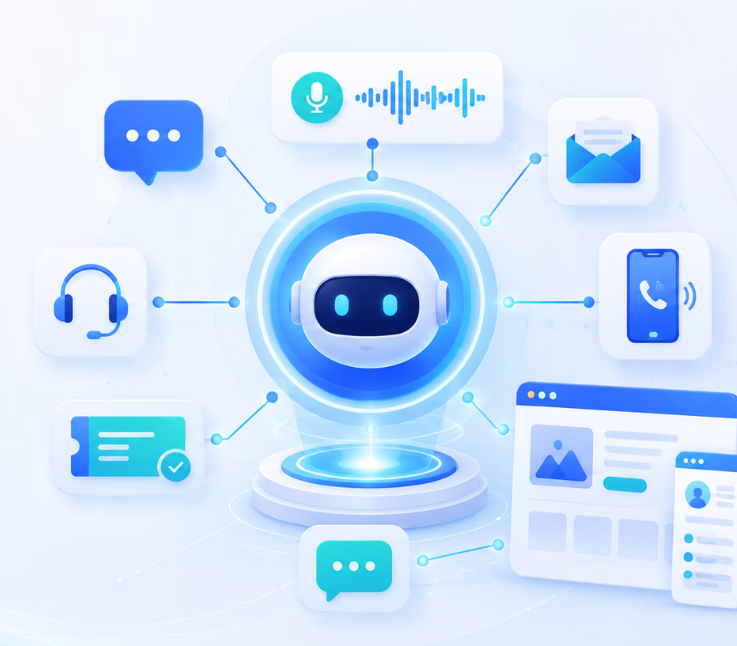
Multimodal CX and AI agents unify conversations across voice, chat, SMS, email, and WhatsApp. They use AI to maintain context, automate workflows, and support fluid human handoff, delivering faster, higher-quality support and reducing operational complexity.
Fragmented customer support erodes loyalty and drives up costs. I have seen teams struggle when customers repeat the same details on different channels, causing frustration, delays, and lost trust.
Enterprise CX leaders and operations managers feel constant pressure to modernize support while juggling rising customer expectations. Channel silos, context loss, and manual handoff hold back even advanced support setups.
This guide explains how multimodal CX and AI agents fix these core issues. You will learn what true multimodality means, how it works in the real world, its direct impact on business results, and practical next steps for your organization.
Why Multimodal CX and AI Agents Matter
Multimodal CX combines all major communication channels—voice, chat, SMS, email, WhatsApp—into a single, AI-managed support environment. This lets customer conversations move fluidly across modalities, with context always preserved.
In business terms, multimodal CX empowers support teams to deliver fast, human-like help, no matter where or how customers reach out. Instead of repeating steps or information, customers are recognized and assisted across every channel in one unified conversation. Operational KPIs like CSAT, NPS, and first contact resolution rise, while costs and escalations drop.
Multimodal CX is more than adding channels—it is about eliminating silos and orchestrating smart, context-rich support journeys that mimic the way people actually communicate.
How Multimodal CX and AI Agents Work
A truly multimodal customer service approach is built on three essentials: all-channel coverage, shared conversation history, and AI-powered understanding that adapts across modalities. In my experience, real operational change comes from unifying these foundations—not just bolting channels together.
Today’s best multimodal AI agents use elements like NLP, speech-to-text, computer vision, and large language models to process each communication type—voice, text, email, image—then link them into one context-aware workflow.
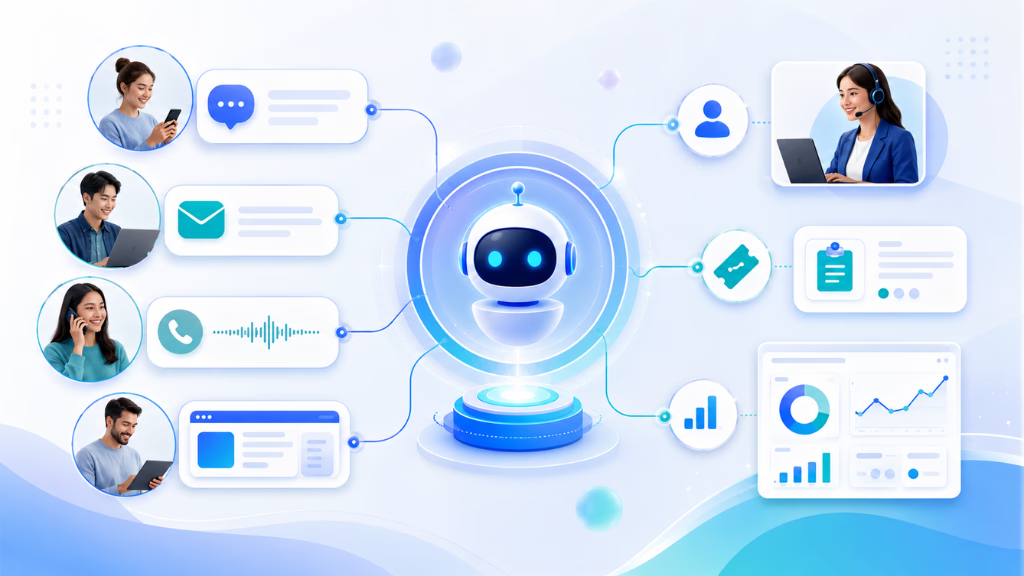
Below, I break down how this works in practice, how it is different from simple omnichannel routing, and how unified context and AI agent orchestration deliver better outcomes.
Multimodal vs. Omnichannel vs. Channel-Switching
- Single-Channel: Only one support mode at a time (e.g., chat-only).
- Omnichannel: Multiple channels, but each often runs on siloed systems. Context often gets lost when switching.
- Channel-Switching: Transfers between channels, but may require restarting the conversation.
- Multimodal: All channels feed into one conversation. The agent—AI or human—sees the whole history, no matter how a customer moves between voice, chat, email, or sends images.
In my POV, only multimodal CX prevents information loss and customer frustration during channel pivots. It’s the difference between “start over” and “let’s pick up where we left off.”
Unified Context: The Heart of Seamless Customer Experience
Unified context means every agent—AI or human—sees the full conversation, including past chats, calls, emails, and content like photos or files. This is where many teams struggle: context rot causes delayed resolutions and makes customers repeat themselves.
With joint context, support can:
- Instantly reference prior interactions.
- Personalize every response with full knowledge.
- Avoid repeated ID checks or data gathering.
The real issue is not just moving data between systems, but stitching it together in a way that’s useful for both the customer and the agent.
AI Agent Orchestration: Managing Conversation Flow Across Channels
Modern AI agents use cross-modal “memory” to manage the entire customer journey, not just single interactions. For example, a customer may start with a text on WhatsApp, then switch to a call, and later send a photo by email—yet the agent maintains continuity.
In my experience, this allows for smoother handoffs, smarter routing, and more accurate resolutions, as every support step is informed by the complete, real-time context.
Human + AI Collaboration in a Multimodal World
No AI can solve every query. That’s why human fallback is still critical. The best multimodal systems make it easy for AI agents to escalate complex cases—passing the entire conversation, across all modalities, to the live agent.
A better approach is context-aware escalation, where the human receives the full context, transcripts, and customer inputs (including voice recordings or image attachments). Teams using Commplify, for example, often see smoother transitions with no loss of info, which is what improved our CSAT scores last quarter.
Visual, Voice, and Text Combinations: Real-World Interaction Examples
- A patient starts booking an appointment by voice, then sends a photo of their insurance card in the chat.
- A retail customer initiates a support chat, switches to a phone call for clarity, and uploads a photo of the damaged product.
- A field technician sends a voice memo and a picture from a remote site in a single support ticket, reducing routing time.
Each journey is now a dynamic blend of channels—always tracked in a unified context thread.
Business Impact of Multimodal CX and AI Agents
Implementing multimodal CX unlocks concrete business benefits that leadership can track and measure. In my experience, the following metrics move the fastest:
- CSAT/NPS: Customers feel recognized and valued, not just processed.
- Average Handle Time (AHT): No more backtracking or repeated info gathering.
- First Contact Resolution (FCR): Agents see the whole picture, leading to quicker solves.
- Self-Service Rate: AI can resolve more complex queries thanks to deeper context access.
- Escalation Reduction: Fewer cases need manager intervention, freeing up senior staff.
| Metric | Traditional CX | Multimodal CX (with AI Agents) |
|---|---|---|
| CSAT/NPS | 7.0 / 50 | 8.8 / 72 |
| AHT | 9 min | 6 min |
| FCR | 60% | 79% |
| Escalation Rate | 25% | 8% |
| Self-Service Rate | 43% | 65% |
Before multimodal CX: Multiple systems, repeated questions, tech silos, higher costs.
After multimodal CX: Single conversation thread, richer self-service, smarter AI/human blend, higher satisfaction.
Real-World Use Cases and Industry Applications
Multimodal CX adapts to many industries. Here, I have seen real results when support teams rethink their approach:
| Industry | Typical Scenario |
|---|---|
| Healthcare | Appointment booking by voice, insurance card photo upload |
| E-commerce | Order return via chat, call, and product image upload |
| Fintech | Compliance query in chat, escalated to secure call |
| Field Services | Voice note plus photo/location sent in support request |
| B2B SaaS | Multi-modal onboarding: chat, calls, document sharing |
Let’s look at a few deep-dives:
- Healthcare: A patient starts an appointment by phone, then texts a photo of an insurance card. All info flows seamlessly to the scheduler.
- Retail: Customer reports a damaged item by chat, switches to a call, sends in a picture, and receives a refund—all tracked as one ticket.
- Fintech: Initiate an account issue in chat, escalate to a voice call for verification, send documents by email—context is retained end-to-end.
- Field Services: Site engineer sends a voice memo and a photo from the job site; dispatcher receives all data in a single workflow for faster dispatch.
Each example reflects practical gains—faster resolution, less customer effort, and lower operational friction.
Implementation Considerations and Challenges
Deploying multimodal CX is not plug-and-play. It requires planning across systems, data, and process. The mistake I see often is treating multimodal as “just another channel” instead of a core strategy.
Key factors to address:
- Legacy integration: Connect multimodal AI to existing CRMs and ticketing tools.
- Unified architecture: You need joint embeddings, a unified conversation inbox, and event-driven workflows.
- Data privacy & security: Voice and image data must meet compliance standards.
- Training data: Train AI agents for intent recognition across all channels, not just text.
- Pitfalls: Watch for partial integrations, lingering channel silos, and context rot as data spreads across too many tools.
Checklists, audits, and regular cross-team drills are a good way to surface these gaps before go-live.
How Platforms Like Commplify Enable Multimodal CX
In my experience, trying to bolt together chat, voice, SMS, email, and WhatsApp without a unified system will amplify context loss and frustration.
Modern AI CX platforms such as Commplify unify these channels into a single conversation timeline. Their AI agents can process, reason, and escalate across touchpoints with built-in workflow automation and real-time AI-to-human handoff. This not only streamlines support but ensures every agent—human or digital—has exactly the right context at every moment.
That means you future-proof your support stack against channel fragmentation and raise customer expectations without raising your operational burden.
Conclusion
Multimodal CX and AI agents are no longer a future promise—they are fast becoming a new standard for quality, efficient, human-centric customer support. When you unify every support channel and empower AI to maintain context, you move from reactive to pro-active service.
Platforms with unified communication and strong AI orchestration, like Commplify, help enterprises cut through operational noise, keep teams focused, and earn genuine customer trust.
The future of CX belongs to organizations that blend the best of human and AI support—where memory, empathy, and speed work together. This is the path to stronger loyalty, reduced workload, and a higher-performing customer-facing operation.
FAQs
What defines a multimodal customer experience?
A multimodal customer experience unifies voice, chat, SMS, email, WhatsApp, and more into a single conversation, allowing fluid, context-rich support across channels.
How do multimodal AI agents differ from traditional chatbots or single-modal systems?
Multimodal AI agents operate across many channels in one conversation thread, preserving context and memory, unlike traditional bots which are stuck in one format or channel.
Why is multimodal CX important for modern enterprises?
It matches how people communicate, reduces customer effort, boosts satisfaction, and supports efficient operations across all preferred channels.
Can AI agents handle voice, chat, SMS, email, and images in one conversation?
Yes, modern multimodal AI agents process and integrate all these modalities into a single unified support flow, keeping context intact.
What’s the difference between multimodal and omnichannel CX?
Omnichannel allows many channels, but often keeps them siloed; multimodal CX unifies all channels and context into one live conversation for continuous support.
How do multimodal AI agents know when to escalate to a human?
When an AI agent detects complex cases or emotional signals beyond its scope, it triggers escalation, delivering the full multi-channel context to a human agent.
What operational KPIs can be improved by adopting multimodal CX?
Most teams see gains in CSAT, NPS, first contact resolution, average handle time, escalation rate, and self-service rates.
Are there unique data privacy or ethical challenges?
Yes, voice and image processing requires compliance with privacy laws and careful data management to protect customer trust.
Which industries stand to benefit most from multimodal AI agents?
All customer-centric sectors see gains, especially healthcare, fintech, retail, B2B SaaS, field services, and BPOs.
How does context get preserved across voice, text, and images?
A unified conversation inbox and AI-powered context threading keep every input tied together, no matter the channel.
What does “downstream data rot” mean, and how do unified platforms prevent it?
Downstream data rot occurs when info fragments across systems; unified platforms prevent it by centralizing all conversation data and context.
How can enterprises get started with multimodal CX adoption?
Begin by auditing current channels, consolidating conversation history, and selecting a platform set up for unified, multimodal orchestration with strong integration and automation.
This page was last edited on 22 June 2026, at 4:25 am