Quick Answer
Real-world AI customer experience examples include Domino’s chatbots for order automation, Netflix’s personalized recommendations, The DermSpecs’ 96% auto-bookings, and unified omnichannel AI support that increases efficiency and boosts satisfaction across all channels.
Support teams are on the front line of rising customer demands—instant, always-on answers, tailored experiences, and true accountability. Meeting these targets puts constant strain on operations, regardless of industry or sector.
In my experience, executives are skeptical about “AI in CX” that offers grand promises but rarely delivers measurable improvements where it counts: response times, retention, and bottom-line efficiency.
This article shares seven actionable, real-world AI customer experience examples—each grounded in realistic metrics and operational stories. You’ll gain both the context and the confidence to plan your next move.
Why Real-World AI Customer Experience Examples Matter
AI-driven solutions have shifted from promise to proven results in customer experience. Companies now rely on AI for tasks like automating support, analyzing customer intent, and optimizing communications across all touchpoints.
In practical terms, seeing how other organizations succeed with AI builds both trust and internal momentum. Real use cases deliver social proof—not just vendor buzzwords. They also clarify what’s possible, help teams avoid classic pitfalls, and highlight measurable gains like higher CSAT, better retention, and greater agent productivity.
The real issue for many CX leaders today is not whether to use AI, but which use cases make a practical, positive difference in daily operations.
Real-World AI Customer Experience Examples in Action
| Company | AI Use Case | Technology | Key Result |
|---|---|---|---|
| Domino’s Pizza | Order automation, live tracking | AI chatbot | Faster responses, higher CSAT |
| Netflix | Personalized content journeys | Machine learning | Increased retention, more usage |
| H&M | Virtual shopping assistant | NLP chat, recommendations | Shorter waits, better conversion |
| The DermSpecs | Healthcare scheduling automation | Conversational AI | 96% auto-bookings, efficiency |
| Volvo | Predictive maintenance | AI analytics, IoT | Lower downtime, loyal customers |
| Butternut Box | Sentiment analysis | AI for feedback scoring | Faster fixes, tailored offers |
| Global BPO | Unified omnichannel support | AI-native CX platform | Higher FCR, efficient workflows |
Domino’s Pizza — Automating Orders with AI Chatbots
Domino’s must handle countless orders and updates each minute, especially during peak hours. High call and chat volume frequently bogs down support teams and frustrates customers. The company deployed AI-powered chatbots that span web, app, and messaging channels. These bots field orders, answer FAQs, and provide live delivery tracking—without waiting for an agent.
Quick Verdict: Automation slashed response times, let staff focus on complex tasks, and drove measurable CSAT gains.
Netflix — Personalizing Customer Journeys at Scale
Netflix faces the challenge of preventing user drop-off in a world of endless viewing choices. Its AI algorithms harness user behavior, history, and feedback to recommend new content uniquely suited to each viewer’s habits. This machine-learning-driven personalization increases engagement and session duration.
Quick Verdict: Custom journeys keep users hooked, grow retention, and directly support the subscription business model.
H&M — Virtual Shopping Assistant for Product Discovery
Shoppers interrupted online or in-store want instant help. H&M bridges this gap using an AI-powered virtual shopping assistant that helps customers discover products, suggests sizes, and shares deals based on shopper behavior. Natural language processing lets the assistant handle varied queries, reducing friction.
Quick Verdict: Wait times and abandonment dropped, conversions rose, and agents spend time on high-value support rather than routine questions.
The DermSpecs — Automated Scheduling in Healthcare
Healthcare clinics often struggle with manual appointment booking and follow-ups, especially during staff shortages. The DermSpecs rolled out conversational AI that triages requests, asks qualifying questions, and auto-books with real-time calendar sync. Almost all incoming bookings complete without agent touch.
Quick Verdict: 96% of appointments auto-booked, freeing staff hours and improving both patient and workforce satisfaction.
Volvo — Predictive Maintenance Using AI Analytics
Volvo wanted to tackle the costly problem of vehicle downtime due to unplanned maintenance. By using predictive analytics on IoT sensor data, Volvo’s AI system now flags likely issues before drivers encounter problems, triggering proactive alerts and service reminders.
Quick Verdict: This shift from reactive to predictive support reduced breakdowns and earned customer loyalty in competitive markets.
Butternut Box — Sentiment Analysis for Customer Feedback
For brands like Butternut Box, pet owners are vocal and passionate. The company used to miss signals in mountains of unstructured feedback, slowing down product and service responses. An AI tool now analyzes every message, tags sentiment, and flags urgent issues or trending topics for teams to address fast.
Quick Verdict: Faster reaction to user issues and richer insights led to better-suited offerings, higher repeat purchase, and sharper marketing.
Global BPO — Unified Omnichannel Support
Global BPO teams face channel silos: voice, chat, SMS, and emails all running on separate platforms. This creates context gaps and inconsistent customer experiences, especially when scaling. By adopting an AI-native omnichannel CX platform, all channels and bots feed into a single inbox—backed by workflow automation and smart routing.
Quick Verdict: Teams resolved more cases on the first contact (higher FCR), achieved better workflow efficiency, and delivered consistent support no matter the channel.
Cross-Channel AI CX: Key Considerations for Success
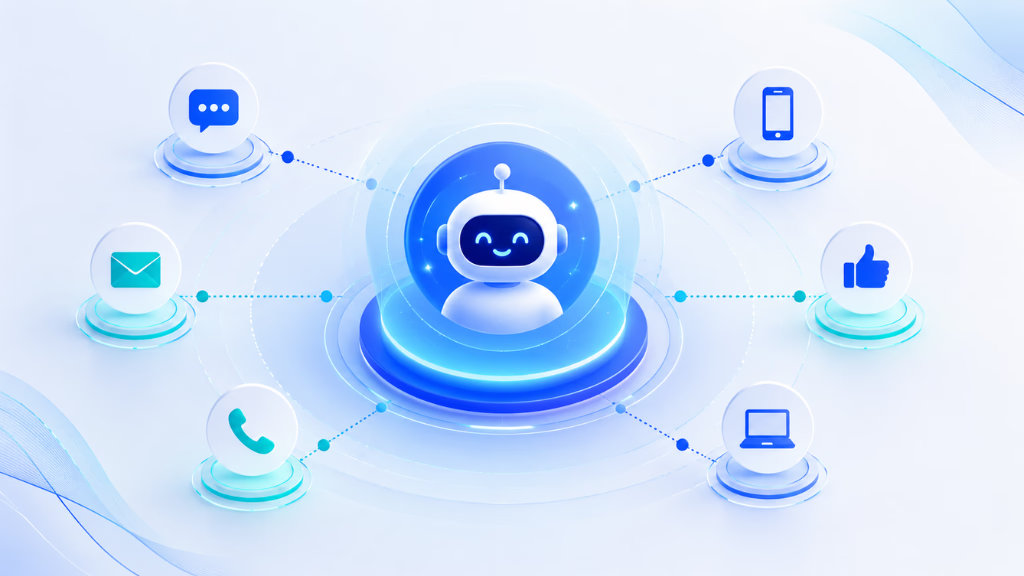
Moving to omnichannel AI support is not just technical. The real complexity lies in unified workflows, integrations, and agent enablement.
- Siloed implementation by channel or department.
- Overlooking backend knowledge management connections.
- Ignoring operational analytics and agent feedback loops.
- Believing AI alone replaces expert agents—it never should.
A better approach anchors around:
- A unified view of the customer and their journey.
- Workflow automation spanning all support channels.
- Empowering agents with AI knowledge at their fingertips.
- Real-time analytics to spot trends and improve continuously.
How Omnichannel AI Platforms Like Commplify Enable Real-World Impact
Based on what I see in practice, true omnichannel AI CX platforms make the difference between disconnected support and a joined-up, modern customer experience.
With Commplify, for example, every conversation—no matter if it starts on phone, WhatsApp, chat, SMS, or email—lands in one coordinated inbox. AI agents handle first-layer requests, route according to context, and trigger automated actions (booking follow-ups, CSAT requests, reminders, and more) across every channel.
When workflow automation is added, follow-ups and escalations become automatic and reliable, while agents get rapid access to the right context and knowledge.
From an operational POV, this unified approach:
- Removes silos between departments.
- Cuts handover errors and delay.
- Lets teams track, analyze, and optimize every interaction in a single dashboard.
The CX impact is tangible: higher first-contact resolution, faster responses, and better resource allocation.
Conclusion
Measurable, real-world AI customer experience examples prove that AI is no longer just a tech trend—it is table stakes for delivering modern support.
Companies big and small are moving from theory to practice with AI, driving up CSAT, streamlining requests, and empowering support teams. The best results come when AI-powered automation and unified omnichannel communication go together, often in platforms like Commplify that natively combine both.
In my experience, the faster your team pilots—even a single, well-chosen AI use case—the sooner you see operational gains. The real risk now is sitting still as peers transform support from the ground up.
AI-driven CX will keep evolving, but the core lesson stands: success belongs to teams who act, measure, and refine using real-world models—not vendor hype.
FAQs
What are some real-world examples of AI in customer experience?
AI is used for chatbots in ordering (Domino’s), personalized recommendations (Netflix), automated healthcare scheduling (The DermSpecs), sentiment analysis (Butternut Box), and unified omnichannel support in BPOs.
How do leading companies use AI to enhance support operations?
They deploy AI for automation, personalization, predictive service, knowledge-driven responses, and routing—improving speed, accuracy, and satisfaction across channels.
What impact does AI have on customer satisfaction and retention?
AI reduces wait times, personalizes services, and pre-empts problems, directly boosting CSAT and retention by making support more responsive and consistent.
How can businesses implement AI for omnichannel CX?
By adopting platforms that unify voice, chat, SMS, email, and messaging into one system, and deploying AI agents to automate and route tasks across all channels.
What are best practices for launching AI in customer support?
Start small, choose high-impact use cases, secure organizational buy-in, integrate with existing systems, track metrics closely, and keep human agents in the loop for escalation.
This page was last edited on 23 June 2026, at 4:33 am