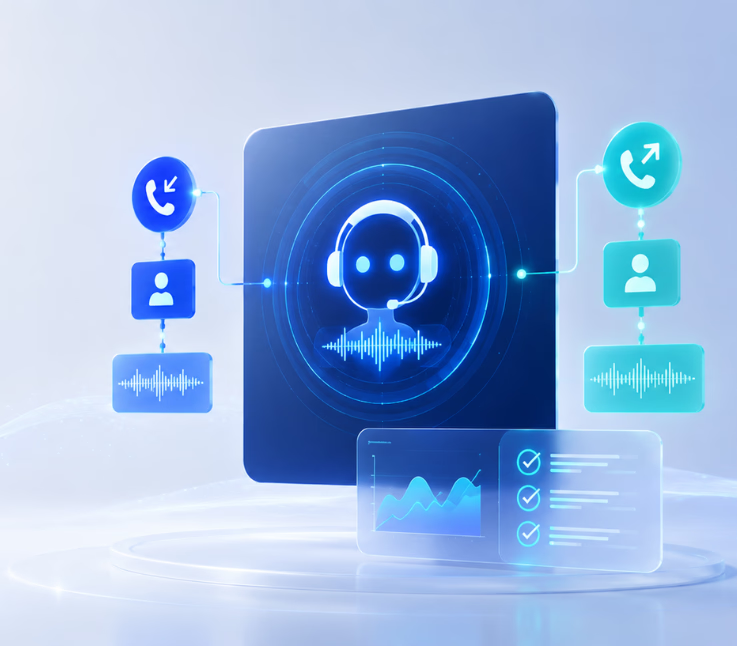
AI voice agent testing tools simulate inbound and outbound calls, validate agent logic, and automate cross-channel workflows. They let teams catch issues, ensure compliance, and improve customer experiences before deploying AI voice in the real world.
AI voice agents are reshaping contact centers, but launching them without thorough testing is risky. In my experience, even the best bot can struggle if not validated across real customer scenarios.
Business leaders now face the dual challenge: supporting both inbound queries and outbound campaigns using AI. Each has different flows, risks, and compliance demands.
This guide shares practical strategies to test AI voice agents for inbound and outbound calls. You’ll find out why proper simulation matters, essential features, best practices, pitfalls to avoid, and real ways to boost CX and ROI—before you risk your brand on customers.
Best AI Voice Agent Testing Tools for Inbound and Outbound Call Flows
AI voice agent testing requires more than making a few sample calls and checking whether the voice sounds natural. A production-ready agent must understand different accents, manage interruptions, follow business rules, trigger the correct tools, protect sensitive information, and transfer calls without losing context.
The tools below support different parts of that process. Some are dedicated voice AI testing platforms built for simulations and regression testing. Others combine agent development, call management, monitoring, and quality assurance in one environment.
Quick Comparison of AI Voice Agent Testing Tools
| Tool | Best for | Testing approach | Standout capability |
|---|---|---|---|
| Commplify | Omnichannel call-flow QA and enterprise CX operations | Rubric-based QA, workflow validation, risk detection and performance analysis | Connects voice QA with routing, sentiment, automation and human handoff |
| Hamming AI | Large-scale automated voice-agent testing | Simulated calls, regression tests, load testing and production monitoring | Tests interruptions, noise, accents, latency and adversarial behavior |
| Cekura | Automated simulations and workflow debugging | Voice, WebRTC and text-based simulations | Tool mocking, automated outbound tests and production-call analysis |
| Retell AI | Teams building and testing agents on one platform | Playground, LLM simulations and real phone-call testing | Native testing for inbound and outbound Retell agents |
| Vapi | Developer-led voice-agent development | Test suites, AI callers and voice simulations | Real phone-call testing with scripts and evaluation rubrics |
| Coval | Deployment readiness and continuous evaluation | Simulation, production evaluations and human QA | Tests policies, tool use, escalation and complex caller behavior |
| LangWatch | Open-source and customizable testing workflows | Simulations, evaluations, observability and CI testing | Flexible testing for voice, chat and real-time agents |
1. Commplify: Best for Unified Voice QA and Call-Flow Optimization
Commplify takes the number-one position for organizations that want to connect voice-agent testing with the wider customer experience operation. Instead of treating QA as an isolated technical activity, the platform combines interaction analysis, workflow orchestration, sentiment detection, intelligent routing and human support.
Its Co-QA module evaluates calls, chats and emails using defined scoring rubrics. Teams can use it to identify compliance risks, inconsistent responses, missed customer intents and interactions that require coaching or workflow changes. Co-Build supports routing, integrations and post-interaction automation, while Co-Emotion helps detect customer sentiment and prioritize urgent conversations.
This combined approach is particularly useful when testing complete inbound and outbound call journeys rather than only checking the agent’s spoken responses.
Testing inbound call flows with Commplify
For inbound customer service, technical support or order-status calls, teams can examine whether the AI agent:
- Identifies the caller’s intent correctly
- Retrieves the right customer or account information
- Provides an accurate and relevant response
- Routes the conversation to the appropriate workflow
- Escalates complex cases to a human agent
- Preserves context during the handoff
- Records the outcome in connected business systems
Commplify’s orchestration layer unifies calls, chats and emails while providing real-time intent detection, contextual routing and human fallback. It can also connect with platforms such as Salesforce, Zendesk, HubSpot, Slack, Microsoft Teams, Zapier and Intercom.
Testing outbound call flows with Commplify
Outbound workflows often involve lead qualification, appointment booking, customer follow-up or service notifications. These calls need to be tested for more than script accuracy. The agent must verify the person it has reached, explain the purpose of the call, handle objections, record the correct outcome and stop or escalate when required.
Commplify can help teams evaluate whether these conversations follow the intended workflow and whether the interaction produces the correct operational result. Its public platform capabilities include lead qualification, appointment booking, sentiment and intent detection, AI-to-human handoff, workflow automation and QA scoring across customer interactions.
Why Commplify stands out
Commplify is especially valuable for enterprises, BPOs and customer experience teams that need one system for:
- Call-quality evaluation
- Omnichannel customer journeys
- AI and human-agent performance
- Sentiment and intent analysis
- Workflow automation
- Context-aware escalation
- CRM and help-desk integration
- On-premise or hybrid-cloud deployment
Based on its current public positioning, Commplify is more focused on operational QA, orchestration and CX optimization than on generating thousands of synthetic caller simulations. A company that requires intensive pre-launch stress testing may therefore use Commplify alongside a specialized simulation platform.
Best suited for: Enterprises and contact centers that want to test, monitor and improve voice interactions as part of a complete omnichannel customer experience.
2. Hamming AI: Best for High-Volume Automated Voice Testing
Hamming AI is a dedicated voice and conversational-agent QA platform. It allows teams to connect an agent, generate test scenarios, run simulated calls and monitor performance after deployment.
The platform can test realistic caller behavior, including interruptions, long silences, fast or slow speech, background noise and emotional conversations. It also evaluates conversational metrics such as turn-taking latency, time to first word, interruptions and talk-to-listen ratio.
One of Hamming’s strongest features is production-call replay. When a real customer call fails, the interaction can be converted into a regression test so the team can check whether a prompt, model or workflow update actually fixes the problem.
Hamming also supports security red-teaming, compliance validation, CI/CD integration and large-scale load testing across inbound, outbound and WebRTC paths. According to its documentation, enterprise tests can reach more than 50,000 concurrent calls, depending on the connected platform and test configuration.
Best suited for: Voice AI engineering and QA teams that need large-scale simulations, regression testing, security checks and continuous production monitoring.
3. Cekura: Best for Testing Complex Workflows and Tool Calls
Cekura is designed for automated QA across voice and chat agents. It integrates with voice platforms such as Retell and can simulate conversations, analyze call performance and evaluate whether the agent follows the expected workflow.
Its testing capabilities include prompt synchronization, function and tool mocking, automatic production-call retrieval, automated outbound calls, audio review and detailed evaluation metrics. Tool mocking is particularly useful when a team wants to test appointment booking, payment, CRM updates or account lookups without triggering real production actions.
Cekura also supports text-based testing for voice-agent workflows. This allows teams to validate conversation logic more quickly before running slower and more expensive end-to-end voice tests. Voice or WebRTC testing can then be used for final checks involving audio quality, speech recognition and telephony behavior.
Best suited for: Teams that need automated workflow testing, function-call validation, integration debugging and repeated outbound-call simulations.
4. Retell AI: Best Native Testing Suite for Retell Voice Agents
Retell AI combines agent building, testing, deployment and monitoring in the same platform. It supports inbound and outbound calls and offers several testing methods for different development stages.
The LLM Playground is useful for quickly checking prompts, variables and function calls. LLM Simulation Testing allows teams to create caller personas, define goals, run repeatable conversations and evaluate the results against specified metrics.
For final validation, Retell offers web and phone-call testing. These tests help teams examine voice quality, latency, interruptions, background noise, DTMF input and telephony performance under more realistic conditions.
Retell also includes call-flow controls, real-time function calling, call transfers, batch calling, post-call analysis and continuous QA. That makes it a practical option for teams that do not want to connect a separate testing product to their voice platform.
Best suited for: Businesses already using Retell that want native simulations, phone testing, analytics and production monitoring without adding another vendor.
5. Vapi: Best for Developer-Controlled Voice Test Suites
Vapi is a developer-focused platform for building, testing and deploying voice agents. Its test suites use an AI testing agent that interacts with the target voice agent according to a predefined script.
During a voice test, the agents conduct a real phone conversation. Vapi records and transcribes the call, then evaluates it against a rubric defined by the development or QA team. This provides end-to-end validation of the telephony connection, voice pipeline and conversation logic.
Vapi’s simulation framework also lets teams create different caller personalities, scenarios and structured evaluation criteria. Tests can run in voice mode for realistic end-to-end validation or in chat mode for faster development iterations. It can also test transitions and handoffs between agents in a multi-agent squad.
Best suited for: Engineering teams that need API-level control over their agents, test scenarios, evaluation criteria and deployment infrastructure.
6. Coval: Best for Deployment Readiness and Continuous Evaluation
Coval focuses on proving whether a voice agent is ready for real customers. It combines pre-launch simulation, production evaluations and human QA in a continuous improvement loop.
Teams can simulate difficult caller situations involving noisy audio, missing information, interruptions, policy restrictions and failed tool calls. Coval can also evaluate live production conversations and route high-risk or low-confidence calls to human reviewers.
Its agent connections support both inbound and outbound voice configurations. Test workflows can reference agent-specific attributes, knowledge-base content and visual conversation flows, helping evaluators check whether the agent gave an accurate answer and followed the correct business process.
Coval is a strong choice for regulated or high-risk use cases because it emphasizes policy compliance, identity verification, correct escalation, hallucination detection and task completion.
Best suited for: Enterprises that need measurable deployment readiness, human-reviewed QA and consistent testing across multiple voice AI vendors.
7. LangWatch: Best Open-Source Option for Custom Testing
LangWatch provides an open-source testing and evaluation environment for voice, chat and other AI agents. It connects pre-launch simulations with evaluations, production monitoring and observability.
Its Scenario framework can simulate a user speaking directly with a real-time voice agent. A separate evaluator then judges the completed conversation against the team’s requirements. These tests can run without manual microphones or speakers and can be added to continuous integration workflows.
Because LangWatch is customizable and can be self-hosted, it is a useful option for technical teams that want more control over test data, scoring logic, deployment and integration with an existing AI observability stack.
Best suited for: Developers looking for an open-source, customizable testing framework that can support automated simulations and CI-based regression testing.
What Should an AI Voice Agent Testing Tool Evaluate?
Regardless of which platform you choose, the testing process should cover the complete call journey.
Conversation accuracy
The agent should understand the caller’s intent, maintain context and provide information that matches approved company policies and knowledge sources.
Call-flow completion
A test should confirm that the agent reaches the correct operational result. For example, an appointment should appear in the calendar, a support ticket should be created, or a qualified lead should be recorded in the CRM.
Voice and turn-taking quality
Teams should measure response latency, interruptions, overlapping speech, silence handling, pronunciation, voice consistency and the agent’s ability to recover after misunderstanding the caller.
Tool and integration reliability
Every API request, database lookup, CRM update, payment action, scheduling function and webhook should be tested with both valid and invalid data.
Inbound routing
Inbound tests should cover new and returning callers, unknown intents, after-hours requests, language selection, department routing and transfers to human agents.
Outbound call outcomes
Outbound tests should include answered calls, voicemail, no answer, wrong numbers, objections, opt-out requests, rescheduling and follow-up actions.
Human handoff
A reliable agent must recognize when it cannot resolve the issue. Testing should confirm that it transfers the interaction to the correct person, shares the conversation context and prevents the customer from repeating everything.
Compliance and privacy
The agent should follow consent requirements, avoid exposing sensitive data and apply industry-specific rules consistently. These tests are especially important in healthcare, financial services, insurance and other regulated environments.
How to Choose the Right Voice Agent Testing Platform
Choose the tool according to where testing fits into your operating model.
Select Commplify when your priority is connecting voice QA with customer experience orchestration, omnichannel interactions, sentiment, routing, automation and human-agent performance.
Choose Hamming AI, Cekura or Coval when you need a specialized testing layer that can simulate large numbers of difficult conversations before launch.
Consider Retell AI or Vapi when you prefer to build, test and deploy the voice agent within the same technical platform.
Use LangWatch when open-source flexibility, self-hosting or deeply customized evaluation workflows are central requirements.
The most reliable approach is to combine fast text-based workflow tests, realistic voice simulations, controlled pilot calls and continuous production QA. Testing should not end when the agent goes live. Every failed or unusual production call should become a new regression case for the next release.
Conclusion
AI voice agent testing tools for inbound and outbound call flows are now business critical. Brands that get testing right avoid costly mistakes, build trust, and deliver better customer outcomes.
The key is to invest in tools that handle real-world scenario simulation, workflow automation, analytics, and tight compliance—all in one place. I have found that platforms like Commplify, with their real-time test consoles and no-code builders, make the testing journey thorough and fast.
CX leaders who make this a part of their process earn customer trust, compliance peace of mind, and agility to improve rapidly. As AI becomes a central pillar of customer communication, expect testing and QA to become the foundation of every successful deployment.
FAQs
What is an AI voice agent testing tool?
An AI voice agent testing tool simulates telephone conversations, validates call flows, checks agent logic, and helps ensure AI performance before deployment.
How do inbound and outbound AI call flow tests differ?
Inbound tests focus on handling customer-initiated calls, FAQs, and escalations. Outbound tests require opt-out management, compliance checks, and intent tracking for agent-initiated outreach.
Why is testing AI voice agents before launch critical?
Testing prevents logic errors, compliance violations, missed leads, and customer frustration by revealing issues before the agent is used in real-world scenarios.
What features matter most in a voice agent testing platform?
Essential features include real-time simulation, scenario builder, analytics, omnichannel support, compliance tools, and workflow automation.
How can I simulate real customer calls and conversation paths?
Use a live test console to walk through typical and edge-case conversations, reviewing transcripts and agent decisions within the platform.
What are best practices for ensuring compliance in AI voice agent testing?
Simulate DNC lookups, test consent flows, check time-based restrictions, and log all opt-out actions during testing.
How do I monitor and optimize agent performance during testing?
Review analytics dashboards for drop-offs, escalating calls, compliance events, and scenario pass/fail outcomes to improve agent logic.
Which tools offer live scenario simulation for both inbound/outbound flows?
Platforms with real-time test consoles support live inbound and outbound flow simulation, offering analytics and workflow automation features.
How do I automate regression and scenario testing for voice AI?
Use automated QA features to re-test all conversation scenarios whenever flows are updated, spotting errors before go-live.
Can workflow automation platforms help test cross-channel follow-ups and escalations?
Yes. Workflow automation platforms can simulate triggers and actions across voice, SMS, email, and chat—ensuring the full customer journey works as intended.
This page was last edited on 7 August 2026, at 8:10 am