Top options include Commplify, Synthflow AI, and Smith.ai. Key lead qualification features to look for are intent recognition, dynamic questions, real-time lead scoring, warm transfers, appointment booking, CRM sync, and 24/7 availability.
A prospect calls your business at 8:30 PM.
They have a real problem, a budget, and a plan to buy soon. But no one picks up.
The next morning, your sales team sees the missed call. They call back. No answer.
That lead may already be speaking with a competitor.
This happens more often than teams want to admit. Sales reps are busy. Support teams are overloaded. After-hours calls go unanswered. And even when someone responds, valuable leads can still get stuck in slow follow-ups, generic scripts, or poor routing.
The bigger problem is not just answering faster. It is knowing who is worth prioritizing and what should happen next.
That is where an AI virtual receptionist can change the process.
In this guide, you can explore AI virtual receptionist with top lead qualification features, how AI qualifies prospects, which platforms stand out, and how to choose a solution that helps turn more conversations into real sales opportunities.
What Is an AI Virtual Receptionist?
An AI virtual receptionist is a 24/7 conversational AI system that answers customer and prospect inquiries, understands intent, asks relevant questions, and completes tasks such as lead qualification, appointment booking, call routing, and CRM updates. It uses NLP, NLU, Speech-to-Text (STT), Text-to-Speech (TTS), Large Language Models (LLMs), and intent recognition to handle natural conversations in real time.
Unlike traditional IVR systems, which rely on fixed menus, an AI virtual receptionist can understand free-form speech and respond dynamically.
For lead qualification, it can:
- capture structured lead information,
- ask dynamic qualification questions,
- apply BANT, CHAMP, or MEDDPICC logic,
- perform real-time lead scoring,
- detect high-intent prospects,
- book meetings or trigger warm transfers, and
- sync transcripts, summaries, and lead data with a CRM.
10 Top Lead Qualification Features an AI Virtual Receptionist Should Have
An AI virtual receptionist with top lead qualification features should do more than answer calls.
It should understand the caller. It should collect the right information. It should identify buying intent. It should also move qualified leads to the right next step.
The best systems combine conversational AI, NLP, NLU, large language models (LLMs), STT, TTS, lead scoring, CRM integration, and workflow automation.
Here are the 10 features that matter most.
1. Intent Recognition That Understands Why the Lead Is Calling
Lead qualification starts with understanding the purpose of the conversation.
A good AI receptionist uses intent recognition, natural language processing (NLP), and natural language understanding (NLU) to identify what the caller wants. It should distinguish a sales inquiry from support, billing, partnership, or general questions.
For example, a caller may say:
“We have 80 support agents and want to automate our customer calls.”
The AI should recognize this as a potential sales opportunity. It can then start the appropriate qualification flow instead of treating it like a general inquiry.
This intent identification and triage also helps detect urgency. High-intent signals such as “I need pricing,” “we want to implement this month,” or “can I book a demo?” can receive higher priority.
Effective intent recognition enables faster call triage, lead pre-sorting, and high-value deal prioritization.
2. Dynamic Qualification Questions Instead of Fixed Scripts
A prospect should not feel like they are completing a form over the phone.
An effective automated lead intake voice agent uses dynamic questioning. The next question depends on what the prospect has already said.
Suppose a caller says:
“We’re replacing our current call center platform within three months.”
The AI already knows there is an existing solution and a clear timeline. It should not ask those questions again.
Instead, it may ask:
“What is the main reason you’re looking to replace your current platform?”
This is known as call-flow branching. It creates dynamic conversation paths based on the prospect’s answers.
Modern systems can also use multi-turn LLM context retention. This helps the AI remember information shared earlier in the conversation.
The result is a shorter and more natural qualification experience.
3. Custom BANT, CHAMP, or MEDDPICC Qualification Logic
Every company has a different definition of a qualified lead.
Your AI receptionist should allow you to build qualification rules around your own sales process.
A common option is the BANT framework:
- Budget: Can the prospect afford the solution?
- Authority: Are they involved in the buying decision?
- Need: Does your solution solve a real problem for them?
- Timeline: When do they plan to buy or implement?
Teams with more complex sales cycles may use CHAMP or MEDDPICC qualification standards.
The AI should not simply ask every framework question in order. It should identify information the prospect has already provided and focus on missing details.
You should also be able to define disqualification criteria and gatekeeping rules.
For example, a company may automatically deprioritize leads that fall below its minimum company size or need a service it does not provide.
This prevents SDRs from spending valuable time on poor-fit opportunities.
4. Real-Time Lead Scoring and High-Intent Detection
Not every inbound lead deserves the same level of attention.
A virtual voice receptionist for lead scoring can evaluate information while the conversation is happening. It can then calculate a score or assign a category.
For example, you could use a 0–100 real-time lead scoring model based on:
- ICP fit,
- company size,
- business need,
- purchasing authority,
- budget,
- urgency,
- implementation timeline, and
- engagement level.
A prospect with a strong ICP match, urgent need, and short buying timeline might score 85/100.
Another caller who is only researching options could score 30/100.
The system can then classify leads as high, medium, or low priority.
High-intent signal detection also helps recognize buying language such as “send me pricing,” “we need this immediately,” or “I’d like to speak with sales.”
This gives sales teams a practical way to prioritize the best opportunities first.
5. Intent-Based Routing and Live Warm Transfers
Finding a high-value prospect is useful only if the system knows what to do next. An AI receptionist should support intent-based call routing, call triage, escalation protocols, and live agent warm transfers.
For example, imagine the AI qualifies a prospect with:
- 500 employees,
- an approved budget,
- an urgent implementation timeline, and
- a request for an enterprise demo.
Instead of placing that prospect into a general callback queue, the AI can immediately transfer the call to an enterprise sales rep.
A proper warm transfer should also provide context.
The salesperson should know who is calling, why they called, what they need, and what qualification information has already been collected.
This improves the real-time CRM handoff and prevents customers from repeating themselves.
If a salesperson is unavailable, the AI can trigger automated callback scheduling or appointment booking instead.
6. Instant Appointment Booking and Calendar Sync
Qualified prospects should not have to wait for an email just to arrange a meeting.
A strong AI receptionist can check availability and book the next step during the conversation.
With calendar sync and appointment booking integrations such as Google Calendar or Calendly, the AI can offer available times in real time.
For example:
“I can schedule a demo for Tuesday at 2 PM or Wednesday at 11 AM. Which works better?”
Once the prospect selects a time, the appointment can be created automatically.
This removes unnecessary back-and-forth and shortens the speed-to-lead response window.
It can also reduce drop-off between qualification and the sales meeting.
7. Bidirectional CRM Sync
Lead qualification data loses value when it stays inside the AI calling platform. Your receptionist should connect directly with systems such as Salesforce, HubSpot, or Zoho through bidirectional CRM sync.
Bidirectional means the AI can both read and update information. Before a conversation, it might retrieve:
- contact details,
- previous interactions,
- account status,
- lead owner, and
- existing opportunity data.
After the conversation, it can update:
- qualification status,
- lead score,
- business needs,
- timeline,
- appointment details,
- call outcome, and
- next action.
This creates a more complete customer record and supports structured intake and field extraction.
Custom APIs, webhooks, Zapier, or Make integrations can also connect the qualification workflow with other business systems.
8. Automated Transcripts, Summaries, and Structured Lead Records
Sales reps should not need to listen to every recording or read an entire transcript to understand a lead. The AI receptionist should provide automated call transcription and AI summarization after each conversation.
It should also convert important details into structured CRM fields. For example:
- Lead intent: Enterprise demo
- Company size: 250 employees
- Current system: Legacy IVR
- Pain point: High call volume
- Timeline: Within 60 days
- Lead score: 82/100
- Next step: Demo booked
This type of structured contact and intake capture makes the information easier for SDRs to use. Transcripts can still support quality assurance and compliance. Summaries make quick follow-up easier.
These records can also support pipeline analytics and call sentiment analysis across a larger volume of conversations.
9. Low-Latency, Natural Conversations
Qualification fails quickly when an AI receptionist feels slow or robotic. A caller should not need to wait several seconds after every sentence.
Effective systems use real-time Speech-to-Text (STT) to understand speech and Text-to-Speech (TTS) to respond naturally. NLP, NLU, and LLMs help interpret what the caller means.
The entire process needs strong real-time response processing and low latency.
The receptionist should also handle normal conversational variation. This includes:
- interruptions,
- pauses,
- corrections,
- incomplete sentences,
- unexpected responses, and
- changes of topic.
This conversational variance handling is one reason AI receptionists can provide a more natural experience than a legacy Interactive Voice Response (IVR) menu.
Low response latency can also support better speed-to-lead because prospects receive useful answers without unnecessary waiting.
10. 24/7 Concurrent Lead Handling
Leads do not always call during business hours. An effective AI phone receptionist for lead qualification should provide 24/7 availability and after-hours coverage.
That means a prospect who calls at 10 PM can still ask questions, complete qualification, and book a meeting. But availability alone is not enough.
The platform should also provide enough concurrent call capacity to handle several inbound conversations at the same time.
This becomes important during:
- campaign launches,
- seasonal demand,
- sudden traffic spikes,
- after-hours periods, and
- high-volume contact center operations.
Instead of creating long hold queues, AI can qualify multiple prospects simultaneously.
For sales teams, this improves lead capture efficiency and reduces missed opportunities. It can also automate repetitive SDR work and support cost-per-lead optimization.
The goal is not to remove humans from the sales process. It is to let AI handle first-stage qualification at scale, while sales reps focus on the leads that need human expertise.
How Does an AI Virtual Receptionist Qualify Leads?
An AI virtual receptionist with top lead qualification features follows a step-by-step process.
It does not just answer the call.
It listens to the prospect. It understands the reason for the inquiry. It asks the right questions. It captures useful details. It scores the lead. Then it moves the prospect to the right next step.
Here is how the process works.
1. Capture the Incoming Lead
The process starts when a prospect contacts your business. This may happen through an inbound voice call, web live chat, SMS, WhatsApp, or social media message.
For voice calls, the AI uses Speech-to-Text (STT) to convert spoken words into text. It can then capture important contact details. This may include:
- name,
- phone number,
- email,
- company name,
- job role,
- company size,
- and reason for contacting you.
This is known as structured contact and intake capture. The AI can also identify whether the person is a new lead or an existing contact. If the system is connected to your CRM, it may recognize the caller before qualification begins.
This helps reduce repeated questions. It also supports faster lead handling. For businesses that receive calls after office hours, 24/7 availability is useful. The AI can capture and qualify prospects even when the sales team is offline.
2. Identify the Lead’s Intent
The next step is to understand why the prospect is contacting you. This is important because not every caller should follow the same conversation path.
The AI uses natural language processing (NLP) and natural language understanding (NLU). It also uses intent recognition and intent identification.
For example, a prospect may say:
“I want to know your enterprise pricing.”
The AI should recognize this as a sales-related inquiry.
Another caller may say:
“I need help with an existing account.”
That should be treated as a support request. The AI can also perform urgency and intent triage. It looks for signals that show how serious or urgent the opportunity is.
For example:
“We need to implement this within 30 days.”
This is a strong buying signal. The system can use these signals to decide which qualification path should begin.
3. Ask Dynamic Qualification Questions
Once the intent is clear, the AI starts asking qualification questions. A good system does not follow a rigid script. It uses dynamic questioning and call-flow branching.
This means the next question changes based on the prospect’s answer.
For example:
“How many agents are on your support team?”
The prospect says:
“Around 150.”
The AI may then ask:
“Are you looking to automate all inbound calls or only specific call types?”
This creates a more natural conversation. It also prevents the AI from asking unnecessary questions. The system can use multi-turn LLM context retention to remember what the prospect has already shared.
It can also apply qualification frameworks such as:
- BANT
- CHAMP
- MEDDPICC
For example, BANT looks at Budget, Authority, Need, and Timeline. The AI can use these criteria to understand whether the lead is a good fit.
4. Extract Structured Lead Data
The AI now turns the conversation into structured information. This step is important because sales teams need clear data, not just a recording. Suppose a prospect says:
“We have 120 agents. We are using an old IVR system. We want to replace it before December.”
The AI can extract:
Team size: 120
Current system: Legacy IVR
Need: AI call automation
Timeline: Before December
This process is called structured intake and field extraction. It helps convert an unstructured conversation into CRM-ready data. The system may also generate an automated call transcript.
It can then create an AI summary. This gives sales reps a quick overview of the conversation. It also saves time during follow-up.
5. Score and Categorize the Lead
After collecting enough information, the AI evaluates the lead. This is where real-time lead scoring comes in. The system may use a 0–100 scoring model.
It can look at factors such as:
- ICP fit,
- company size,
- budget,
- authority,
- business need,
- buying timeline,
- urgency,
- and engagement level.
For example, a lead may have a clear need and a short timeline. The person may also have decision-making authority. That prospect may receive a high score. Another caller may only be doing general research. That lead may receive a low score.
The AI can then place the lead into a category.
For example:
- high priority,
- medium priority,
- low priority,
- or disqualified.
The system can also apply disqualification criteria and gatekeeping rules. This helps filter out poor-fit inquiries. It also supports better lead pre-sorting and pipeline staging.
6. Trigger the Right Next Action
Once the lead is scored, the AI decides what should happen next. A high-intent lead may be transferred directly to a salesperson. This is called a live agent warm transfer. The AI can also use intent-based call routing. This helps send the prospect to the right team.
For example, an enterprise lead can go to enterprise sales. A smaller lead can go to an SMB sales queue. The AI can also book a meeting immediately. It can connect with Google Calendar or Calendly.
This enables instant appointment booking and calendar sync. If no salesperson is available, the system can schedule a callback. It may also send follow-up information through SMS or email.
This helps improve the speed-to-lead response window. It also reduces unnecessary delays.
7. Sync Everything With the CRM
The final step is to update the CRM. A strong system supports bidirectional CRM sync. This means it can read existing data and also write new information.
The AI may connect with:
- Salesforce,
- HubSpot,
- Zoho.
After the conversation, it can update:
- contact details,
- lead score,
- qualification status,
- business need,
- budget information,
- timeline,
- appointment details,
- transcript,
- summary,
- and next action.
This creates a complete real-time CRM handoff. The salesperson can see what happened before the next conversation starts. The AI can also trigger extra workflows through APIs, webhooks, Zapier, or Make.
For example, a high-score lead may automatically enter a priority pipeline stage. A medium-score lead may enter an email nurture sequence. A disqualified lead may be removed from the SDR queue.
In simple terms, the full qualification flow looks like this:
Capture → Understand intent → Ask questions → Extract data → Score → Route → Sync
Top 5 AI Virtual Receptionist Platforms for Lead Qualification
The best AI virtual receptionist with top lead qualification features should do more than answer inbound calls. It should capture lead information, understand intent, ask useful questions, and route qualified prospects to the right next step.
Each platform takes a different approach. Some focus on omnichannel lead qualification. Others are designed mainly for voice automation. Some are better for smaller businesses. Others are built for enterprise contact centers.
Here are five platforms worth considering.
1. Commplify: Omnichannel AI Lead Qualification
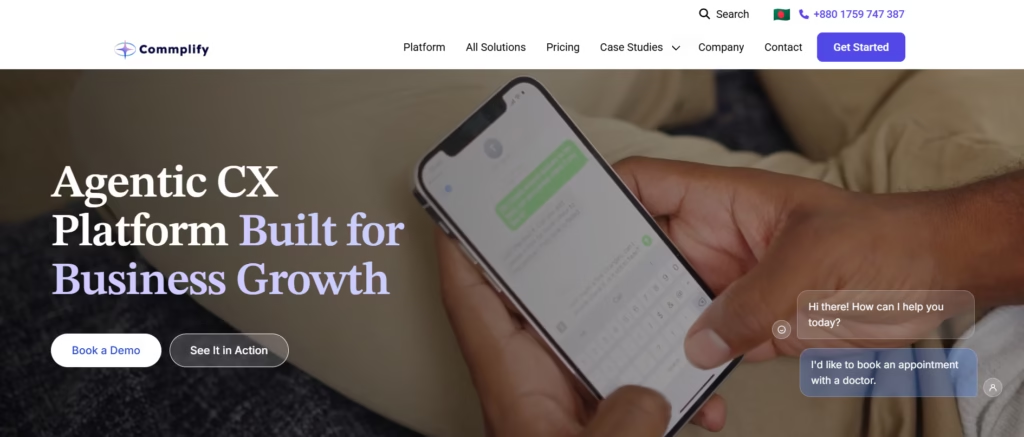
Commplify is an omnichannel AI CX platform. It combines AI voice, chat, messaging, email, workflow automation, and human handoff in one environment.
For lead qualification, Commplify can identify customer intent and capture structured lead information. It can support lead pre-sorting, qualification workflows, and sales routing. It can also connect customer conversations across multiple channels. This is useful when a prospect starts on voice and continues the conversation through chat or messaging.
The platform is a good fit for businesses that want lead qualification to be part of a wider customer journey. It is also relevant for enterprises, BPOs, contact centers, and CX teams.
Key Features
- Omnichannel AI for voice, chat, and messaging
- Intent detection and lead qualification
- Structured contact and intake capture
- AI-generated conversation summaries
- CRM synchronization
- Human handoff with conversation context
- Sentiment and conversation insights
- Workflow automation
- API and integration support
- 24/7 AI availability
- Real-time analytics
Pricing
Commplify uses usage-based and resolution-based pricing. Resolution pricing starts from $0.30 per successful resolution. Chat conversations start from $0.05 per conversation. AI voice starts from $0.10 per minute for web calls. Inbound U.S. voice starts from $0.12 per minute. Enterprise plans use custom pricing.
2. Synthflow AI: AI Voice Receptionist with Workflow Automation
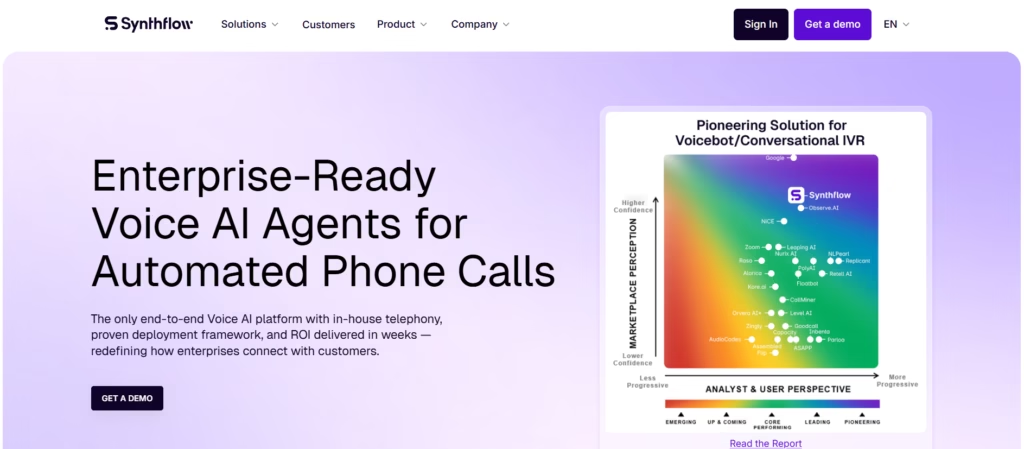
Synthflow AI is a voice AI platform for automated inbound and outbound calls. It allows businesses to create AI voice agents that can answer calls, qualify prospects, route conversations, and trigger workflow actions.
Its main strength is configurable voice automation. Businesses can build different call paths based on customer responses. This supports dynamic qualification questions, call-flow branching, appointment booking, and human escalation.
Synthflow is well suited for voice-heavy sales teams, BPOs, and contact centers. It is especially useful when the qualification process depends on structured call flows and workflow automation.
Key Features
- Inbound and outbound AI voice agents
- Conversational AI call handling
- Dynamic call flows
- Lead qualification workflows
- Human call transfer
- Appointment booking
- CRM integrations
- Calendar integrations
- Webhooks and APIs
- Telephony integrations
- Call analytics
- Concurrency support
Pricing
Synthflow currently uses sales-led pricing for new enterprise deployments. Enterprise contracts start at around $30,000 per year. Final pricing depends on call volume, concurrency, integrations, telephony, and implementation needs.
3. My AI Front Desk: AI Phone Receptionist for Inbound Lead Handling
My AI Front Desk focuses on automated front-desk communication. Its AI receptionist can answer incoming calls, respond to common questions, capture lead details, and help move prospects toward booking.
The platform also supports web chat and 2-way SMS. This gives businesses more ways to continue the conversation after the initial call. It also includes CRM and automation features for managing follow-up.
This platform is a practical option for small and midsize businesses. It is especially useful for teams that want phone answering, lead capture, scheduling, and follow-up in one system.
Key Features
- 24/7 AI phone answering
- Lead capture and qualification
- Web chat
- 2-way SMS
- AI-native CRM
- Workflow automation
- Appointment booking
- Multilingual support
- Zapier integration
- Voice and digital lead handling
Pricing
The Business-in-a-Box plan costs $99 per month when billed monthly. It costs $79 per month when billed annually. The plan includes 200 voice minutes, chatbot conversations, SMS, CRM access, and automation tools. Enterprise plans use custom pricing.
4. Goodcall: AI Phone Agent for Lead Capture and Routing
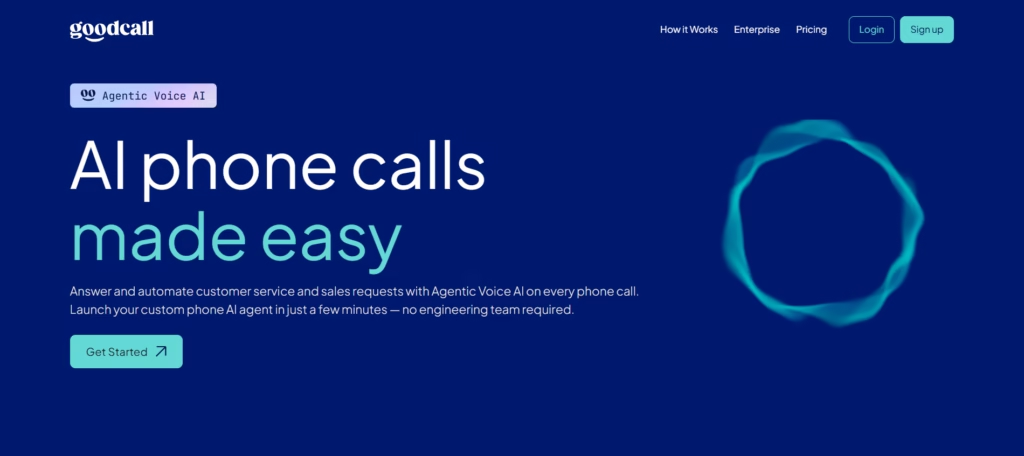
Goodcall provides AI phone agents for business call automation. It can answer common questions, collect caller information, and route conversations based on predefined rules.
The platform also supports configurable logic flows. These flows can help businesses build simple qualification paths. For example, the AI can ask about service needs, collect contact details, and send qualified callers to the right team.
Goodcall works well for small and midsize businesses that need an intelligent call-screening AI bot without building a complex voice system from scratch.
Key Features
- AI-powered call answering
- Custom logic flows
- Structured lead capture
- Call routing
- Human transfer
- Customer information collection
- Call and customer history
- Workflow automation
- API integrations
- Team and directory management
Pricing
The Starter plan costs $79 per month per agent and includes 100 unique customers. The Growth plan costs $129 per month per agent and includes 250 unique customers. The Scale plan costs $249 per month per agent and includes 500 unique customers. Enterprise pricing is custom.
5. Smith.ai: AI-Assisted Reception and Lead Intake
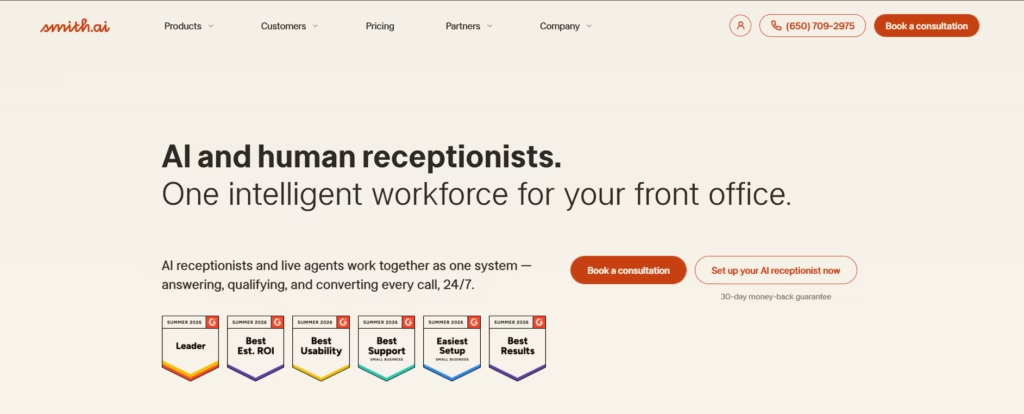
Smith.ai combines an AI receptionist with optional human support. Its AI Receptionist can answer calls, screen callers, qualify leads, route conversations, and schedule appointments.
One of its biggest differences is human escalation. The AI can manage the first part of the conversation. A live agent can step in when the inquiry becomes more complex. This can be useful for professional services and high-value lead intake.
Smith.ai also provides recording, transcription, summaries, and integration options. This gives teams a clear record of each conversation and helps support structured follow-up.
Key Features
- 24/7 AI call answering
- Lead qualification
- Call screening
- Call routing
- AI appointment scheduling
- Call recording
- Automated transcription
- Conversation summaries
- Spam screening
- CRM and workflow integrations
- Optional human escalation
- Multi-location support
Pricing
Smith.ai offers a Free AI Receptionist plan with 25 calls per month. Additional calls cost $3 per call. The Pro plan starts at $150 per month. The Enterprise plan starts at $500 per month. Larger deployments use custom pricing.
How to Choose an AI Virtual Receptionist for Lead Qualification
Choosing an AI virtual receptionist with top lead qualification features should start with your sales process.
Do not judge a platform only by how natural the voice sounds. Check how well it understands intent, qualifies prospects, updates your CRM, and moves each lead to the right next step.
Use this checklist when comparing an AI virtual receptionist with top lead qualification features:
- Natural conversation handling: Look for NLP, NLU, STT, intent recognition, and multi-turn context retention.
- Custom qualification logic: It should support BANT, CHAMP, MEDDPICC, or your own rules.
- Dynamic questioning: The AI should use call-flow branching based on each answer.
- Real-time lead scoring: It should rank leads by fit, need, authority, budget, urgency, and timeline.
- High-intent detection: It should recognize buying signals such as pricing, demo, and urgent implementation requests.
- Warm transfer and routing: Qualified leads should reach the right salesperson quickly.
- Context-rich handoff: Sales reps should receive lead details, scores, and qualification answers.
- Appointment booking: Look for real-time calendar sync with tools such as Google Calendar or Calendly.
- Bidirectional CRM sync: The AI should read and update Salesforce, HubSpot, Zoho, or similar CRMs.
- Concurrent call handling: Check 24/7 availability and the ability to manage multiple conversations at once.
- Transcripts and summaries: The platform should create structured call records and AI summaries.
- Omnichannel continuity: It should preserve context across voice, SMS, web chat, WhatsApp, email, and social messaging.
The right platform should help you qualify leads faster, reduce manual SDR work, and move high-value prospects to the right next step.
In Commplify‘s published GlobalFin Bank case study, its AI voice deployment was used for product prequalification, intent-based routing, and banking support. The case study reports that the lead qualification rate for loan and card inquiries increased from 11% to 27%, while 58% of calls were handled without human intervention.
Build a Faster Lead Qualification Pipeline With an Omnichannel AI Receptionist
A faster qualification process depends on how smoothly leads move from first contact to the right sales action.
An omnichannel AI receptionist can help by handling voice, chat, SMS, WhatsApp, and other digital channels in one connected flow. It can identify intent, ask qualification questions, capture structured lead data, and support real-time lead scoring.
The next step can then happen without unnecessary delay. A qualified lead may be transferred to sales, booked into a calendar, or added to the CRM for follow-up.
This is the kind of workflow platforms such as Commplify are designed to support. The goal is not simply to automate conversations. It is to reduce manual SDR work, improve speed-to-lead, and help sales teams focus on the opportunities that matter most.
Final Thoughts
An AI virtual receptionist can do much more than answer calls. With the right lead qualification features, it can identify intent, ask relevant questions, score prospects, route high-value leads, book meetings, and keep the CRM updated.
The key is to choose a system that fits your actual sales process. Natural conversations matter. So do dynamic qualification, real-time scoring, warm transfers, CRM sync, and 24/7 availability.
For sales teams, contact centers, and growing businesses, the real value comes from faster response and better prioritization. Platforms such as Commplify show how omnichannel AI can connect qualification with the wider customer journey.
The goal is simple: respond faster, qualify smarter, and help the right leads reach the right next step without unnecessary friction.
FAQs
What is an AI virtual receptionist for lead qualification?
An AI virtual receptionist for lead qualification is a conversational AI system that answers incoming inquiries, understands prospect intent, asks qualification questions, captures structured lead information, and triggers actions such as lead scoring, appointment booking, CRM updates, or sales transfers.
Can an AI receptionist qualify sales leads automatically?
Yes. An AI receptionist can evaluate leads using predefined criteria such as company fit, need, authority, budget, urgency, and purchasing timeline. It can then score or categorize the prospect and trigger the appropriate next action.
What questions should an AI receptionist ask to qualify leads?
Questions depend on your sales process. Common topics include the prospect’s business problem, company size, current solution, budget, decision-making role, required capabilities, implementation timeline, and urgency. The AI should ask only questions relevant to the conversation rather than following a rigid checklist.
Can an AI receptionist use BANT for lead qualification?
Yes. BANT evaluates Budget, Authority, Need, and Timeline and can be incorporated into AI qualification logic. More complex sales organizations can also incorporate CHAMP, MEDDPICC, ICP criteria, or custom scoring rules.
Can AI receptionists score leads in real time?
Yes, provided the platform supports real-time scoring or workflow logic. The AI can evaluate conversation signals and structured data while the interaction is happening, then classify the prospect or trigger an action once a qualification threshold is reached.
Can an AI receptionist transfer qualified leads to sales reps?
Yes. Platforms with live-transfer capabilities can route qualified prospects to sales representatives or specialized queues. A warm transfer can also provide the receiving rep with conversation context so the prospect doesn’t have to repeat everything.
Does an AI receptionist integrate with CRM software?
Many AI receptionist platforms integrate with CRM systems. Depending on the platform, the integration may create contacts, update lead records, save qualification information, log call outcomes, store summaries, or trigger follow-up workflows. Always verify whether an integration is truly bidirectional if that is important to your process.
Can an AI receptionist qualify leads across phone, chat, SMS, and WhatsApp?
Some omnichannel platforms can support lead qualification across multiple communication channels, while other AI receptionists remain primarily voice-focused. If cross-channel qualification matters, check whether the platform shares customer context and qualification data across channels rather than running each channel independently.
This page was last edited on 7 October 2026, at 7:17 am