Automation in the BPO industry automates customer interactions, workflows, and processes using AI, RPA, and unified omnichannel tools. This reduces errors, cuts costs, boosts customer satisfaction, and enables BPOs to scale high-quality service efficiently.
Every BPO leader feels the squeeze: do more with less, respond faster, and keep both customers and clients happy. The pace of digital transformation isn’t waiting for anyone, and manual processes alone can’t meet growing expectations—especially with pressure to keep costs low.
In my experience, the gap between manual and automated BPOs is only getting wider. Teams that rely on outdated models are plagued by slowdowns, errors, and customer frustration. Those who automate stay agile, meet SLAs, and keep clients loyal.
This guide explains how modern BPO automation—using unified omnichannel automation and smart workflow tools—transforms CX, scale, and day-to-day operations. If you’re a decision-maker, this is what you need to know right now.
What Is Automation in the BPO Industry?
Automation in the BPO industry refers to the use of software, artificial intelligence, robotic process automation, and other digital technologies to perform repetitive business processes with minimal human intervention. It helps BPO companies complete tasks faster, reduce operational costs, improve accuracy, and deliver more consistent services.
Traditional BPO operations often depend on large teams to handle data entry, customer inquiries, document processing, invoice management, reporting, and other routine activities. Automation transforms these processes by allowing technology to manage predictable tasks while employees focus on complex conversations, problem-solving, decision-making, and relationship-building.
Automation does not necessarily replace the human workforce. Instead, it creates a more efficient operating model in which humans and intelligent systems work together.
Why Automation Is Becoming Essential for BPO Companies
BPO providers operate in a highly competitive environment where clients expect faster service, lower costs, better accuracy, and round-the-clock availability. Manual processes alone often make it difficult to meet these expectations at scale.
Automation enables BPO companies to:
- Process higher volumes of work without proportionally increasing staff
- Reduce errors caused by repetitive manual tasks
- Deliver faster response and resolution times
- Maintain consistent service quality across different channels
- Improve compliance through standardized workflows
- Offer 24/7 support without relying entirely on overnight teams
- Generate real-time performance and customer insights
As client expectations continue to rise, automation is becoming an important part of maintaining profitability and service quality.
Key Technologies Driving Automation in the BPO Industry
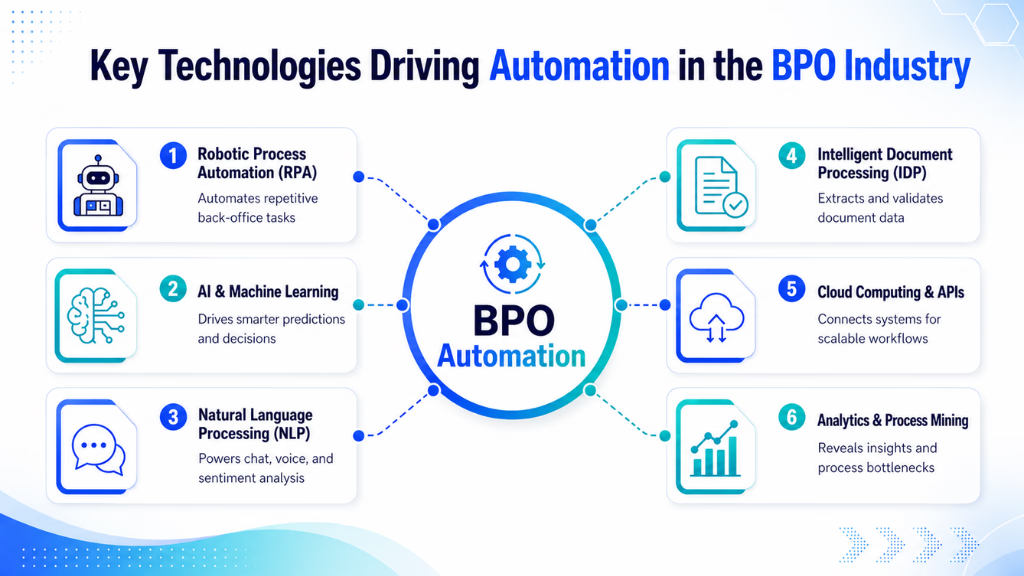
Automation in the BPO industry is powered by a combination of intelligent technologies that streamline repetitive tasks, improve decision-making, and enhance service delivery. From robotic process automation and conversational AI to document processing and advanced analytics, these technologies help BPO providers operate more efficiently, reduce errors, and deliver faster, more consistent customer experiences.
1. Robotic Process Automation
Robotic process automation, or RPA, uses software bots to perform structured and rule-based tasks. These bots can log into systems, copy information, update records, generate reports, validate data, and transfer information between applications.
Common BPO applications of RPA include:
- Data entry and migration
- Invoice processing
- Payroll administration
- Customer record updates
- Order processing
- Report generation
- Claims administration
RPA is particularly useful for high-volume processes that follow clearly defined steps.
2. Artificial Intelligence
Artificial intelligence enables BPO systems to perform tasks that require language understanding, pattern recognition, prediction, and decision support. Unlike basic rule-based automation, AI can analyze unstructured information and adapt its responses based on available data.
BPO companies use AI for customer intent detection, sentiment analysis, intelligent routing, predictive analytics, quality monitoring, and personalized customer support.
3. Conversational AI
Conversational AI powers chatbots, virtual agents, and AI voice assistants that communicate with customers through natural language. These systems can answer questions, collect information, authenticate users, schedule appointments, provide order updates, and complete simple transactions.
When a customer requires human assistance, the conversation can be transferred to an agent along with the relevant context. This reduces repetition and helps agents resolve issues more efficiently.
4. Intelligent Document Processing
BPO providers frequently handle invoices, contracts, claims forms, identification documents, emails, and application forms. Intelligent document processing combines optical character recognition, machine learning, and natural language processing to extract and organize information from these documents.
This technology reduces manual document review and accelerates back-office processes such as:
- Insurance claims processing
- Loan application review
- Account verification
- Invoice management
- Compliance checks
- Healthcare documentation
5. Workflow Automation
Workflow automation connects different tasks, departments, and systems within a single automated process. It can automatically assign work, trigger notifications, request approvals, escalate delayed cases, and update process statuses.
For example, a customer complaint can be categorized, assigned to the correct department, prioritized based on urgency, and escalated if it remains unresolved beyond a defined period.
6. Process Mining and Analytics
Process mining tools analyze operational data to identify delays, bottlenecks, repetitive steps, and process variations. BPO companies can use these insights to determine which processes should be improved or automated.
Analytics also helps managers monitor performance indicators such as response time, resolution rate, processing accuracy, customer satisfaction, agent productivity, and cost per interaction.
Major Applications of Automation in BPO Operations
Automation can support nearly every area of BPO operations, from customer service and finance to HR, sales, data management, and quality assurance. By automating repetitive, high-volume tasks, BPO providers can improve speed, accuracy, scalability, and service consistency while allowing employees to focus on complex and customer-focused responsibilities.
Customer Service Automation
Customer service is one of the most common areas for BPO automation. AI-powered chatbots and voice agents can handle frequently asked questions, provide account information, process simple requests, and guide customers through standard procedures.
Automation can also support human agents by:
- Displaying relevant customer information
- Recommending appropriate responses
- Summarizing previous conversations
- Automatically creating support tickets
- Suggesting next-best actions
- Generating post-call notes
- Monitoring conversation quality
This agent-assist approach improves productivity without removing the human element from sensitive or complicated interactions.
Finance and Accounting Automation
Finance and accounting outsourcing involves many repetitive, rules-based activities. Automation can streamline invoice matching, payment reconciliation, expense validation, accounts payable, accounts receivable, and financial reporting.
Automated systems can flag unusual transactions or incomplete records for human review, allowing finance teams to focus on exceptions rather than checking every transaction manually.
Human Resources Process Automation
BPO providers can automate several HR-related activities, including employee onboarding, attendance tracking, payroll processing, benefits administration, candidate screening, and document collection.
For example, an automated onboarding workflow can send forms, collect employee information, request approvals, schedule orientation sessions, and notify relevant departments.
Data Entry and Data Management
Manual data entry is time-consuming and vulnerable to errors. Automation can capture, validate, organize, and transfer information between business systems.
Automated validation rules can detect missing fields, duplicate records, incorrect formats, and inconsistent information before the data enters a client’s primary system.
Sales and Lead Management
Automation helps BPO sales teams capture leads, qualify prospects, update customer relationship management systems, schedule follow-ups, and assign opportunities to the appropriate representatives.
AI-powered systems can also analyze customer behavior and lead attributes to identify prospects with a higher likelihood of conversion.
Quality Assurance
Traditional quality assurance teams can review only a small percentage of customer interactions. AI-powered quality monitoring can analyze a much larger volume of calls, chats, and emails.
These systems can identify:
- Compliance violations
- Negative customer sentiment
- Missing disclosures
- Repeated customer complaints
- Long periods of silence
- Incorrect information
- Coaching opportunities
Supervisors can then focus on interactions that require immediate attention.
Benefits of Automation in the BPO Industry
Automation delivers significant operational and strategic benefits for BPO companies by reducing manual workloads, accelerating service delivery, and improving overall process consistency. It enables providers to manage higher work volumes, control costs, minimize errors, and offer faster, more reliable services.
By combining automation with human expertise, BPO organizations can improve customer experiences while allowing employees to focus on complex and value-driven tasks.
Lower Operational Costs
Automation reduces the amount of manual effort required to complete repetitive tasks. It allows providers to handle larger workloads without continuously expanding their workforce.
The resulting savings can be invested in employee training, technology upgrades, customer experience improvements, and service innovation.
Faster Service Delivery
Software bots and AI systems can complete many activities within seconds. Faster processing reduces customer waiting times, improves turnaround times, and helps BPO providers meet demanding service-level agreements.
Improved Accuracy
Repetitive manual work can lead to typing mistakes, missed steps, and inconsistent outputs. Automated workflows follow predefined rules and validate information before processing it.
While automation still requires monitoring, it can significantly reduce preventable operational errors.
Greater Scalability
Customer demand can increase suddenly during product launches, promotional campaigns, holidays, or service disruptions. Automation enables BPO companies to manage higher interaction and transaction volumes without immediately increasing staffing levels.
Consistent Customer Experience
Automated systems follow the same process across every interaction. Customers receive consistent information regardless of when they contact the business or which channel they use.
Consistency is especially valuable for BPO providers serving clients across different regions and time zones.
Better Employee Productivity
When repetitive tasks are automated, employees can focus on activities that require empathy, judgment, creativity, negotiation, and strategic thinking.
This can improve job satisfaction while helping BPO companies use their workforce more effectively.
Stronger Data Visibility
Automated platforms capture detailed information about customer interactions, process performance, employee activities, and service outcomes. Managers can use this data to identify trends and make informed operational decisions.
Challenges of Implementing Automation in BPO
Implementing automation in BPO can deliver significant efficiency and cost benefits, but the transition is not always straightforward. BPO providers must address technical integration, data security, workforce readiness, process complexity, and ongoing system management to achieve successful results.
Without proper planning and human oversight, automation may create operational gaps instead of improving performance.
Integration With Legacy Systems
Many BPO companies and their clients use older platforms that may not easily connect with modern automation tools. Poor integration can create isolated workflows and require additional technical development.
A successful implementation should include a clear integration strategy for connecting automation with customer relationship management platforms, enterprise software, communication systems, and client databases.
Data Security and Privacy
BPO providers frequently handle sensitive customer, financial, healthcare, and employee information. Automated systems must follow strict security and privacy requirements.
Strong access controls, encryption, audit logs, data retention policies, and regular security assessments are essential for reducing risk.
Employee Resistance
Employees may worry that automation will eliminate their roles. This uncertainty can create resistance and reduce adoption.
BPO leaders should explain how automation will change responsibilities, provide training, and create opportunities for employees to develop skills in customer experience, analytics, process management, and AI supervision.
Poor Process Selection
Not every process should be automated. Processes with unclear rules, frequent exceptions, or constantly changing requirements may produce poor results when automated too early.
BPO providers should begin with stable, repetitive, measurable, and high-volume processes.
Lack of Human Oversight
AI and automation systems can make mistakes, misunderstand customer intent, or fail to handle unusual situations. Human oversight remains essential, especially in complex, emotional, regulated, or high-value interactions.
Clear escalation paths should allow customers and automated systems to reach a qualified human agent when necessary.
High Initial Investment
Although automation can reduce long-term costs, implementation may require investment in software, infrastructure, integration, cybersecurity, training, and ongoing maintenance.
BPO companies should evaluate both immediate expenses and long-term operational value before selecting a solution.
How to Implement Automation in BPO Operations
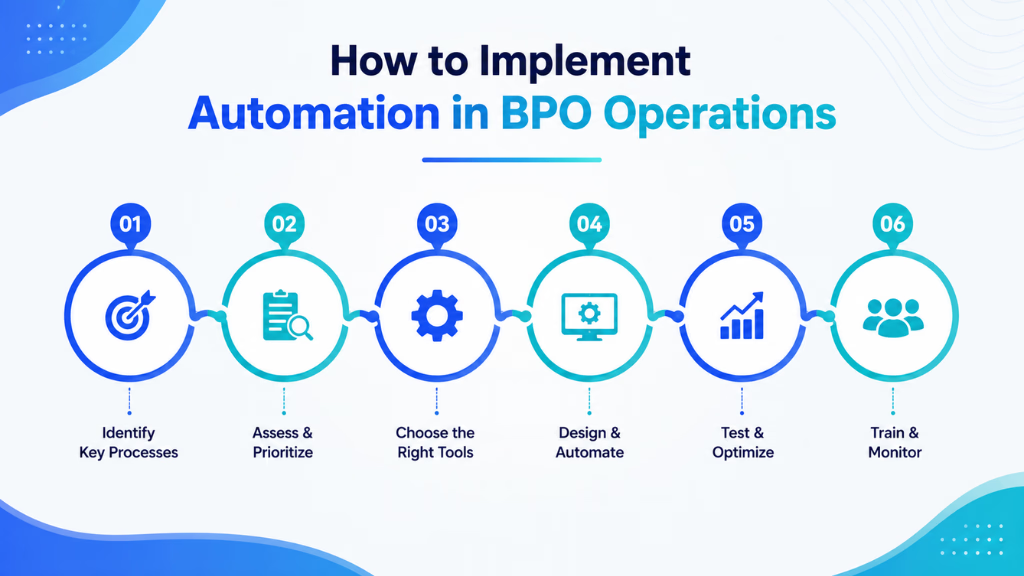
Implementing automation in BPO operations requires a structured approach that aligns technology with business goals, existing workflows, and customer expectations. Rather than automating every process at once, BPO providers should identify high-impact tasks, select the right tools, test solutions on a small scale, train employees, and continuously measure performance to achieve sustainable results.
Step 1: Identify High-Impact Processes
Start by analyzing processes that consume significant time, involve repetitive work, generate frequent errors, or create customer delays.
Suitable candidates often include data entry, ticket categorization, invoice processing, reporting, document verification, and frequently asked customer questions.
Step 2: Define Clear Business Objectives
Automation initiatives should support measurable business goals. These may include reducing average handling time, improving processing accuracy, lowering cost per transaction, increasing self-service adoption, or improving customer satisfaction.
Clear objectives help teams evaluate whether the implementation is delivering meaningful results.
Step 3: Map the Existing Workflow
Document every stage of the current process, including decision points, systems, approvals, exceptions, and handoffs. This prevents the company from automating an inefficient or unnecessary workflow.
The process should be simplified before automation is introduced.
Step 4: Choose the Right Technology
Technology selection should be based on the nature of the process. RPA may be appropriate for structured tasks, while conversational AI is better suited to customer interactions. Intelligent document processing may be required for document-heavy workflows.
The selected solution should also support integration, security, scalability, analytics, and human escalation.
Step 5: Run a Controlled Pilot
Begin with a limited implementation involving one process, department, or client account. Monitor performance, collect employee feedback, identify errors, and improve the workflow before expanding it.
A controlled pilot reduces risk and provides evidence for future investment.
Step 6: Train Employees
Employees should understand how to use automated tools, manage exceptions, review AI-generated outputs, and take over escalated interactions.
Training should focus not only on technical skills but also on communication, analytical thinking, and decision-making.
Step 7: Measure and Optimize Performance
Automation should be continuously evaluated against defined performance indicators. Important metrics may include:
- Processing time
- Error rate
- Cost per transaction
- First-contact resolution
- Customer satisfaction
- Automation completion rate
- Escalation rate
- Employee productivity
Continuous monitoring helps BPO providers identify weak points and improve system performance.
The Role of Humans in an Automated BPO Environment
The future of BPO is not based on automation alone. It depends on effective collaboration between human employees and intelligent technologies.
Automated systems are well suited to handling repetitive tasks, processing large data volumes, and providing instant responses. Human employees remain essential for managing emotionally sensitive conversations, resolving unusual problems, making judgment-based decisions, and building customer trust.
In an effective hybrid model, automation handles routine activities while human agents focus on interactions where empathy, expertise, and flexibility create the greatest value.
The Future of Automation in the BPO Industry
Automation in the BPO industry is moving beyond isolated bots and basic scripted chatbots. Future operations will increasingly use connected AI agents capable of understanding customer intent, accessing business systems, completing multi-step tasks, and coordinating work across departments.
Predictive analytics will help BPO providers anticipate customer needs, workforce demand, service risks, and process delays. Generative AI will support agents by summarizing conversations, creating responses, retrieving knowledge, and preparing reports.
At the same time, governance, transparency, data privacy, and human supervision will become increasingly important. The most successful BPO providers will not simply automate the highest number of tasks. They will create balanced operating models that combine technology, skilled employees, secure processes, and customer-centered service.
How Commplify Addresses Unified Omnichannel Automation and Workflow Challenges
Unified omnichannel automation matters most when you need context, scale, and full control from a single place. Commplify brings all conversations—voice, chat, email, SMS, WhatsApp—into one inbox. This removes channel silos and simplifies surface-to-resolution tracking.
I have seen teams benefit from Commplify’s no-code workflow automation, which allows business users to set up triggers (like a new query, a missed call, or an escalated ticket) and actions (such as sending reminders, updating records, or routing cases) across any channel instantly. With configurable AI agents, teams can adjust workflows per department and use case—for example, one agent for payroll, another for customer support, and both using knowledge intelligence to answer accurately.
The analytics dashboard gives live feedback: you can see how many queries the AI handles, escalation rates, customer sentiment, and resolution timing. This data is critical for continuous improvement—and for showing ROI to internal or client stakeholders.
By centralizing, automating, and making analytics transparent, Commplify reduces manual effort, improves CX consistency, and keeps human experts involved only where their judgment is needed most.
Conclusion
The automation wave in the BPO industry isn’t just a trend—it’s the new backbone of operational excellence, customer satisfaction, and scalable growth. Automation allows BPOs to meet rising client demands, lower costs, and compete in a tougher market.
Unified omnichannel automation sits at the core of this shift. It gives BPOs the flexibility to handle any channel, adapt processes quickly, and blend the speed of AI with human empathy. Tools like Commplify help teams rethink not only how they interact with customers, but also how they route, resolve, and learn from every conversation.
BPOs that embrace smart automation—working hand-in-hand with their people—will stay relevant and drive the standard for excellent CX. As AI matures, I expect the line between digital and human support to blur even more, creating BPO workflows that are adaptive, personal, and deeply efficient.
The future belongs to those who can automate well and stay human where it matters.
FAQs
What is BPO automation and why is it important?
BPO automation uses technology to handle manual or repetitive tasks, making service faster, cheaper, and more accurate. It is essential for scaling and delivering consistent, high-quality customer experiences.
What technologies are used for automation in BPO?
Core technologies include AI, robotic process automation (RPA), chatbots, workflow automation platforms, and omnichannel customer engagement tools.
How does automation improve customer experience in BPO?
Automation ensures faster responses, fewer errors, and consistent service across all channels. It also lets agents focus on complex or sensitive cases, resulting in higher customer satisfaction.
Can automation replace human agents in BPO operations?
No. Automation handles routine work, but human agents are needed for complex, judgment-based, or high-empathy cases. The best BPOs use both together.
What are real-world examples of automation in the BPO industry?
Examples include automated ticket routing, AI-driven chat on multiple channels, invoice processing with RPA, knowledge base search, and workflow-triggered CRM updates.
How does automation impact the BPO workforce?
Automation shifts agents from repetitive tasks to higher-value work. Agents manage escalations, provide feedback, and support complex cases. Change management and upskilling are key.
How do BPOs handle data security when implementing automation?
BPOs use encrypted data channels, access controls, regular audits, and strict compliance checks for all automated workflows and AI-processed data.
What are common challenges in automating BPO operations?
Challenges include legacy IT integration, data privacy, workforce resistance, maintaining process quality, and ensuring ongoing process improvement.
What metrics are used to measure the success of BPO automation?
Key metrics are response time, customer satisfaction (CSAT), escalation rates, automation coverage percentage, and error rates.
How do I choose a BPO provider or technology partner with strong automation capabilities?
Look for unified omnichannel support, flexible workflow automation, advanced analytics, integration options, compliance standards, and proven change management support. Ask about real use cases and references.
This page was last edited on 31 July 2026, at 6:29 am