AI-powered agents for BPO service providers automate and optimize customer interactions across all channels. They lower costs, improve satisfaction, and scale support—while letting humans handle complex or sensitive cases.
BPO leaders face a new reality: pressure is up, talent is tight, and clients now expect more than just low-cost labor. The market wants real-time, multi-channel support, with zero drop in quality—no matter how many conversations you handle each day.
This is where many teams struggle. Old automation tools break with rising demand, while “AI pilot” projects stall before scaling. Some BPOs try to patch things up with bots or RPA, but those quick fixes can create as many headaches as they solve.
In this guide, I will show you how AI-powered agents for BPO service delivery providers can manage every channel, automate intelligently, and unlock deep analytics. You will learn what works, what doesn’t, and how platforms like Commplify are helping top BPOs deliver better CX with less effort.
What Are AI-Powered Agents for BPO Service Delivery Providers?
AI-powered agents are intelligent software systems that can understand requests, access business information, make decisions, complete tasks, and communicate with customers or employees. Unlike traditional chatbots that follow predefined scripts, modern AI agents use technologies such as natural language processing, machine learning, generative AI, speech recognition, and workflow automation.
For BPO service delivery providers, these agents can work independently or alongside human representatives across customer support, sales, technical assistance, finance, healthcare administration, data processing, and other outsourced operations.
An AI-powered agent can, for example:
- Understand a customer’s question in natural language.
- Verify the customer’s identity.
- Retrieve information from connected systems.
- Update an account or process a request.
- Generate a personalized response.
- Escalate complicated cases to a human representative.
- Summarize the interaction for reporting and quality assurance.
This allows BPO companies to move beyond labor-based outsourcing and offer technology-enabled, outcome-focused services. Industry research describes this shift as an opportunity for BPO providers to become AI-first transformation partners rather than simply supplying human resources.
How AI-Powered Agents Transform BPO Service Delivery
Traditional BPO operations depend heavily on human teams, manual processes, static scripts, and disconnected applications. These models can deliver reliable service, but they often face challenges related to high interaction volumes, agent turnover, inconsistent quality, language coverage, and rising operational costs.
AI-powered agents introduce a more flexible service-delivery model. They can manage routine work independently, assist human employees during complex interactions, and coordinate tasks across multiple systems.
The goal is not necessarily to remove human representatives from the process. Instead, AI agents handle repetitive and predictable activities while people focus on conversations that require empathy, judgment, negotiation, or creative problem-solving.
This creates a hybrid operating model consisting of:
- Autonomous AI agents: Complete selected processes from beginning to end without direct human involvement.
- Agent-assist systems: Provide real-time recommendations, knowledge, summaries, and next-best actions to human representatives.
- Human specialists: Manage sensitive, unusual, high-value, or emotionally complex interactions.
- AI supervisors and orchestration systems: Route tasks, monitor performance, enforce rules, and coordinate multiple AI and human agents.
This combination can help BPO providers improve productivity without sacrificing the human support required for difficult customer situations.
Key Use Cases of AI-Powered Agents in BPO Services
AI-powered agents can support a wide range of front-office and back-office BPO operations, from handling customer inquiries to automating repetitive administrative tasks. By combining conversational AI, workflow automation, and real-time data access, these agents help service providers improve efficiency, response times, consistency, and overall service quality.
1. Automated Customer Support
Customer support is one of the most common applications of AI agents in BPO operations. AI-powered voice and chat agents can answer frequently asked questions, provide account information, explain policies, check order status, troubleshoot common problems, and process simple service requests.
Unlike basic bots, an AI agent can maintain context throughout a conversation. It can interpret follow-up questions, retrieve relevant customer data, and adjust its response based on the situation.
For example, an e-commerce customer could ask about a delayed order. The AI agent could identify the customer, locate the order, check its delivery status, explain the delay, and initiate an approved resolution—all within the same conversation.
Research into large-scale customer-support AI deployments shows that production success depends on structured context, human feedback, careful evaluation, and ongoing measurement rather than simply connecting a language model to a support channel.
2. AI Voice Agents for Contact Centers
AI voice agents can conduct natural telephone conversations using speech recognition, language models, and text-to-speech technology. They are particularly useful for high-volume inbound and outbound calling operations.
Common voice-agent applications include:
- Appointment scheduling and confirmation.
- Order-status inquiries.
- Customer verification.
- Payment reminders.
- Lead qualification.
- Survey collection.
- Service activation.
- Basic technical troubleshooting.
- After-hours assistance.
These agents can answer calls immediately, reducing queues and missed-call rates. They can also operate outside standard business hours, allowing BPO providers to offer continuous service without maintaining the same staffing level overnight.
When a conversation becomes complicated, the AI voice agent can transfer the customer to a human employee along with the transcript, account details, identified intent, and a summary of the issue.
3. Real-Time Assistance for Human Agents
AI-powered agent-assist tools support representatives while they are speaking or chatting with customers. The system analyzes the interaction and displays information relevant to the current request.
An agent-assist solution may:
- Recommend an appropriate response.
- Retrieve articles from the knowledge base.
- Display policy or compliance reminders.
- Suggest the next best action.
- Translate messages in real time.
- Detect customer sentiment.
- Generate a conversation summary.
- Complete after-call documentation.
This reduces the time employees spend searching for information or performing repetitive administrative work. It can also help new representatives become productive more quickly because they receive guidance during live interactions.
However, recommendations should remain transparent and reviewable. Human representatives must be able to reject inaccurate suggestions and take control when an AI-generated response is unsuitable.
4. Intelligent Ticket Routing and Prioritization
Traditional ticket-routing systems often depend on manually selected categories or fixed keyword rules. AI agents can analyze the customer’s message, identify intent, estimate urgency, detect language, recognize sentiment, and route the request to the appropriate queue.
For example, a cancellation request from an important customer may be sent directly to a retention specialist. A technical issue involving a known outage may be routed to a dedicated incident workflow. A simple password-reset request may be handled automatically.
Intelligent routing helps reduce unnecessary transfers and ensures that human specialists receive cases matching their expertise.
5. Back-Office Process Automation
BPO providers are responsible for many processes that take place outside customer-facing channels. These may include document processing, data entry, claims administration, invoice management, order verification, employee onboarding, and record maintenance.
AI agents can extract information from emails, forms, PDFs, images, and business applications. They can validate the information, identify missing fields, enter data into connected systems, and request human review when required.
Unlike traditional robotic process automation, which normally depends on rigid rules and predictable interfaces, AI agents can interpret less-structured information and adapt their actions according to context. However, conventional automation remains valuable for highly repetitive, rules-based tasks. Many successful solutions combine AI reasoning with deterministic workflow controls.
6. Quality Assurance and Compliance Monitoring
Manually reviewing a small sample of calls may not provide an accurate picture of contact-center performance. AI-powered quality-management systems can examine a much larger percentage of customer interactions.
They can assess whether agents:
- Followed the required greeting.
- Completed identity verification.
- Provided accurate information.
- Used approved language.
- Followed disclosure requirements.
- Demonstrated appropriate communication skills.
- Resolved or correctly escalated the issue.
The system can then identify coaching opportunities, recurring customer complaints, knowledge gaps, and potential compliance risks.
Human review should remain part of the process, particularly when an AI system flags an employee, interprets emotional behavior, or contributes to a performance-related decision.
7. Multilingual Customer Service
Global BPO providers frequently support customers across multiple countries. Recruiting separate teams for every language can be expensive and operationally difficult.
AI-powered translation and conversational systems can help agents communicate across languages through real-time text or speech translation. They can also generate localized answers based on approved content.
This does not eliminate the need for native-language specialists. Cultural differences, regional expressions, sensitive situations, and complex conversations may still require human expertise. However, AI can expand basic language coverage and support multilingual teams during periods of high demand.
8. Sales and Lead-Qualification Support
BPO providers delivering outsourced sales services can use AI agents to engage prospects, ask qualification questions, collect relevant information, schedule meetings, and update customer relationship management systems.
An AI sales agent might evaluate:
- The prospect’s business requirements.
- Budget range.
- Purchase timeline.
- Location.
- Company size.
- Product interest.
- Eligibility for a specific offer.
Qualified prospects can then be transferred to a human salesperson. This allows sales teams to focus on conversations with stronger purchase intent instead of manually screening every inquiry.
AI agents should clearly identify themselves where required and avoid misleading prospects into believing they are communicating with a human.
9. Workforce Management and Operational Support
AI agents can also assist BPO managers with internal operations. They may analyze interaction forecasts, staffing availability, historical service levels, seasonal patterns, and employee skills to support workforce-planning decisions.
Internal AI assistants can answer questions such as:
- Which queue currently has the longest waiting time?
- What caused yesterday’s increase in handle time?
- Which employees are qualified for a particular account?
- Which processes generate the most repeat contacts?
- Where are service-level agreements at risk?
These insights help managers respond to operational changes more quickly.
Major Benefits for BPO Service Delivery Providers
AI-powered agents help BPO service delivery providers improve efficiency, scale operations, and deliver faster, more consistent customer experiences. By automating repetitive tasks and supporting human agents with real-time insights, these systems enable providers to reduce operational pressure while maintaining service quality across multiple clients, channels, and regions.
Greater Operational Scalability
AI agents allow providers to manage sudden increases in demand without adding the same number of human employees. This is especially valuable during product launches, seasonal campaigns, outages, emergencies, or billing cycles.
The AI layer can handle routine demand while human teams concentrate on escalations and valuable interactions.
Faster Response and Resolution
Customers no longer have to wait for an available representative before receiving basic assistance. AI-powered agents can respond immediately and complete approved transactions during the conversation.
When escalation is necessary, the human agent receives the relevant context instead of asking the customer to repeat the entire issue.
Consistent Service Quality
Human performance may vary according to experience, workload, training, or access to information. AI agents can apply the same approved workflows, knowledge sources, and compliance rules across interactions.
Consistency, however, depends on the quality of the underlying data and governance. An AI system connected to inaccurate or outdated information will deliver inaccurate answers consistently.
Reduced Repetitive Work
BPO employees often spend significant time on repetitive inquiries, data entry, call summaries, system updates, and routine verification. Automating these activities gives representatives more time for complex customer needs.
It may also improve the employee experience by reducing monotonous work and providing real-time assistance during difficult conversations.
Expanded Service Availability
AI agents can support customers at night, on weekends, and during holidays. They can provide continuous coverage for common requests while sending urgent or complex cases to an on-call team.
This gives smaller BPO providers an opportunity to offer broader service coverage without creating a fully staffed operation in every time zone.
More Actionable Customer Insights
Every interaction contains information about customer expectations, service failures, product issues, and purchasing behavior. AI systems can identify patterns across thousands of conversations and convert unstructured interaction data into useful insights.
BPO providers can use these findings to improve scripts, training materials, knowledge bases, processes, and client reporting.
How to Implement AI-Powered Agents in BPO Operations
Implementing AI-powered agents in BPO operations requires more than deploying a chatbot or automation tool. It involves selecting the right processes, preparing reliable data, integrating business systems, defining human escalation paths, and continuously measuring performance.
A structured implementation approach helps BPO providers reduce risk, improve service quality, and scale AI adoption successfully.
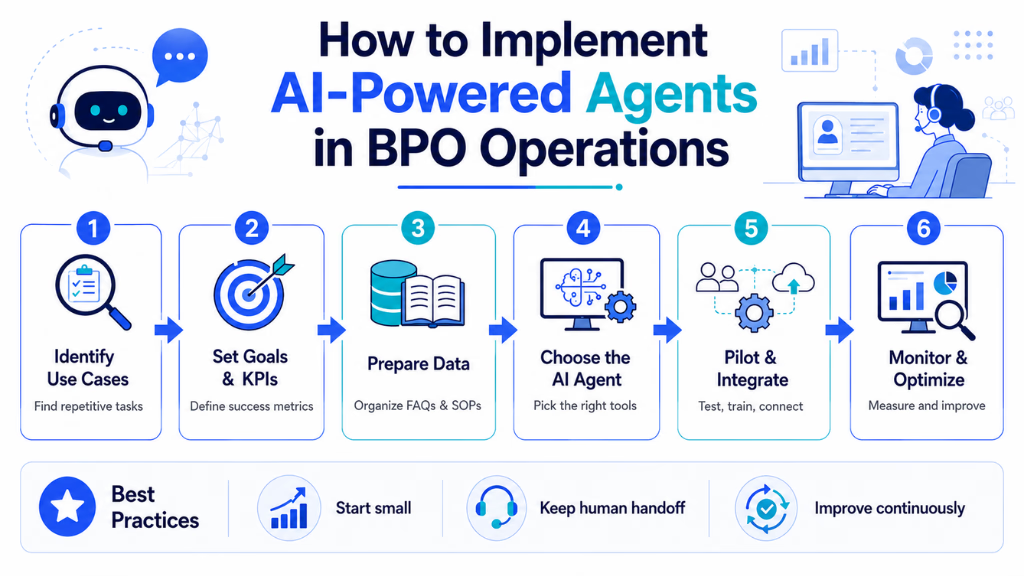
Step 1: Select a Suitable Process
Begin with a high-volume process that has clear rules, measurable outcomes, and manageable risk. Good starting points include order tracking, appointment booking, frequently asked questions, ticket classification, and interaction summarization.
Avoid beginning with the most sensitive or complicated workflow simply because it has the highest cost. A controlled implementation allows the organization to develop its data, governance, and evaluation capabilities before expanding.
Step 2: Map the Complete Workflow
Document every step required to complete the selected process, including:
- Customer intents.
- Required information.
- Authentication procedures.
- Business rules.
- System integrations.
- Exception scenarios.
- Escalation conditions.
- Compliance requirements.
- Successful outcomes.
This prevents the AI agent from becoming only a conversational interface that cannot complete the underlying task.
Step 3: Prepare the Knowledge Base
The agent needs access to accurate, organized, and current information. Review help-center articles, scripts, process documents, product data, policies, and troubleshooting guides before deployment.
Remove duplicates, resolve conflicting instructions, assign content owners, and establish a regular review schedule.
Step 4: Connect Essential Business Systems
Depending on the use case, the AI agent may need controlled access to:
- Customer relationship management platforms.
- Ticketing systems.
- Order-management tools.
- Payment systems.
- Scheduling platforms.
- Knowledge bases.
- Enterprise resource planning software.
- Workforce-management applications.
Each integration should use appropriate permissions. The AI agent should only be able to access or modify the information required for its assigned task.
Step 5: Establish Human Escalation Rules
Customers must have a clear route to human assistance. Escalation may be triggered when:
- The customer requests a person.
- Identity verification fails.
- The request involves an exception.
- The system has low confidence.
- The customer appears highly dissatisfied.
- A regulated or sensitive issue arises.
- The AI cannot complete the required action.
- The transaction exceeds an approved limit.
The transfer should include the interaction history and a concise summary to create a smooth customer experience.
Step 6: Test the Agent Thoroughly
Testing should cover more than ideal conversations. Evaluate the system using spelling mistakes, unclear requests, different accents, interruptions, incomplete information, unusual scenarios, unsupported requests, and attempts to manipulate the agent.
The evaluation process should measure both conversational quality and operational correctness. A helpful-sounding answer is not successful when the system performs the wrong action.
Step 7: Launch in a Controlled Environment
Start with a limited audience, channel, process, client account, or percentage of traffic. Monitor the AI agent closely and compare its performance with the previous service model.
Human supervisors should review failures, unclear cases, customer feedback, and unexpected behavior during the early stages.
Step 8: Improve Continuously
AI-agent deployment is not a one-time software installation. Knowledge, products, regulations, customer behavior, and internal processes will change.
BPO providers should continuously review conversations, update information, test new versions, measure business results, and refine escalation rules.
Metrics for Measuring AI-Agent Performance
BPO providers should avoid measuring success only through cost reduction or the number of conversations automated. A balanced measurement framework should include operational, customer, employee, and risk indicators.
Important metrics include:
- First-response time.
- Average resolution time.
- First-contact resolution.
- Self-service completion rate.
- Escalation rate.
- Containment rate.
- Customer satisfaction.
- Repeat-contact rate.
- Task-completion accuracy.
- Average handle time for human agents.
- Cost per interaction.
- Compliance-adherence rate.
- AI-response accuracy.
- Employee adoption and satisfaction.
Containment should not be treated as success when customers are prevented from reaching a human or abandon the interaction without receiving help. The more meaningful measure is successful resolution.
One recent large-scale customer-support study found that evaluation-driven development could improve self-service performance and customer satisfaction, illustrating the importance of rigorous testing and production measurement.
Challenges BPO Providers Must Address
Implementing AI-powered agents can significantly improve BPO service delivery, but it also introduces operational, technical, and ethical challenges. Providers must address data security, system integration, response accuracy, customer acceptance, employee concerns, and governance to ensure AI delivers reliable and compliant outcomes.
Data Privacy and Security
BPO operations regularly involve personal, financial, healthcare, employment, and account information. Providers must control how data is collected, stored, processed, shared, and retained.
Security controls should include encryption, role-based permissions, audit logs, data minimization, vendor assessments, and incident-response procedures.
Inaccurate AI Responses
Generative AI can produce answers that sound convincing but are incomplete or incorrect. Connecting the system to approved knowledge, restricting its actions, applying validation rules, and requiring human review for high-risk decisions can reduce this risk.
Integration Complexity
An AI agent cannot deliver meaningful automation when it is disconnected from the applications where work happens. Legacy systems, inconsistent data, limited APIs, and fragmented client environments may increase implementation difficulty.
Customer Acceptance
Some customers will prefer human assistance. BPO providers should make the AI experience transparent, useful, and easy to exit. Forcing customers through a frustrating automated process can damage satisfaction instead of improving it.
Employee Resistance
Employees may worry that AI adoption will eliminate jobs or increase surveillance. Providers should communicate how roles will change, involve frontline teams in system design, provide training, and establish fair policies for AI-assisted quality management.
Governance and Accountability
Organizations must determine who is responsible for the AI agent’s knowledge, actions, permissions, performance, and failures. Governance should involve operational leaders, IT teams, security specialists, compliance professionals, client stakeholders, and frontline employees.
Research examining deployed AI-agent systems has also highlighted inconsistent transparency around evaluations, safety features, and societal impacts, making vendor due diligence and internal governance especially important.
How to Choose an AI-Powered Agent Solution for BPO Service Delivery
BPO providers should evaluate platforms based on operational fit rather than choosing the system with the most impressive demonstration.
Important capabilities to consider include:
Omnichannel Support
The solution should support relevant channels such as voice, web chat, email, messaging applications, and social media while maintaining context across interactions.
Workflow Automation
The AI agent should be able to complete actions, not only answer questions. Look for secure integrations, workflow builders, approval controls, and support for multi-step processes.
Human-Agent Collaboration
The platform should provide smooth transfers, real-time assistance, conversation summaries, and shared customer context.
Customization and Client Separation
BPO providers frequently serve multiple clients with different brands, policies, systems, and security requirements. The solution should support separate knowledge bases, workflows, permissions, analytics, and configurations.
Security and Compliance
Evaluate data handling, access controls, encryption, auditability, regional hosting, retention settings, and support for applicable regulatory requirements.
Analytics and Evaluation
The platform should make it possible to measure accuracy, resolution, customer satisfaction, escalation patterns, workflow failures, and changes between different agent versions.
Multilingual Capabilities
Providers serving global markets should test language quality using real regional conversations rather than relying only on a vendor’s list of supported languages.
Scalability and Reliability
Review the platform’s ability to manage peak interaction volumes, maintain response quality, recover from failures, and provide dependable service across regions and channels.
Transparent Pricing
Consider usage charges, telephony expenses, integration costs, implementation services, model fees, maintenance, and the cost of human oversight. A low per-conversation price may not reflect the total cost of operating the system.
How BPOs Use Commplify to Manage Omnichannel AI Agents
BPO leaders now use Commplify to build and manage AI agents for each client or channel. With its unified inbox, workflow builder, and native support for every major interaction channel, Commplify streamlines both inbound work and proactive outreach.
For example, a BPO running missed call recovery uses Commplify to trigger SMS after every dropped voice call, tag the interaction by channel, and escalate unresolved cases to live agents—all with deep analytics on response rates and CSAT.
This full-stack approach lets BPOs recover missed opportunities, ensure compliance, and adapt quickly to client demands, without getting stuck in channel silos or costly manual processes.
Conclusion
AI-powered agents are now central to competitive BPO service delivery. When configured well, they cut costs, boost quality, and give overworked teams room to focus on complex or high-value cases.
Platforms like Commplify show that you can automate intelligently—across every channel—while keeping humans ready for any edge case or escalation. The right blend of automation, analytics, and human oversight sets top BPOs apart.
If your team is still debating bots versus process reengineering, take a closer look at unified AI agent platforms. The future of CX is about control, clarity, and adaptability—with true agentic AI as your foundation.
BPOs that move now will set the pace for the next decade of customer service.
FAQs
What are AI-powered agents in BPO service delivery?
AI-powered agents are digital workers that automate and optimize customer interactions across channels, using AI to handle routine queries and support human teams for complex cases.
How do AI agents differ from traditional chatbots or RPA bots?
AI agents use intent detection, conversation memory, and adaptive workflows—unlike chatbots or RPA which rely on basic rules and scripted responses.
What BPO functions see the fastest ROI from AI agent automation?
Tier 1 support, missed call recovery, lead qualification, appointment reminders, and proactive outreach typically deliver the fastest ROI.
How do AI-powered agents integrate with existing BPO systems?
They use APIs, event triggers, and workflow automation to sync with CRMs, ERPs, ticketing, and other tools.
How do you ensure security and compliance when deploying AI agents?
Ensure role-based access, tenant-level data isolation, audit trails, and full alignment with certifications like SOC 2 and GDPR.
What’s the difference between agentic AI and rule-based automation in BPOs?
Agentic AI adapts to context and learns, while rule-based bots follow fixed, step-by-step scripts only.
How do you measure the impact of AI agents on performance and CSAT?
Track KPIs like CSAT, response time, AI-human handoff rates, resolution time, and error reduction with analytics dashboards.
What is the typical deployment timeline for AI agents in BPO environments?
Deployments typically take two to six weeks, based on process complexity, integration, and team readiness.
Can all support channels—voice, chat, SMS, WhatsApp—be managed by AI agents?
Yes, with the right platform, AI agents can manage all major support channels from a single workflow layer.
How do BPOs maintain human oversight and escalation with AI agents in place?
They set intent-based escalation rules, monitor audits, and allow live agents to intervene or take over when AI hits boundaries.
This page was last edited on 30 July 2026, at 8:13 am