Conversational AI transforms customer experience by automating routine support, delivering fast, personalized service across all channels, and guiding seamless agent handoff. The result: higher CSAT, reduced costs, and scalable 24/7 customer engagement.
Customer service expectations have never been higher. Leaders face a hard question daily: How do you deliver fast, human service without breaking your team or budget?
If you run operations, you have seen support teams burned out by volume, customers frustrated by long waits, and chaos as messages pour in from every direction — voice, chat, SMS, email, and WhatsApp.
There is a better way. Conversational AI for customer experiences brings all those channels into a single, intelligent flow. This guide is your map: practical, honest, and grounded in what really works for enterprise CX leaders, service managers, and IT teams.
What Is Conversational AI for Customer Experience?
Conversational AI uses technologies such as natural language processing (NLP), machine learning, speech recognition, generative AI, and large language models to communicate with customers through natural conversations.
Unlike traditional rule-based chatbots that depend heavily on predefined scripts and keywords, modern conversational AI can understand customer intent, maintain context, interpret different ways of asking the same question, and generate relevant responses in real time.
For customer experience teams, conversational AI can support interactions across website chat, mobile apps, messaging platforms, voice calls, email, and other digital channels. Its role is not simply to automate conversations. The larger goal is to make customer interactions faster, easier, more personalized, and more consistent throughout the customer journey.
How Conversational AI Improves Customer Experiences
Conversational AI improves customer experience by reducing the effort customers need to make when looking for information, solving problems, or completing routine tasks. Instead of searching through knowledge bases, waiting in support queues, or navigating complicated menus, customers can simply explain what they need.
1. Provides Immediate, 24/7 Customer Support
Customers increasingly expect support outside traditional business hours. Conversational AI allows businesses to answer common questions and handle routine service requests at any time.
An AI assistant can help customers check order status, reset passwords, review account information, understand product features, schedule appointments, or troubleshoot basic problems without waiting for a human representative.
For customers, this means shorter response times. For businesses, it reduces pressure on support teams while extending service availability.
2. Creates More Personalized Conversations
Personalization becomes much more effective when conversational AI is connected to customer data.
With the appropriate permissions and integrations, an AI system can use information such as:
- Previous purchases
- Customer preferences
- Account information
- Support history
- Recent website activity
- Subscription or loyalty status
- Previous conversations
Instead of giving every customer the same generic answer, the system can provide recommendations and responses based on the customer’s situation.
For example, a returning customer asking about an order should not need to repeatedly provide information that already exists in the company’s systems. Conversational AI can retrieve relevant context and guide the customer more efficiently.
3. Maintains Context Across Conversations
One of the biggest differences between basic automation and advanced conversational AI is the ability to understand context.
Consider this conversation:
Customer: “Where is my latest order?”
AI: “Your latest order is scheduled to arrive Friday.”
Customer: “Can I change the delivery address?”
A basic chatbot may treat the second question as a completely new request. A conversational AI system can understand that “the delivery address” refers to the order already being discussed.
Contextual understanding makes conversations feel less repetitive and allows customers to communicate more naturally.
4. Reduces Customer Wait Times
Long waiting times are one of the most common sources of frustration in customer service.
Conversational AI can manage many routine requests immediately while identifying situations that require a human agent. This allows support teams to prioritize complex, sensitive, or high-value interactions instead of spending large amounts of time answering repetitive questions.
Customers receive faster assistance, while agents can concentrate on problems where human judgment and empathy provide the greatest value.
5. Delivers Consistent Experiences Across Channels
Modern customers may communicate with a company through several channels during the same journey.
A customer might first ask a question through website chat, contact support through a mobile application later, and eventually call the service center.
Conversational AI can help businesses provide more consistent information across these touchpoints when the underlying systems share customer and conversation data.
This omnichannel consistency helps prevent situations where customers receive different answers depending on which channel they use.
Key Conversational AI Use Cases in Customer Experience
Conversational AI can support customers throughout the complete customer lifecycle rather than functioning only as a customer service chatbot.
AI-Powered Customer Support
Customer support remains one of the most common applications.
AI assistants can handle frequently requested tasks such as:
- Answering FAQs
- Checking orders and deliveries
- Processing basic account requests
- Updating customer information
- Providing billing explanations
- Troubleshooting common technical problems
- Sharing product or policy information
More advanced systems can determine when automation is no longer appropriate and escalate the conversation to a human representative.
AI Voice Agents for Customer Calls
Conversational AI is increasingly being used in voice-based customer interactions.
AI voice agents can understand spoken requests and respond naturally instead of forcing callers through traditional interactive voice response systems with options such as “Press 1 for sales.”
They can assist with appointment scheduling, order inquiries, customer verification, lead qualification, reservation management, billing questions, and other structured conversations.
When integrated correctly, AI voice systems can also transfer customers to the appropriate human agent while providing the agent with the context of the previous conversation.
Sales and Product Recommendations
Conversational AI can act as a digital sales assistant by helping customers identify the most suitable product or service.
Instead of forcing visitors to browse multiple product pages, an AI assistant can ask questions about their requirements, budget, preferences, or intended use and recommend relevant options.
For example, an online software company could ask:
“What size is your team?”
“Which customer support channels do you currently use?”
“Do you need voice automation, live chat, or both?”
Based on the answers, conversational AI can recommend an appropriate plan or direct the prospect toward the next step in the sales process.
Lead Qualification
Sales teams often spend significant time determining whether incoming prospects are qualified.
Conversational AI can conduct the initial qualification process by collecting information such as company size, use case, budget, required features, purchasing timeline, and contact details.
High-intent prospects can then be routed directly to sales representatives, while other visitors can receive relevant resources or automated follow-up.
Customer Onboarding
Poor onboarding can lead to confusion, low product adoption, and customer churn.
Conversational AI can guide new customers through setup by answering questions and recommending the next actions based on their progress.
A SaaS company, for example, could use an AI assistant to help customers configure their account, connect integrations, discover important features, and resolve setup problems without requiring them to search through lengthy documentation.
Appointment and Reservation Management
Businesses in healthcare, professional services, hospitality, automotive services, beauty, and many other industries can use conversational AI for scheduling.
Customers can ask for available appointments in natural language, select suitable times, reschedule existing bookings, or cancel appointments.
Connecting the AI directly with scheduling systems can reduce administrative workload and create a smoother booking experience.
Proactive Customer Engagement
Conversational AI does not always have to wait for customers to initiate a conversation.
Businesses can use contextual signals to provide assistance when customers may need it.
For example, an AI assistant could:
- Offer help when a visitor repeatedly views the same pricing information
- Remind a customer about an incomplete application
- Provide setup guidance after a new account is created
- Send delivery updates
- Explain subscription renewal options
- Recommend relevant products after a previous purchase
Proactive engagement can improve customer experience when it provides genuinely useful assistance rather than unnecessary interruptions.
How Conversational AI Works Across the Customer Journey
Conversational AI can support different stages of the customer journey.
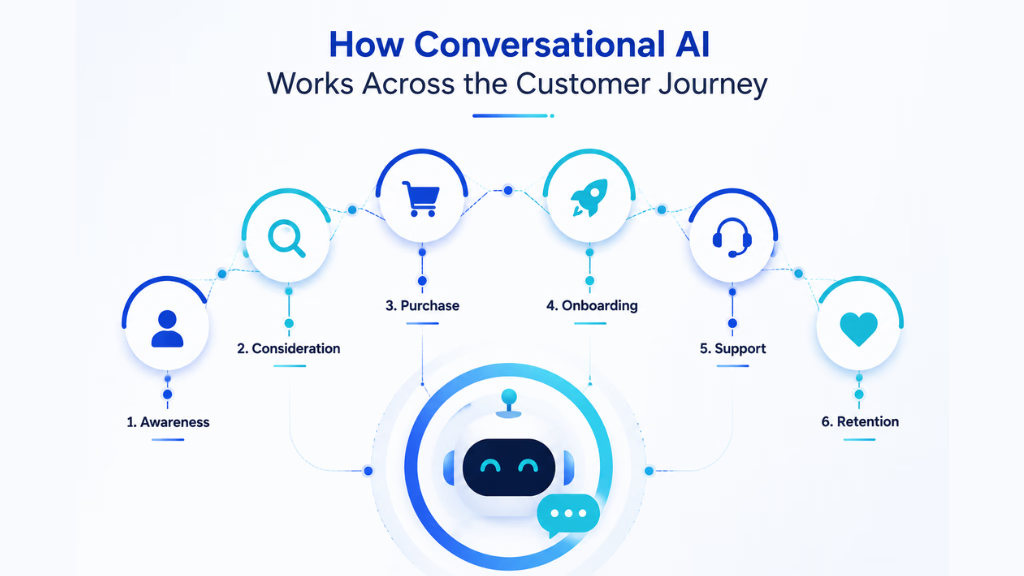
Awareness and Discovery
Potential customers frequently arrive with basic questions about products, services, pricing, capabilities, or availability.
AI assistants can answer these questions instantly and guide visitors toward relevant resources.
Consideration
During evaluation, conversational AI can explain features, compare options, recommend appropriate products, and answer questions that may prevent customers from making a decision.
Purchase
AI systems can help customers complete purchases by answering checkout questions, explaining payment options, checking inventory, or resolving common purchasing problems.
Onboarding
After conversion, conversational AI can guide customers through activation, setup, configuration, and initial product adoption.
Customer Support
Customers can receive immediate assistance with account issues, billing questions, troubleshooting, returns, and other service requests.
Retention and Loyalty
Conversational AI can continue supporting existing customers by recommending useful features, identifying service issues, collecting feedback, and directing customers toward relevant renewal or upgrade options.
Conversational AI vs Traditional Customer Service Chatbots
Although the terms are often used interchangeably, conversational AI and traditional chatbots are not necessarily the same.
Traditional chatbots typically follow predefined conversation paths. They work well for simple questions where customers select from menus or use predictable keywords.
Conversational AI is designed to understand more flexible language and handle conversations dynamically.
| Capability | Traditional Chatbot | Conversational AI |
|---|---|---|
| Rule-based responses | Common | Can be combined with AI |
| Natural language understanding | Limited | Advanced |
| Context awareness | Limited | Strong |
| Generative responses | Usually no | Often supported |
| Voice conversations | Limited | Supported |
| Personalization | Basic | Advanced with integrations |
| Complex conversations | Difficult | More capable |
| Human-agent handoff | Basic | Context-aware handoff possible |
Traditional chatbots can still be effective for simple workflows. Conversational AI becomes more valuable when businesses need more natural interactions, deeper personalization, multiple integrations, or support for complex customer journeys.
Benefits of Conversational AI for Customer Experience
Conversational AI helps businesses create faster, more efficient, and personalized customer interactions by combining automation with intelligent communication.
From reducing response times to improving customer satisfaction, it enables companies to deliver consistent support experiences across multiple channels while allowing human teams to focus on more complex and valuable customer needs.
Faster Customer Service
Conversational AI can respond within seconds, eliminating waiting periods for many routine inquiries.
Lower Customer Effort
Customers can describe problems naturally rather than searching help centers or navigating complicated support menus.
Greater Support Scalability
AI systems can manage large numbers of simultaneous conversations, helping businesses handle spikes in demand without increasing staffing at the same rate.
Better Agent Productivity
Automating repetitive interactions gives human agents more time for complex cases, relationship-building, escalations, and situations requiring judgment.
More Consistent Service
AI can draw answers from approved company knowledge, helping maintain consistency across conversations when knowledge sources are properly managed.
Improved Customer Insights
Conversational interactions generate valuable data about what customers want and where they encounter problems.
Businesses can analyze conversations to identify frequently reported issues, emerging customer concerns, common product questions, recurring complaints, and opportunities to improve products or services.
Increased Conversion Opportunities
Customers often abandon purchases because they cannot quickly find the information they need.
Providing immediate conversational assistance can help remove purchasing barriers and guide high-intent prospects toward the right product or sales representative.
The Role of Human Agents in Conversational AI
Conversational AI does not eliminate the need for human customer service teams.
The most effective customer experience strategies typically combine AI efficiency with human expertise.
AI can manage routine tasks, gather information, and provide immediate answers. Human agents remain especially important for situations involving:
- Complicated complaints
- Sensitive customer issues
- Negotiations
- Unusual exceptions
- High-value customers
- Emotionally difficult conversations
- Decisions requiring judgment
The transition between AI and human support is particularly important.
When a customer is transferred, the agent should ideally receive the conversation history, identified intent, customer information, and actions already completed. Customers should not have to restart the entire conversation.
How to Implement Conversational AI for Customer Experience
Successful conversational AI implementation requires more than installing a chatbot on a website.

Identify High-Impact Customer Journeys
Begin by reviewing customer interactions and identifying repetitive, high-volume processes.
Look at support tickets, call center data, website searches, customer feedback, and agent conversations to determine where customers experience unnecessary friction.
Good initial use cases usually combine high customer demand with relatively predictable workflows.
Connect Conversational AI With Business Systems
The quality of the experience depends heavily on the information and actions available to the AI.
Useful integrations may include:
- CRM platforms
- Customer support systems
- Knowledge bases
- Ecommerce platforms
- Order management systems
- Scheduling software
- Billing platforms
- Inventory databases
Without integrations, conversational AI may be limited to answering general questions. With appropriate integrations, it can perform useful actions.
Build a Reliable Knowledge Base
Generative AI requires accurate business information.
Companies should maintain structured, current content covering products, policies, pricing, troubleshooting instructions, procedures, and frequently asked customer questions.
Outdated knowledge can result in incorrect answers and poor customer experiences.
Design Clear Human Escalation Paths
Businesses should define situations where AI should stop handling the interaction.
Escalation may be triggered when the AI cannot understand the request, the customer explicitly asks for an agent, sentiment becomes strongly negative, the issue involves sensitive information, or a particular workflow requires human approval.
Continuously Review Conversations
Customer language and expectations change over time.
Teams should regularly review AI conversations to identify misunderstood questions, missing knowledge, unsuccessful workflows, and opportunities for better automation.
Conversational AI should be treated as an evolving customer experience system rather than a one-time deployment.
Best Practices for Using Conversational AI in Customer Experience
To create a genuinely useful experience, businesses should follow several important principles.
- Make the AI easy to understand. Customers should know whether they are interacting with an automated assistant and what the system can help them accomplish.
- Keep conversations natural but efficient. Customers usually want answers, not unnecessarily long conversations. Responses should be conversational without becoming verbose.
- Avoid asking for information unnecessarily. If customer data already exists and can be accessed appropriately, the system should not repeatedly ask for it.
- Provide an easy path to human assistance. Customers should never feel trapped inside an automated workflow.
- Protect customer data. Access controls, authentication, encryption, retention policies, and regulatory requirements should be considered when AI systems access customer information.
- Use AI to assist agents as well as customers. Conversational AI can summarize conversations, retrieve knowledge, recommend responses, and prepare agents for customer interactions.
- Measure outcomes rather than automation volume. Automating more conversations is not automatically better if customers become frustrated.
Measuring the Success of Conversational AI
Businesses should evaluate conversational AI using customer experience and operational metrics rather than measuring only the number of automated conversations.
Important metrics can include:
- Customer satisfaction (CSAT)
- First-contact resolution rate
- Average response time
- Average resolution time
- Customer effort score
- AI containment or self-service resolution rate
- Human escalation rate
- Abandonment rate
- Conversion rate
- Appointment completion rate
- Cost per interaction
- Agent productivity
- Repeat contact rate
Conversation quality should also be reviewed directly. A high automation rate means little if customers receive incorrect answers or repeatedly contact support afterward.
Common Challenges of Conversational AI
Conversational AI can significantly improve customer experience, but poor implementation can create new problems.
Incorrect or Hallucinated Answers
Generative AI systems may occasionally generate information that is inaccurate or unsupported.
Businesses should ground AI responses in approved knowledge sources, define appropriate restrictions, and monitor important interactions.
Poor Integration With Customer Data
An intelligent conversational interface cannot deliver personalized support if it cannot access the systems required to resolve customer requests.
Integration architecture is therefore just as important as the AI model itself.
Difficult Human Handoffs
Customers become frustrated when they explain an issue to an AI assistant and then need to repeat everything after being transferred.
Conversation context should follow the customer whenever possible.
Excessive Automation
Not every customer interaction should be automated.
Companies should consider the emotional complexity, business value, risk, and sensitivity of different interactions when determining whether AI or a human should handle them.
The Future of Conversational AI in Customer Experience
Conversational AI is moving beyond simple question-and-answer systems toward more autonomous customer experience platforms.
Future AI systems will increasingly be able to understand customer intent, retrieve information from multiple systems, complete multi-step tasks, coordinate different workflows, and transfer conversations intelligently when human assistance is required.
The larger shift is from AI that simply answers customers to AI that can help customers accomplish goals.
For businesses, the strongest opportunity is not replacing every human interaction. It is creating a customer experience in which AI handles speed, availability, routine processes, and information retrieval while human teams focus on complex decisions, empathy, and relationship-building.
When these capabilities work together, conversational AI can create customer experiences that are faster, more convenient, more personalized, and easier to scale.
Conclusion
Conversational AI now sets the standard for customer experience, but only when it’s built for omnichannel orchestration, clear escalation, and ongoing learning. In my experience, the real payback arrives when teams marry automation with human judgment and analytics that drive constant improvement.
Platforms like Commplify, designed with unified conversation management at their core, give leaders the control to handle volume, boost customer satisfaction, and empower agents — all without hidden silos or dead ends.
If your goal is to make every customer interaction count, start by connecting the dots: automation, insightful analytics, and the right human touch. The future of CX will belong to those who get this balance right.
FAQs
How does conversational AI improve customer experience?
Conversational AI automates routine support, delivers quick, personalized answers, and connects customers to human agents when needed — boosting satisfaction and reducing wait times across all service channels.
What are the benefits of conversational AI in customer service?
It provides 24/7 support, faster response times, personalized interactions, consistent quality, lower costs, agent relief from routine tasks, and strong analytics for continuous improvement.
What’s the difference between conversational AI and chatbots?
Conversational AI uses advanced technologies to understand context and intent, enabling richer, human-like conversations, while basic chatbots follow fixed scripts and struggle with open-ended queries.
Can conversational AI be used on multiple customer service channels?
Yes. Modern conversational AI works across voice, chat, SMS, email, and messaging apps, allowing customers to reach support on their preferred channels with consistent quality.
What technologies power conversational AI?
Core technologies include NLP (Natural Language Processing), NLU (Natural Language Understanding), machine learning, large language models, and real-time analytics.
What are common challenges with implementing conversational AI?
Challenges include poor channel integration, unclear escalation paths, outdated knowledge bases, customer trust issues, data privacy, and too much reliance on automation.
How do you measure the ROI or impact of conversational AI on CX?
Track metrics like CSAT scores, containment rates, average handle time, escalation rates, and cost per contact. Monitor both service performance and customer feedback over time.
How does conversational AI support agent productivity?
By handling repetitive tasks, suggesting answers, managing context, and reducing manual workload, conversational AI lets agents focus on complex and high-value cases.
What types of customer queries does conversational AI resolve best?
It excels at handling FAQs, appointment scheduling, simple account requests, order lookups, technical troubleshooting, and routine policy questions.
What industries benefit most from conversational AI for CX?
Industries like healthcare, financial services, SaaS, retail, BPO, real estate, and logistics see strong value from conversational AI due to high query volumes and need for consistent support.
This page was last edited on 13 August 2026, at 4:32 am