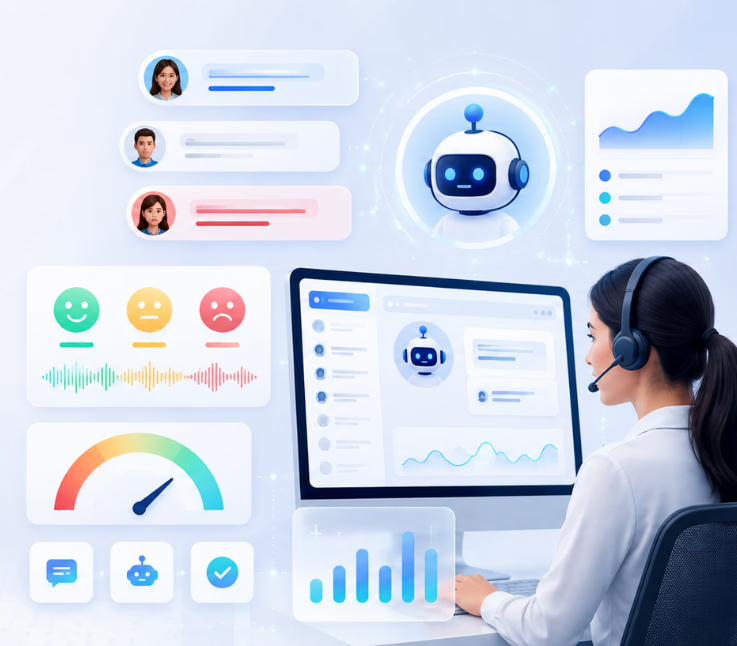
AI-driven customer service solutions with sentiment analysis identify and act on customer emotions across all channels in real time, helping businesses detect dissatisfaction, prevent churn, and enhance support operations with actionable insights and automated workflows.
Customer expectations are at an all-time high. Many support leaders struggle to see problems as they happen, much less respond with empathy and speed. Centralized visibility across channels is rare, and the cost of missed emotions is growing.
I have seen teams try to manage sentiment with scattered notes or manual QA — but friction always creeps in. The real issue is that sentiment flows fast, and pain signals often go unnoticed until it is too late.
This guide unpacks how AI-driven sentiment analysis changes the game: what it is, how it works, the benefits, risks, best practices, and how the right design unlocks true omnichannel empathy you can act on.
How Sentiment Analysis Works in AI Customer Service
Sentiment analysis uses NLP and machine learning models to analyze customer language and classify the emotional tone behind an interaction. Depending on the platform, sentiment can be analyzed from written conversations, voice transcripts, or directly from speech characteristics.
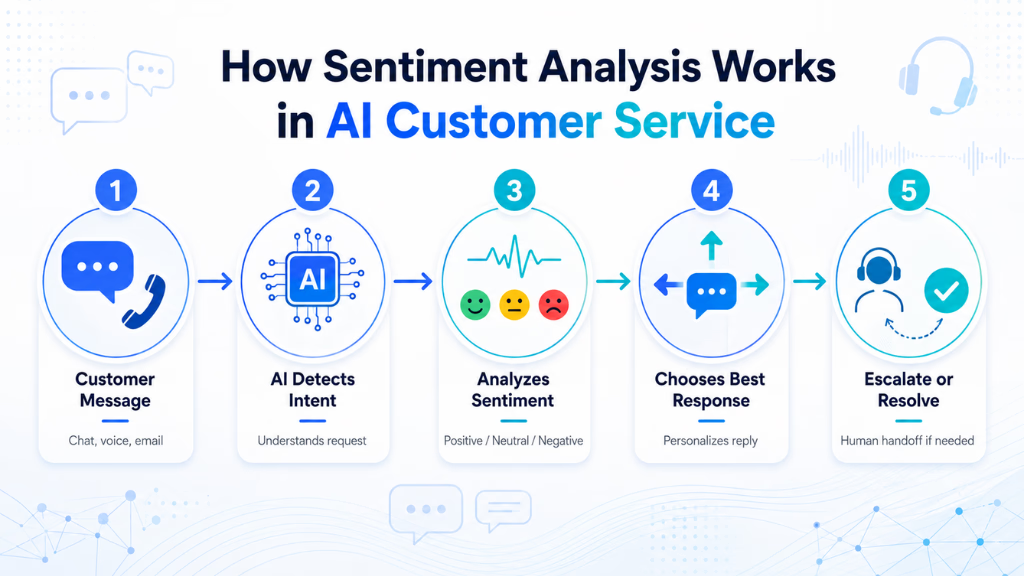
The process generally includes several stages.
1. Customer Interaction Is Captured
The customer contacts the business through a supported communication channel, such as:
- AI voice agents
- Live chat
- SMS
- Contact center conversations
- Social media messaging
- Support tickets
The customer’s message or conversation becomes the input for customer sentiment analysis.
2. AI Identifies Intent and Context
The system analyzes the conversation to determine what the customer wants.
For example, the intent could be:
- Tracking an order
- Reporting a billing problem
- Requesting a refund
- Rescheduling an appointment
- Canceling a subscription
- Reporting a technical problem
At the same time, AI considers previous messages and conversation history so that individual phrases are not interpreted without context.
3. Sentiment Is Detected
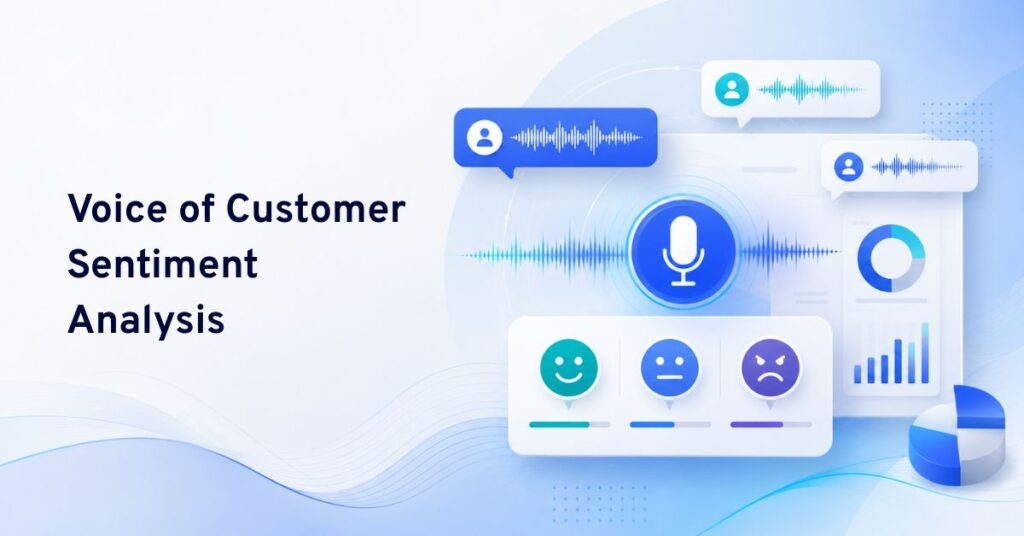
The sentiment analysis model evaluates the language used during the interaction and may classify the customer as positive, neutral, or negative.
More advanced solutions can recognize additional signals such as:
- Frustration: The customer repeatedly explains the same problem or expresses dissatisfaction.
- Urgency: The customer indicates that the issue requires immediate attention.
- Confusion: The customer appears unable to understand instructions or next steps.
- Satisfaction: The customer responds positively after receiving assistance.
Instead of evaluating only one sentence, modern systems can continuously analyze sentiment as the conversation develops.
4. The AI Adjusts the Response
Once sentiment is understood, the customer service system can change its next action.
For instance, if a customer becomes increasingly frustrated, the AI might simplify its response, avoid repetitive troubleshooting questions, prioritize the case, or initiate a human-agent handoff.
If sentiment remains neutral and the request is straightforward, the AI can continue resolving the issue automatically.
5. Sentiment Data Is Stored for Analysis
The detected sentiment can also be connected with CRM, help desk, contact center, or analytics systems.
Businesses can then evaluate sentiment across thousands of conversations to identify recurring problems, underperforming processes, customer experience trends, or products generating unusually high dissatisfaction.
Key Ways Sentiment Analysis Improves AI Customer Service
Sentiment analysis becomes especially valuable when it influences what happens during the conversation rather than simply producing another analytics score.
Smarter AI-to-Human Handoffs
One of the strongest use cases is determining when automation should stop.
A customer may technically be asking a question that AI can answer, but continuing automation is not always the best experience. If sentiment analysis detects increasing frustration, repeated objections, or escalating dissatisfaction, the system can transfer the conversation to a human agent.
The handoff can include important context such as:
- Customer identity
- Reason for contacting support
- Conversation transcript
- Actions already attempted
- Detected sentiment
- Relevant customer history
This prevents customers from having to repeat the entire situation after reaching an agent.
Real-Time Conversation Prioritization
Not every customer interaction requires the same level of urgency.
Sentiment-aware customer service systems can help prioritize conversations based on both business rules and emotional signals. A highly dissatisfied customer experiencing an account or payment problem, for example, can receive higher priority than a routine informational inquiry.
This allows support teams to focus their limited human resources where intervention matters most.
Personalized AI Responses
Customer sentiment provides additional context that allows AI responses to become more appropriate to the situation.
Consider two customers asking about the same delayed delivery.
One simply asks:
“Can you tell me when my package will arrive?”
Another says they have already contacted support multiple times and still have not received an answer.
The underlying intent is similar, but the second interaction requires greater acknowledgment, clearer explanation, and potentially escalation.
Sentiment-aware AI can recognize this difference and adjust the conversation accordingly.
Early Detection of Customer Frustration
Customers do not always explicitly say that they are unhappy.
Negative sentiment can gradually appear through repeated questions, changes in language, shorter responses, complaints, or signs that previous solutions have failed.
Continuous sentiment monitoring helps customer service systems recognize this change earlier. The business can then intervene before frustration develops into a complaint, cancellation request, negative review, or customer churn.
Better Quality Monitoring
Traditional call center quality assurance often depends on supervisors manually reviewing a relatively small sample of conversations.
AI sentiment analysis can evaluate interactions at much larger scale.
Customer experience teams can identify conversations containing:
- Strong negative sentiment
- Sentiment deterioration
- Repeated customer frustration
- Sudden positive sentiment after resolution
- Frequent escalation
- Poor outcomes following specific workflows
Managers can then review the conversations that actually require attention instead of randomly selecting interactions.
AI-Driven Customer Service Use Cases for Sentiment Analysis
Sentiment analysis can support multiple customer-facing workflows rather than being limited to contact center reporting.
AI Voice Customer Service
AI voice agents can use sentiment signals during inbound and outbound calls.
If a routine conversation becomes difficult or emotionally sensitive, the AI system can alter the interaction or transfer the caller to an available human representative.
Sentiment information can also help businesses understand which call flows generate frustration and which successfully resolve customer needs.
Customer Support Chatbots
Customer service chatbots can analyze sentiment across the entire chat instead of relying only on keywords.
If the customer repeatedly states that a suggested solution did not work, the system can recognize deteriorating sentiment and stop cycling through the same automated workflow.
Email Support
AI can classify incoming emails according to intent, urgency, and sentiment.
A company receiving thousands of support emails can use these signals to route highly negative or urgent requests to specialized teams while allowing lower-priority inquiries to follow normal queues.
Contact Center Agent Assistance
Sentiment analysis does not need to replace human agents. It can support them.
During live conversations, AI systems can surface customer context, suggested responses, relevant knowledge base information, and alerts when sentiment begins to decline.
Supervisors can also identify interactions where agents may require assistance.
Customer Feedback Analysis
Companies collect feedback through surveys, reviews, support conversations, social media posts, and open-ended questionnaire responses.
Analyzing these sources manually becomes difficult at scale.
Sentiment analysis can group feedback according to emotional tone and recurring topics, helping businesses understand what customers appreciate and where experiences consistently break down.
Benefits of Combining AI Customer Service With Sentiment Analysis
Combining AI customer service with sentiment analysis helps businesses respond more intelligently to customer needs by understanding both the intent and emotional tone behind each interaction. This enables faster support, more personalized responses, smarter human-agent handoffs, and earlier detection of dissatisfaction—all while helping support teams manage conversations more efficiently.
Faster Response to Dissatisfied Customers
Instead of waiting for customers to request a supervisor or formally complain, businesses can identify negative sentiment earlier and respond proactively.
Higher Automation Quality
Automation becomes more effective when AI knows when it should continue and when human involvement would produce a better outcome.
Reduced Agent Workload
AI can independently handle straightforward conversations while directing complicated or emotionally charged interactions toward human agents.
This allows agents to focus on cases requiring judgment, negotiation, empathy, or specialized knowledge.
Better Customer Experience Insights
Individual customer satisfaction scores provide limited information. Sentiment analysis across thousands of conversations reveals broader patterns.
Businesses can determine whether negative experiences are associated with particular products, support processes, locations, policies, or stages in the customer journey.
More Consistent Service
Sentiment-aware workflows allow businesses to define escalation rules that apply consistently across customer interactions.
Instead of relying entirely on an individual agent to recognize an unhappy customer, automated systems can continuously monitor signals throughout the conversation.
Sentiment Analysis for Inbound and Outbound Customer Service
Sentiment intelligence can be valuable across both inbound and outbound communication.
Inbound Customer Service
During inbound interactions, customers typically contact a company because they need information or have a problem.
Sentiment analysis can help AI systems:
- Detect frustrated callers
- Prioritize urgent cases
- Identify repeated unresolved issues
- Trigger live-agent escalation
- Adjust conversational responses
- Measure customer sentiment after resolution
This is especially useful in customer support, billing, insurance, healthcare administration, telecommunications, financial services, and appointment management.
Outbound Customer Conversations
Sentiment analysis can also improve outbound calls related to sales, follow-ups, reminders, surveys, renewals, and customer retention.
For example, an AI voice agent conducting an outbound follow-up could detect whether the customer appears interested, hesitant, confused, or dissatisfied.
The workflow could then change accordingly rather than forcing every customer through exactly the same conversation script.
Real-Time Sentiment Analysis vs. Post-Interaction Sentiment Analysis
Businesses typically use sentiment analysis in two different ways.
Real-Time Sentiment Analysis
Real-time analysis evaluates sentiment while the customer interaction is still happening.
It is useful for:
- Dynamic AI responses
- Live-agent escalation
- Supervisor alerts
- Conversation routing
- Agent assistance
- Retention opportunities
Its biggest advantage is the ability to influence the customer experience before the conversation ends.
Post-Interaction Sentiment Analysis
Post-interaction analysis evaluates completed calls, chats, emails, or tickets.
It is useful for:
- Quality assurance
- Customer experience reporting
- Product feedback analysis
- Agent coaching
- Trend identification
- Root-cause analysis
The strongest customer service strategies often use both. Real-time sentiment improves individual conversations, while post-interaction analysis helps improve the broader customer experience operation.
How to Implement AI Customer Service With Sentiment Analysis
Adding sentiment analysis should begin with a specific customer experience problem rather than simply adopting another AI feature.
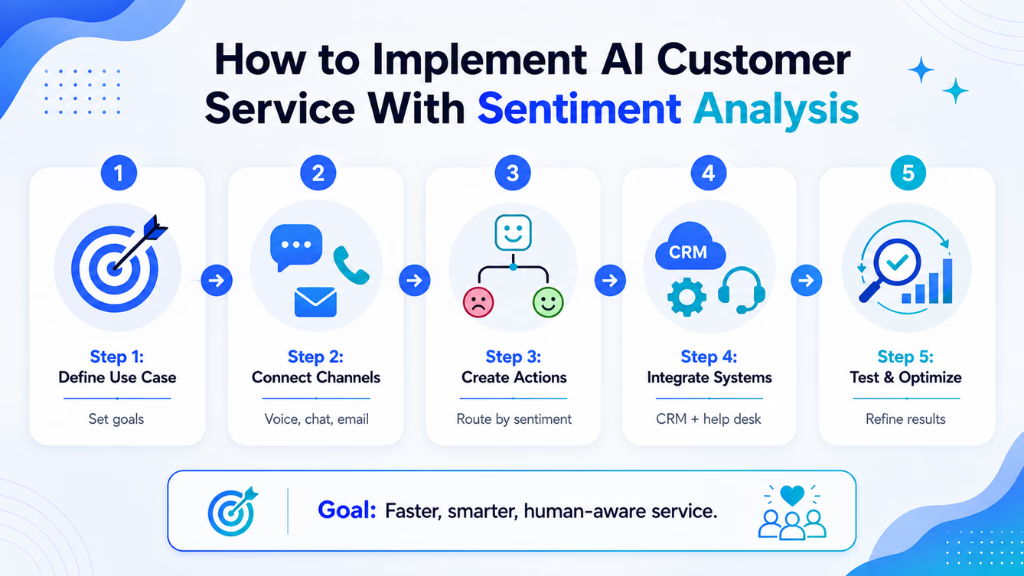
Define the Customer Service Use Case
Determine where sentiment will influence decisions.
For example:
- Should frustrated customers be routed to humans?
- Should negative support tickets receive higher priority?
- Should supervisors receive alerts during difficult calls?
- Should customer feedback be analyzed automatically?
Clear use cases make implementation and measurement easier.
Connect the Required Customer Channels
Identify the channels where sentiment should be analyzed, including voice, chat, email, messaging platforms, or support tickets.
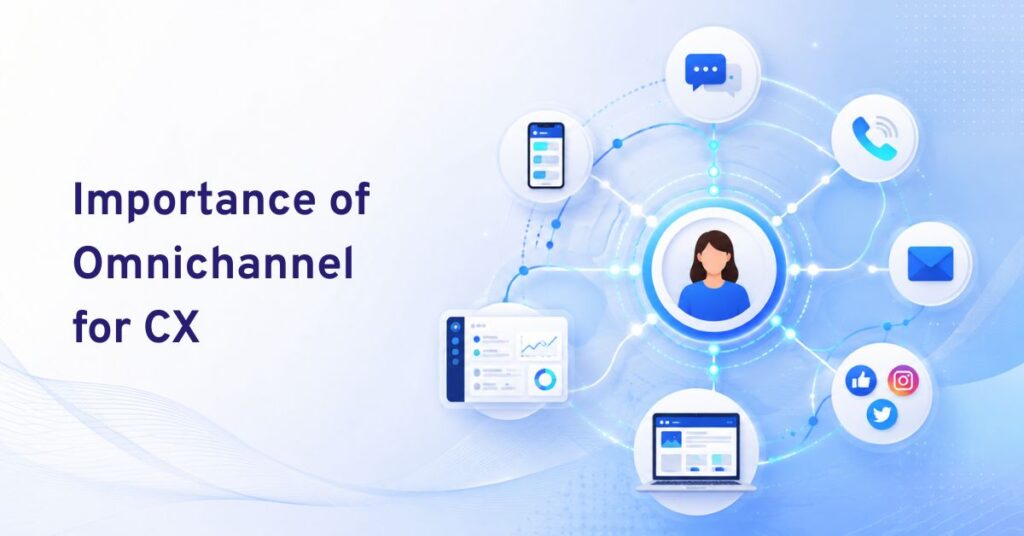
Businesses operating across several channels should ideally centralize sentiment data so customer experience teams can analyze the complete customer journey.
Create Sentiment-Based Actions
A sentiment score has limited value unless the system knows what to do with it.
Businesses can create rules such as:
Negative sentiment + repeated failed resolution → Transfer to human agent
High urgency + billing issue → Prioritize ticket
Negative sentiment after service completion → Trigger customer recovery workflow
Positive sentiment after resolution → Continue automated closure
The exact logic should reflect the company’s service processes.
Integrate With Existing Business Systems
Sentiment-aware AI customer service works best when connected with systems such as:
- CRM platforms
- Help desk software
- Contact center platforms
- Customer databases
- Knowledge bases
- Scheduling systems
- Analytics platforms
These integrations give AI the context required to make better decisions and ensure customer data remains available across teams.
Test With Real Conversation Scenarios
Sentiment analysis should be tested using realistic examples rather than only ideal customer conversations.
Testing should include ambiguous messages, slang, short responses, changing sentiment, repeated complaints, multilingual conversations, and situations where customers use positive words sarcastically or negatively.
No sentiment model will interpret every conversation perfectly, making continuous testing essential.
Important Challenges of AI Sentiment Analysis
Although sentiment analysis can significantly improve customer service automation, it should not be treated as a perfect indicator of customer emotion.
Sarcasm and Indirect Language
A customer might say, “Great, another hour waiting for support.”
Although the word “great” appears positive, the meaning is clearly negative. More advanced language models can understand context better than traditional keyword systems, but errors remain possible.
Cultural and Language Differences
People express dissatisfaction differently across languages and cultures. Sentiment models should therefore be evaluated against the actual customer population the business serves.
Mixed Sentiment
A customer can have multiple emotions within the same interaction.
For example, they may be unhappy about a product problem but satisfied with how the support agent handled it.
A single positive or negative score may not represent this complexity.
Privacy and Data Governance
Customer conversations may contain sensitive or personal information. Businesses should establish appropriate policies around data collection, storage, access, retention, and AI processing before implementing large-scale conversation analysis.
Over-Automation
Sentiment analysis should help businesses determine where automation is appropriate—not provide an excuse to automate every customer interaction.
High-value, complex, sensitive, or emotionally difficult cases may still require human judgment.
How to Measure the Performance of Sentiment-Aware Customer Service
Businesses should evaluate whether sentiment analysis actually improves customer outcomes instead of focusing only on model accuracy.
Useful metrics include:
- Customer satisfaction score (CSAT)
- First-contact resolution rate
- Average resolution time
- Escalation rate
- AI containment or automation rate
- Customer effort score
- Repeat contact rate
- Agent handling time
- Sentiment change during conversations
- Percentage of negative interactions successfully recovered
One especially useful metric is sentiment movement.
If a conversation begins with strong negative sentiment but finishes neutral or positive after resolution, it may indicate that the service process successfully recovered the customer experience.
Best Practices for Sentiment-Aware AI Customer Service
Businesses implementing AI-driven sentiment analysis should keep several principles in mind.
- Use sentiment as context, not absolute truth. Sentiment predictions can be wrong, so important decisions should combine sentiment with customer history, intent, urgency, and business rules.
- Monitor sentiment throughout the conversation. Customer emotions can change rapidly after a failed solution or successful resolution.
- Design clear escalation paths. AI should know when and how to involve human agents without creating additional friction.
- Give agents the conversation context. When escalation occurs, agents should receive the transcript, detected issue, relevant customer information, and actions already completed.
- Regularly evaluate sentiment accuracy. Review incorrectly classified interactions and adjust models, prompts, workflows, or thresholds when needed.
- Measure business outcomes. The goal is not simply to detect negative language. The goal is to resolve customer problems faster and create better customer experiences.
The Future of Sentiment-Aware AI Customer Service
Customer service AI is moving beyond basic intent recognition toward systems capable of understanding broader conversational context.
Sentiment analysis plays an important role in that transition because customer service decisions depend on more than the literal meaning of a customer’s words.
As AI voice agents, conversational AI, real-time analytics, and agent-assistance systems become more connected, businesses will increasingly be able to detect customer experience problems while conversations are happening and respond immediately.
The most effective AI-driven customer service solutions will not simply automate more interactions. They will use sentiment, intent, customer history, and real-time context together to determine when AI should solve the problem, when the conversation should change, and when a human should take over.
Bringing It All Together: How Commplify Supports AI-Driven Sentiment CX
Commplify’s AI agents monitor sentiment in every conversation — voice, chat, SMS, email, WhatsApp — and can automatically trigger specific actions when negative signals emerge. If a customer’s tone shifts from polite to frustrated, workflow automation kicks in: a supervisor gets an alert, or a follow-up message is sent.
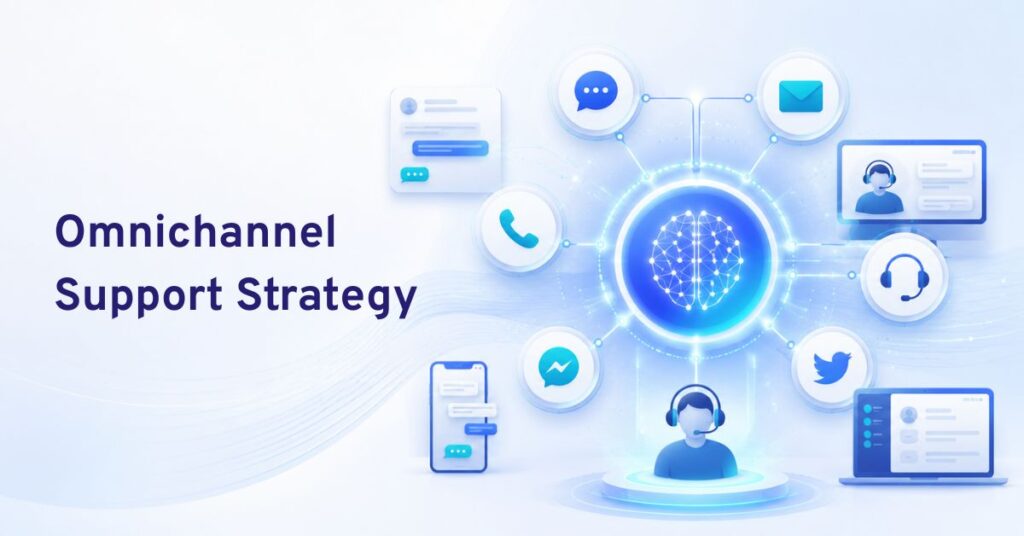
With all channels feeding into a unified inbox, agents get the full picture, not just snippets, leading to a smoother transition and better customer experience. The visual workflow builder lets teams design escalation paths and recovery efforts without code, so every at-risk customer is covered. In my experience, this setup means no lost signals and fewer upset customers slipping through the cracks.
Conclusion
AI-driven customer service solutions with sentiment analysis are no longer optional for enterprises that want real progress in customer experience. Real-time emotional data — unified across channels — lets teams intervene, recover, and even delight before issues spiral out of control.
The right platform does not just label emotions; it makes them part of how you serve, escalate, and improve. Commplify gives you these capabilities natively, but what truly matters is the shift in mindset: proactive, data-driven empathy is now possible, and results will show in customer loyalty and operational performance.
If you want to keep pace as CX gets smarter, now is the time to put sentiment at the core of your omnichannel support. AI-driven solutions are moving from “nice to have” to “must have.” The teams that move first will build the customer relationships that last.
FAQs
What is AI-driven sentiment analysis in customer service?
It is the use of artificial intelligence to detect and interpret customer emotions in real time from all support conversations, across channels.
How do AI platforms detect customer sentiment across channels?
They use NLP and machine learning to analyze words, tone, and context in messages and calls, classifying emotions like positive, negative, or neutral.
What are the main benefits of integrating sentiment analytics in contact centers?
Early detection of issues, reduced churn, better customer satisfaction, more efficient operations, and improved agent coaching.
How can AI sentiment detection reduce churn and improve CSAT?
By flagging at-risk customers in real time, teams can act faster, fix problems early, and close service gaps, boosting loyalty and satisfaction.
What industries see the greatest impact from AI-powered sentiment analysis?
Healthcare, finance, e-commerce, SaaS, BPO, real estate, travel, and any sector with high customer touchpoints.
What challenges should companies expect when deploying sentiment analysis solutions?
Possible pitfalls include accuracy failures with sarcasm or slang, privacy risks, lack of action on emotion signals, and missing cross-channel context.
How do you implement AI-driven sentiment analysis in an omnichannel platform?
Map all channels, train models for your domain, unify data flows, connect robust knowledge bases, and automate workflows for detected sentiment.
Which metrics matter most when measuring sentiment analysis ROI?
Churn rate, CSAT, NPS, escalation frequency, response time, and sentiment trend analytics by channel.
How does sentiment analysis support agent coaching and escalation?
It highlights emotional patterns in interactions, enabling tailored feedback and triggering prompt escalations in high-risk situations.
What privacy and compliance considerations should organizations keep in mind?
Ensure secure storage, limit access, log data use, and stay compliant with relevant laws when capturing and analyzing emotion-related customer data.
This page was last edited on 10 August 2026, at 2:34 am