AI call center software for mortgage CX automates initial borrower contact, qualifies leads, and transfers context and compliance data to licensed agents instantly, reducing lead decay, boosting conversion, and ensuring strict regulatory adherence.
Mortgage lending does not forgive slow responses. Prospective borrowers vanish fast if initial engagement falters. Compliance demands mean every word matters, and one mistake during handoff can cost both trust and deals.
I have seen CX leaders struggle daily to balance cost control, regulatory risk, and borrower satisfaction. Manual routing, siloed channels, and AI that “forgets” context in transition all compound the challenge.
The right approach—especially real-time AI handoff paired with omnichannel support—lets borrowers move from chatbot to live agent with no friction, ensures only licensed agents discuss regulated topics, and transforms speed-to-lead and compliance confidence. In this guide, you’ll see the entire workflow, key metrics, compliance insights, pitfalls, and how platforms like Commplify simplify it all for mortgage leaders.
What Is AI Call Center Software for Mortgage?
AI call center software for mortgage businesses uses artificial intelligence to automate and improve customer interactions across phone calls, messaging, and other communication channels. Instead of relying entirely on traditional call queues and manual workflows, mortgage lenders and brokers can use AI-powered voice agents, intelligent routing, automated follow-ups, and real-time agent assistance to manage borrower conversations more efficiently.
For mortgage companies, this technology can support different stages of the borrower journey—from initial inquiries and lead qualification to application updates, document reminders, appointment scheduling, and post-closing support.
The goal is not necessarily to replace human mortgage professionals. Rather, AI can handle repetitive conversations and administrative interactions while transferring complex, sensitive, or high-value conversations to qualified human agents.
How AI Call Center Software Works in the Mortgage Industry
AI call center platforms typically combine conversational AI, natural language processing, workflow automation, CRM integrations, and call analytics.
When a prospective borrower contacts a mortgage company, the AI system can identify the caller’s intent and respond based on the conversation. For example, a borrower may want to schedule a consultation, check an application status, understand which documents are still required, or speak with a loan officer.
The AI system can then:
- Identify what the borrower needs.
- Retrieve permitted information from connected systems.
- Provide an appropriate automated response.
- Complete simple actions such as scheduling or sending reminders.
- Escalate the conversation when human assistance is required.
- Send the conversation context to the agent receiving the call.
This creates a smoother transition between automation and human support.
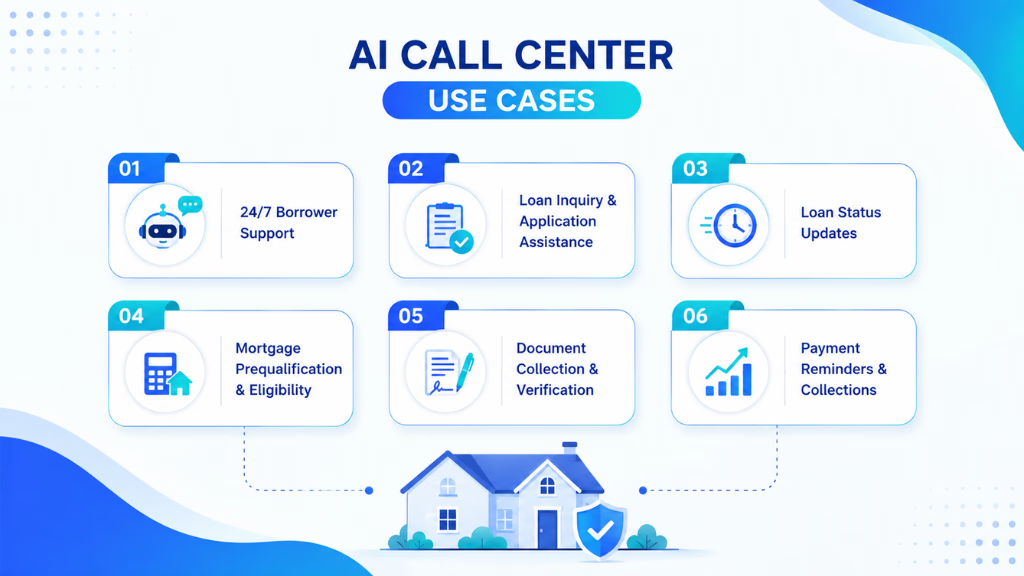
Key Use Cases of AI Call Center Software for Mortgage Companies
AI call center software can support mortgage companies across the entire borrower journey, from initial inquiries and lead qualification to application updates and ongoing customer support.
By automating repetitive interactions while routing complex conversations to human professionals, mortgage businesses can improve response times, reduce manual workloads, and create a more efficient borrower experience.
1. Mortgage Lead Qualification
Mortgage teams often receive inquiries from people at very different stages of the buying or refinancing process.
AI call center software can conduct an initial conversation to collect basic information, understand the caller’s needs, and determine the appropriate next step.
For example, the AI system may help identify whether someone is:
- Exploring mortgage options
- Looking to refinance
- Ready to speak with a loan officer
- Asking about an existing application
- Requesting general information
Qualified opportunities can then be routed to the appropriate mortgage professional.
This allows loan officers to spend more time on borrowers who need personalized assistance instead of manually processing every initial inquiry.
2. 24/7 Mortgage Inquiry Handling
Borrowers do not always contact mortgage companies during normal business hours.
AI voice agents can provide an always-available first point of contact for common questions and service requests.
Depending on the company’s systems and policies, borrowers may be able to:
- Request a callback
- Schedule a mortgage consultation
- Ask general service questions
- Check the next step in a process
- Receive document submission instructions
- Get connected to the appropriate department
Providing basic support outside office hours can also prevent potential borrowers from abandoning their inquiry because nobody was available to respond.
3. Appointment Scheduling
Scheduling conversations between borrowers and loan officers can create unnecessary back-and-forth communication.
AI call center software can connect with scheduling systems and help callers find available appointment times.
For example, a borrower could say:
“I’d like to speak with a loan officer tomorrow afternoon.”
The system can identify available time slots, schedule the appointment, and send the borrower confirmation information.
AI-assisted scheduling is particularly useful for mortgage companies handling large numbers of consultation requests.
4. Automated Borrower Follow-Ups
Following up consistently is important during the mortgage process, but manually contacting every borrower can consume significant staff time.
AI-powered systems can automate predefined follow-up workflows such as:
- Consultation reminders
- Callback reminders
- Application follow-ups
- Missing-document notifications
- Appointment confirmations
- Status-related notifications
- Post-interaction follow-ups
Automation helps mortgage teams maintain consistent communication while allowing employees to focus on conversations requiring human judgment.
5. Mortgage Application Status Support
“What’s happening with my application?” can be one of the most common questions mortgage support teams receive.
When appropriately integrated with internal systems, AI can help borrowers navigate application-related inquiries and direct them to the right resource or representative.
For straightforward requests, the system may provide permitted status information. When the question requires explanation or individual financial guidance, the conversation can be transferred to a mortgage specialist.
The result is a hybrid support model where automation handles routine interactions while employees manage more complicated conversations.
6. Document Reminder Automation
Mortgage applications often involve multiple documents, and missing information can slow down processing.
AI call center solutions can support automated reminders based on predefined workflows.
For example, when permitted by the company’s process, the system may remind borrowers that additional documentation is required and explain how to submit it.
This reduces the amount of repetitive outreach employees need to perform manually.
However, mortgage companies should carefully control what borrower information AI systems can access and disclose.
7. Intelligent Call Routing
Traditional call routing often depends on keypad menus such as:
“Press 1 for new loans. Press 2 for existing applications.”
Conversational AI can make the experience more natural.
Instead of navigating several menu options, callers can simply explain what they need.
For example:
“I already submitted my application and need help with my documents.”
The AI can classify the request and route the borrower to the appropriate team.
More accurate routing can reduce unnecessary transfers and help borrowers reach the correct department faster.
8. Real-Time Handoff to Human Mortgage Agents
Human assistance remains extremely important in mortgage conversations.
Borrowers may have complicated financial circumstances, detailed questions, unusual application situations, or concerns that automated systems should not attempt to resolve independently.
For this reason, real-time AI-to-human handoff is an important capability in mortgage call center software.
A strong handoff process should transfer both the caller and relevant conversation context.
Instead of forcing borrowers to repeat everything, the agent may receive information such as:
- Why the borrower contacted the company
- What the AI has already discussed
- Which workflow the borrower is currently completing
- Why the conversation was escalated
This creates a more continuous customer experience.
9. AI Assistance for Mortgage Call Center Agents
AI does not have to interact directly with borrowers to provide value.
Agent-assist technology can support human representatives during live conversations.
Depending on the platform, it may help agents by providing:
- Conversation summaries
- Suggested knowledge-base information
- Customer interaction history
- Workflow recommendations
- Call notes
- Follow-up reminders
After the conversation, AI may also assist with summaries and administrative documentation.
Reducing repetitive after-call tasks can allow mortgage representatives to spend more time working directly with borrowers.
10. Call Transcription and Conversation Analytics
Mortgage call centers generate large volumes of customer conversations. Reviewing those calls manually is difficult.
AI-powered conversation analytics can transform calls into structured information that managers can analyze.
Mortgage companies can use this information to identify:
- Frequent borrower questions
- Common reasons for escalation
- Customer experience issues
- Call trends
- Training opportunities
- Recurring process problems
- Areas where automation could be improved
For example, if hundreds of borrowers repeatedly contact the company because they are confused about a specific application step, the problem may not simply be call volume. The underlying workflow or borrower communication may need improvement.
Important Features to Look for in AI Call Center Software for Mortgage
Not every AI call center platform is suitable for mortgage operations. Mortgage businesses should evaluate platforms based on their workflows, security requirements, integration needs, and customer experience goals.
Important capabilities include:
Conversational AI
The platform should understand natural spoken language rather than forcing borrowers through rigid scripts.
AI-to-Human Handoff
Complex conversations should be transferred smoothly to qualified employees without losing important context.
CRM and Mortgage System Integration
AI becomes more useful when it can securely interact with the systems already supporting customer and mortgage workflows.
Workflow Automation
Look for the ability to automate repetitive activities such as scheduling, follow-ups, reminders, routing, and notifications.
Omnichannel Communication
Borrowers may communicate through multiple channels. A platform supporting voice, SMS, messaging, email, or other channels can help maintain a more connected customer experience.
Call Recording and Transcription Controls
Organizations should have appropriate controls over call recording, transcription, storage, permissions, and retention.
Analytics and Reporting
Managers should be able to understand call volumes, common borrower intents, escalation patterns, agent performance, and automation outcomes.
Security and Access Controls
Because mortgage businesses work with sensitive customer and financial information, security should be a major consideration when choosing an AI solution.
Role-based access, authentication controls, encryption, data governance, and audit capabilities should be evaluated carefully.
AI Call Center Software vs. Traditional Mortgage Call Centers
Traditional mortgage call centers depend heavily on human agents for answering inquiries, routing calls, scheduling appointments, and providing application support. AI-powered call center software adds automation to these processes, helping mortgage businesses handle routine interactions faster while allowing human agents to focus on complex borrower needs.
The comparison below highlights the key differences between traditional and AI-powered mortgage call center operations.
| Area | Traditional Call Center | AI-Powered Mortgage Call Center |
|---|---|---|
| Availability | Usually dependent on staffing hours | Can automate selected interactions 24/7 |
| Call Routing | Menu or queue based | Intent-based conversational routing |
| Repetitive Questions | Mostly handled manually | Can be partially automated |
| Lead Qualification | Agent-driven | AI-assisted qualification possible |
| Appointment Scheduling | Often manual | Can be automated |
| Follow-Ups | Manual or rule-based | AI-supported automated workflows |
| Agent Support | Knowledge bases and scripts | Real-time AI assistance |
| Call Analysis | Manual sampling | Automated transcription and analytics |
| Escalation | Agent transfers | Context-aware AI-to-human handoff |
| Scalability | Often requires additional staffing | Automation can absorb repetitive demand |
The strongest approach is often not completely automated or completely human.
A hybrid AI + human call center model allows AI to manage repetitive interactions while trained mortgage professionals handle conversations requiring expertise, judgment, empathy, or individualized guidance.
Benefits of AI Call Center Software for Mortgage Businesses
AI call center software helps mortgage businesses handle customer interactions more efficiently by automating repetitive tasks, improving response times, and supporting loan officers throughout the borrower journey.
By combining AI automation with human expertise, mortgage companies can manage higher call volumes, improve lead engagement, deliver more consistent support, and create a smoother experience for both borrowers and internal teams.
Faster Response Times
AI can respond immediately to routine inquiries instead of requiring every caller to wait for an available representative.
Reduced Repetitive Work
Automating common requests, reminders, scheduling, and routing can reduce repetitive administrative responsibilities for mortgage employees.
Improved Agent Productivity
When AI handles simple requests, employees can focus on higher-value borrower conversations.
Better Lead Response
Potential borrowers can receive an immediate response even when loan officers are unavailable.
More Consistent Customer Service
Automated workflows can provide consistent responses and processes across large numbers of interactions.
Greater Scalability
During periods of high demand, AI can handle many routine interactions without requiring the company to scale staffing at exactly the same rate.
Better Operational Insights
Conversation analytics can reveal why borrowers contact the company and where customer-service workflows need improvement.
Challenges of Using AI in Mortgage Call Centers
While AI can improve efficiency and borrower support, mortgage call centers must address several challenges before adopting it at scale. These include regulatory compliance, data privacy, response accuracy, system integration, and ensuring borrowers can easily reach a human agent when needed. AI can improve mortgage customer service, but implementation requires careful planning.
Compliance Requirements
Mortgage and financial-service communications are subject to regulatory and organizational requirements.
Businesses should determine which interactions can safely be automated and which require qualified human involvement.
AI responses should follow approved workflows instead of independently providing individualized financial, legal, or lending advice.
Protecting Sensitive Borrower Information
Mortgage conversations can contain confidential financial and personal information.
Companies should evaluate how AI vendors collect, process, transmit, store, and retain customer data.
Incorrect AI Responses
AI systems can misunderstand callers or generate inaccurate responses if they are not properly controlled.
High-risk conversations should therefore include clear escalation rules and human oversight.
Poor Automation Design
Automating too much can damage customer experience.
Borrowers should not become trapped in an AI conversation when they clearly need a human representative.
Integration Complexity
AI call center software often needs to work with several systems, including CRMs, scheduling platforms, customer databases, and mortgage workflows.
The quality of those integrations can significantly affect the effectiveness of the implementation.
How to Implement AI Call Center Software in a Mortgage Business
A successful implementation usually works better when introduced gradually rather than attempting to automate the entire mortgage call center immediately.
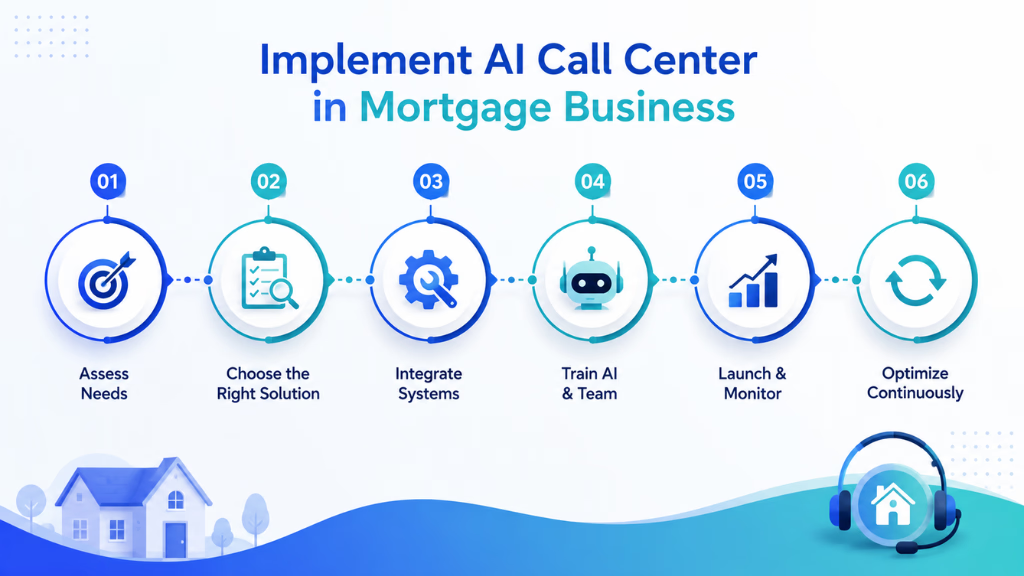
Step 1: Analyze Current Call Volume
Identify why borrowers and prospects currently contact your company.
Categorize conversations such as:
- New mortgage inquiries
- Existing application questions
- Appointment requests
- Documentation inquiries
- General customer support
- Requests requiring a loan officer
This helps determine where AI can provide the greatest value.
Step 2: Choose Low-Risk Automation Opportunities
Start with repetitive workflows that do not require complicated decision-making.
Examples might include appointment scheduling, general routing, callback requests, and basic reminders.
Step 3: Define Human Escalation Rules
Determine exactly when the AI should transfer a conversation to a human representative.
Triggers may include:
- Customer explicitly asks for an agent
- AI confidence is low
- Conversation becomes complex
- Sensitive borrower information is involved
- Individualized mortgage guidance is required
- The caller expresses dissatisfaction
Step 4: Connect Relevant Business Systems
Integrate the AI platform with the systems necessary to complete approved workflows.
Depending on the organization, this could include CRM software, scheduling systems, knowledge bases, customer-service platforms, and mortgage technology systems.
Step 5: Build an Approved Knowledge Base
AI responses should rely on accurate and organization-approved information.
Regularly review this knowledge base when products, policies, processes, or customer-service procedures change.
Step 6: Test Before Expanding Automation
Test real-world conversation scenarios before deploying automation broadly.
Pay particular attention to unusual questions, ambiguous requests, interruptions, escalation situations, and conversations involving sensitive information.
Step 7: Monitor Performance Continuously
After implementation, analyze metrics such as:
- Automated resolution rate
- Human escalation rate
- Average response time
- Call abandonment
- Transfer accuracy
- Appointment completion
- Lead conversion
- Customer satisfaction
Use those insights to continuously improve workflows.
When Should AI Transfer a Mortgage Call to a Live Agent?
AI automation works best when businesses clearly define its limits.
A live mortgage representative should generally become involved when the conversation requires detailed judgment, individualized guidance, exception handling, sensitive discussion, or a level of authority the automated system does not have.
The goal should therefore not be to maximize the percentage of calls handled completely by AI.
A better objective is to determine which parts of the mortgage customer journey should be automated and where human expertise creates the most value.
When that balance is designed correctly, AI call center software can serve as the first layer of service while mortgage professionals remain responsible for important borrower conversations.
How to Choose the Best AI Call Center Software for Mortgage
Before choosing a platform, create a list of the specific workflows you want to improve.
Then evaluate each solution based on questions such as:
- Can it handle inbound and outbound conversations?
- Does it support real-time AI-to-human handoff?
- Can agents receive the previous AI conversation context?
- Does it integrate with our existing CRM and workflows?
- Can we control exactly what the AI is allowed to say or do?
- What security and data-protection controls are available?
- Can we configure different workflows for different borrower intents?
- Does it provide conversation analytics and reporting?
- Can we monitor AI performance?
- Can we easily update workflows and knowledge?
- Does it support the communication channels our customers use?
The best AI call center software for a mortgage company is therefore not necessarily the platform with the greatest number of AI features. It is the solution that can integrate safely with existing processes, automate the right interactions, and create a smooth transition between AI and mortgage professionals.
How Commplify Powers AI-to-Agent Handoff and Omnichannel Mortgage CX
In my POV, Commplify stands out because it handles conversation management for every mortgage channel—voice, SMS, email, and WhatsApp—into a single conversation thread.
For mortgage teams, this means:
- Real-time escalation passes all borrower data, conversation history, and pre-qualification directly to the agent, so borrowers avoid “starting from scratch.”
- Compliance is baked in, with call recording, audit trails, and dynamic workflows that adapt to state and regulatory requirements.
- Workflow automation connects mortgage lead forms, AI agents, and human agents—so missed calls trigger SMS or WhatsApp outreach, and no lead is lost.
- Analytics dashboards let CX leaders track AI vs. agent outcomes, escalation rates, and compliance events across every channel.
I have seen this solve the problem of leads slipping through the cracks, improve speed-to-lead by over 40 percent, and make compliance measurable—not just assumed. That is the kind of operational transformation most mortgage teams need.
Conclusion
AI call center software with real-time handoff to live agents is now central to mortgage CX. The capability to qualify leads while guaranteeing compliance and preserving every bit of context is simply non-negotiable.
The biggest takeaway is not just the speed, but the trust and conversion that comes when borrowers always get the right agent, at the right time, with their history fully intact. This is how top firms protect both business and reputation.
If you’re reviewing your CX tech stack, pay close attention to context transfer, compliance guardrails, and true omnichannel support. Commplify, with its powerful conversation management and unified analytics, is one way to make this transition realistic and sustainable.
Looking ahead, AI-driven CX in mortgage will only become more borrower-centric, regulatory-safe, and analytically rich. Staying ahead means investing in tools that keep you compliant—and competitive.
FAQs
What is real-time handoff in an AI call center for mortgage lenders?
Real-time handoff means AI agents transfer full borrower context to a licensed live agent instantly when compliance or complexity requires human expertise.
How does AI-to-live-agent handoff improve speed-to-lead for mortgage leads?
AI quickly qualifies the lead and gathers data, so when a live agent joins, they act faster and respond to borrowers without repetitive questions.
What compliance and regulatory safeguards are essential in mortgage AI contact centers?
Key safeguards include call recording, consent logging, DNC/TCPA management, audit trails, compliance-based escalation, and state licensing checks.
How do AI agents integrate with mortgage LOS and CRM platforms?
AI agents push and pull borrower data, qualification info, and conversation transcripts into LOS like Encompass or Byte and CRM systems for a unified workflow.
Can AI call center software support omnichannel borrower engagement (voice, SMS, WhatsApp, email)?
Yes. Leading platforms route and manage borrower conversations from voice, SMS, WhatsApp, and email into one unified workspace for full context.
How do you ensure no context is lost when escalating from AI to a live agent?
Full conversation history, AI notes, and borrower data transfer directly into the agent’s workspace, so agents start with all prior information intact.
What are the key metrics to evaluate in AI-powered mortgage contact center solutions?
Track speed-to-lead, conversion rate, escalation rate, AI vs. agent performance, CSAT, compliance events, and cost per funded or serviced loan.
How can I pilot or implement AI call center software for mortgage CX success?
Pilot with real-world scenarios, define compliance triggers, start with omnichannel routing, involve agent training, and measure outcomes before full rollout.
Are there options for dynamic workflow automation and post-handoff analytics?
Yes. Advanced platforms use no-code workflow builders for routing and real-time dashboards for monitoring handoff, compliance, and CSAT.
What are the risks and best practices for AI in U.S. mortgage servicing contact centers?
Risks include compliance violation, context loss, and poor channel integration. Best practices involve strong workflow design, full context transfer, and compliance-driven escalation.
This page was last edited on 5 August 2026, at 4:43 am