Agentic AI is most appropriate for complex, unpredictable tasks that need context, memory, and dynamic decision-making—like orchestrating multi-channel customer support or handling exceptions—where basic, rule-based automation is not enough.
If you’re leading a CX, support, or operations team, you have likely asked: “Should I automate this with simple rules, or does it need something smarter?” The stakes are real. Choose wrong, and you risk frustration for both your customers and your staff.
I have seen companies waste months building rigid bots that melt down at the first real-world exception. Yet when applied well, agentic AI can solve tough, high-variability issues at scale, freeing up human experts for what they do best.
In this guide, you’ll learn when to use agentic AI, which tasks demand its unique strengths, and how to match the right automation model to the real-life workflows inside your enterprise.
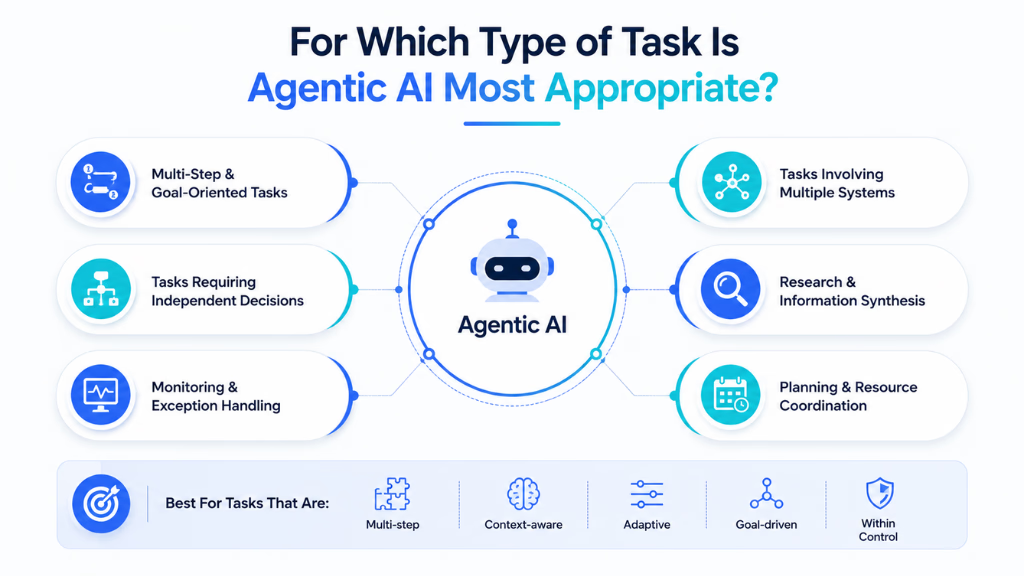
For Which Type of Task Is Agentic AI Most Appropriate?
Agentic AI is most appropriate for tasks that require more than a single response or predefined action. Unlike traditional automation, which follows fixed rules, agentic AI can understand a goal, develop a plan, make decisions, use available tools, complete multiple steps, and adjust its actions based on changing conditions.
This makes it especially valuable for complex, dynamic, and goal-oriented workflows where human employees would normally need to gather information, evaluate options, coordinate systems, and determine the next best action.
However, agentic AI is not equally suitable for every business process. It delivers the greatest value when a task involves autonomy, reasoning, adaptation, and multiple connected actions.
1. Multi-Step and Goal-Oriented Tasks
Agentic AI is highly appropriate for tasks that involve several steps leading toward a defined outcome.
Instead of waiting for a separate instruction at every stage, an AI agent can break the objective into smaller actions, determine their proper sequence, complete each step, and track progress until the goal is achieved.
For example, when asked to prepare a customer renewal strategy, an agent could:
- Review the customer’s account history
- Analyze product usage and engagement
- Identify potential churn risks
- Select an appropriate retention offer
- Draft a personalized outreach message
- Schedule a follow-up activity
- Update the customer relationship management system
Traditional automation may require a separate workflow for each of these activities. An agentic system can coordinate them as parts of one larger objective.
This makes agentic AI suitable for:
- Customer onboarding
- Sales follow-up
- Claims processing
- Employee onboarding
- Vendor evaluation
- Account management
- Research and reporting
- IT service workflows
2. Tasks That Require Independent Decision-Making
Agentic AI works well when a task requires selecting the next action based on available information.
A rule-based system typically follows instructions such as “If condition A occurs, perform action B.” An AI agent can evaluate a wider range of factors, compare possible actions, and choose the option most likely to achieve the intended goal.
For instance, a customer service agentic AI system may assess:
- The customer’s request
- Previous conversations
- Account value
- Sentiment and urgency
- Relevant company policies
- Available support resources
Based on this context, it might resolve the issue, request additional information, recommend a solution, or escalate the case to a human representative.
Agentic AI is therefore appropriate for decision-heavy tasks such as lead prioritization, support ticket routing, fraud investigation, resource allocation, risk assessment, and operational exception handling.
For high-impact decisions, organizations should maintain clear approval rules and human oversight rather than allowing the AI to operate without limits.
3. Tasks Involving Changing Information
Agentic AI is especially useful in environments where information, priorities, or conditions change frequently.
Static workflows can become ineffective when unexpected situations occur. An AI agent can monitor new information, reassess its original plan, and modify its actions accordingly.
For example, a supply chain agent might continuously analyze:
- Inventory levels
- Supplier availability
- Delivery delays
- Demand forecasts
- Transportation costs
- Production schedules
When a supplier experiences a delay, the agent could identify alternative vendors, compare costs and delivery times, recommend a replacement, and update the procurement team.
This adaptive capability makes agentic AI suitable for dynamic tasks in logistics, cybersecurity, customer support, financial operations, workforce management, and project coordination.
4. Tasks That Require Coordination Across Multiple Systems
Many business processes require employees to move between several applications, collect information from each system, and manually transfer data from one platform to another.
Agentic AI can help connect these fragmented activities.
Depending on its permissions and integrations, an AI agent may interact with:
- CRM platforms
- Email systems
- Help desk software
- Enterprise resource planning systems
- Knowledge bases
- Scheduling tools
- Analytics platforms
- Internal databases
Consider a sales qualification workflow. An AI agent could review an incoming lead, enrich the contact information, check previous interactions, calculate a qualification score, assign the lead to the appropriate representative, draft an introductory email, and create a CRM task.
The agent is not simply automating one action. It is coordinating a complete process across different systems.
This makes agentic AI particularly appropriate for workflows affected by disconnected tools, repetitive data transfers, and frequent application switching.
5. Research and Information Synthesis Tasks
Agentic AI can be highly effective for research tasks that require gathering, comparing, organizing, and summarizing information from multiple sources.
Rather than returning a general answer, an agent can follow a structured research process. It may define subtopics, collect relevant information, compare findings, identify gaps, and produce an organized output.
Possible use cases include:
- Market research
- Competitor analysis
- Product research
- Policy review
- Customer feedback analysis
- Industry trend monitoring
- Internal knowledge discovery
- Business intelligence reporting
For example, an agent conducting competitor research could examine product features, pricing, market positioning, customer reviews, and recent announcements. It could then organize the findings into a comparison report and highlight potential strategic opportunities.
Human review remains important when the research will support legal, medical, financial, or major business decisions. The sources, assumptions, and conclusions should be verifiable.
6. Customer Service and Case Resolution Tasks
Customer service is one of the strongest use cases for agentic AI because many support interactions require context, reasoning, and several connected actions.
A conventional chatbot may answer frequently asked questions. An agentic AI system can go further by working toward the actual resolution of the customer’s problem.
For example, it could:
- Identify the customer and retrieve account details
- Understand the issue from the conversation
- Review previous interactions and relevant policies
- Diagnose the likely cause
- Complete approved actions in connected systems
- Confirm whether the issue has been resolved
- Escalate the case when human support is necessary
Typical applications include order-status inquiries, appointment rescheduling, subscription changes, refund eligibility checks, technical troubleshooting, and complaint management.
Agentic AI is particularly valuable when customers expect support across voice, chat, email, social media, and messaging channels. An agent can preserve context across these touchpoints and help maintain a more consistent experience.
7. Personalized Sales and Marketing Tasks
Sales and marketing activities often involve choosing the right message, channel, offer, and timing for each prospect or customer. Agentic AI can analyze individual context and coordinate personalized actions at scale.
A sales agent might:
- Research a prospect
- Identify relevant pain points
- Review previous engagement
- Recommend the next best action
- Draft a personalized message
- Schedule follow-ups
- Update the opportunity record
A marketing agent could monitor campaign results, identify underperforming segments, adjust audience targeting, recommend content variations, and redistribute resources within approved parameters.
Agentic AI is suitable for:
- Lead qualification
- Prospect research
- Sales outreach
- Campaign optimization
- Customer segmentation
- Retention campaigns
- Upselling and cross-selling
- Personalized content delivery
Organizations should establish frequency limits, consent rules, and brand guidelines to prevent excessive or inappropriate automated communication.
8. Monitoring and Exception-Handling Tasks
Agentic AI is useful for tasks that require continuous monitoring followed by action when something unusual happens.
Traditional monitoring systems often generate alerts but leave employees responsible for investigating and responding. An AI agent can analyze the alert, collect additional evidence, determine its severity, and initiate an approved response.
Examples include:
- Detecting unusual account activity
- Monitoring service performance
- Identifying inventory shortages
- Tracking overdue invoices
- Finding compliance exceptions
- Detecting customer dissatisfaction
- Monitoring project delays
- Reviewing cybersecurity alerts
For instance, when a system performance issue occurs, an IT agent could inspect logs, identify affected services, check known solutions, attempt an approved remediation, notify the responsible team, and document the incident.
Agentic AI is most effective in these situations when response boundaries are clearly defined, and high-risk actions require human approval.
9. Scheduling, Planning, and Resource Coordination Tasks
Planning tasks often include multiple constraints, dependencies, and competing priorities. Agentic AI can compare these variables and build or revise plans dynamically.
It may be used for:
- Meeting coordination
- Workforce scheduling
- Delivery planning
- Project task assignment
- Travel planning
- Maintenance scheduling
- Production planning
- Capacity management
For example, a workforce scheduling agent could consider employee availability, skills, workload, shift requirements, labor policies, and forecasted demand. It could then propose a schedule and adjust it when availability changes.
Agentic AI is particularly appropriate when the plan needs to be continuously updated instead of created once and followed without modification.
10. Software Development and IT Operations Tasks
Agentic AI can assist with technical workflows that require analysis, tool use, testing, and iteration.
In software development, agents may help with:
- Reviewing code
- Identifying bugs
- Generating test cases
- Updating documentation
- Investigating failed builds
- Managing development tickets
- Refactoring approved components
- Supporting deployment workflows
In IT operations, agents can help diagnose incidents, search technical documentation, compare configuration changes, recommend fixes, and complete routine remediation steps.
These tasks are appropriate for agentic AI because they often involve repeated cycles of observation, action, testing, and correction.
However, unrestricted access to production environments can create serious security and operational risks. Permissions should follow the principle of least privilege, and major changes should require human authorization.
11. Administrative and Back-Office Tasks
Agentic AI can reduce manual work in administrative processes that involve collecting documents, validating information, updating systems, and following up with stakeholders.
Potential use cases include:
- Invoice processing
- Expense review
- Document classification
- Procurement support
- Contract intake
- HR request handling
- Compliance documentation
- Records management
For example, an accounts payable agent could extract invoice information, compare it with a purchase order, identify discrepancies, request missing details, route the invoice for approval, and update the financial system.
These tasks are especially suitable when they are repetitive but still require contextual judgment and exception handling.
12. Long-Running Tasks That Require Follow-Up
Some business objectives cannot be completed in one interaction. They require monitoring, reminders, stakeholder responses, or actions performed over several days or weeks.
Agentic AI can maintain the task context and continue progressing toward the objective.
Examples include:
- Following up on unpaid invoices
- Tracking customer onboarding progress
- Monitoring contract approvals
- Coordinating recruitment stages
- Managing renewal processes
- Tracking support escalations
- Following project dependencies
An agent could recognize that a requested document has not been submitted, send an approved reminder, update the task status, and alert a human manager if the delay continues.
This ability to maintain continuity makes agentic AI more useful than a one-time chatbot for ongoing workflows.
What Characteristics Make a Task Suitable for Agentic AI?
A task is a strong candidate for agentic AI when it includes several of the following characteristics:
It Has a Clear Goal
The system should be able to determine what successful completion looks like. Vague or conflicting objectives make autonomous execution difficult.
It Involves Multiple Steps
Tasks that require planning, sequencing, and coordination generally benefit more than simple one-action requests.
It Requires Contextual Decisions
Agentic AI is useful when the next step depends on customer history, business conditions, policies, previous actions, or real-time information.
It Changes Over Time
Tasks involving new data, changing priorities, or unexpected events benefit from an agent’s ability to reassess and adapt.
It Requires Tool Use
The task may involve searching databases, sending messages, updating records, scheduling events, or interacting with business software.
Its Results Can Be Verified
Organizations should be able to check whether the task was completed correctly through defined metrics, records, rules, or human review.
Its Risks Can Be Controlled
The system should operate within permission limits, approval requirements, security policies, and escalation procedures.
Tasks That Are Less Appropriate for Agentic AI
Agentic AI should not automatically be used for every process. In many cases, a simpler solution is safer, faster, and less expensive.
It may be unnecessary for highly predictable tasks such as:
- Copying data between fixed fields
- Sending standard notifications
- Performing basic calculations
- Applying simple validation rules
- Triggering a predefined action
- Answering a straightforward FAQ
These tasks can usually be handled effectively by conventional automation, scripts, or rule-based chatbots.
Agentic AI may also be unsuitable for decisions involving serious legal, medical, financial, safety, or ethical consequences unless qualified humans remain directly involved. Examples include final hiring decisions, medical diagnoses, major credit decisions, legal judgments, and actions affecting physical safety.
The more irreversible or consequential an action is, the stronger the need for human authorization.
A Practical Framework for Choosing Agentic AI Tasks
Before implementing agentic AI, organizations can evaluate a task using five questions:
- Does the task require several connected actions?
If it involves only one predictable action, traditional automation may be enough. - Does the correct next step depend on context?
Agentic AI is more valuable when decisions cannot be fully represented by fixed rules. - Will the system need to use multiple tools or data sources?
Cross-platform workflows are often strong candidates. - Can the outcome be measured and reviewed?
Clear success criteria make it easier to evaluate performance and reduce risk. - Can access, approvals, and escalation rules be defined?
The agent should know what it can do, what it cannot do, and when a human must take control.
A task that meets most of these conditions is likely to be a suitable candidate for agentic AI.
How to Start Implementing Agentic AI
Businesses should begin with a narrow, clearly defined workflow rather than attempting to automate an entire department at once.
A practical implementation process includes:
Select a High-Value Use Case
Choose a process with measurable inefficiencies, such as long resolution times, repetitive research, excessive application switching, or frequent manual follow-up.
Define the Goal and Boundaries
Specify the desired outcome, available tools, permitted actions, restricted actions, and escalation conditions.
Provide Reliable Data Access
The agent needs accurate, relevant, and properly governed information. Poor-quality or outdated data will reduce the reliability of its decisions.
Keep Humans in the Workflow
Human review should be required for sensitive, unusual, expensive, or irreversible actions.
Test in a Controlled Environment
Evaluate the agent using realistic scenarios, including incomplete data, conflicting instructions, tool failures, and unexpected user requests.
Measure Business Outcomes
Track metrics such as resolution time, completion rate, accuracy, cost per task, customer satisfaction, escalation rate, and employee productivity.
Expand Gradually
Once the agent performs reliably within its original workflow, organizations can introduce additional tools, responsibilities, and autonomy.
Agentic AI in Action for Omnichannel Customer Experience
A real challenge in CX is keeping context across channels—voice, chat, SMS, WhatsApp—and making sure nothing falls through. I have seen this issue torpedo CSAT scores, even at large enterprises.
Commplify addresses this with configurable AI agents for each channel and workflow. These agents carry memory across every step, from an initial call to a follow-up SMS or email.
Here is an example I have seen in practice: A missed call is automatically detected. The AI collects any missing context, responds with an SMS or WhatsApp message, and decides—based on keywords and history—if the issue can be resolved autonomously or if it needs live agent escalation. Workflow automation ensures that every missed touchpoint is tracked, tagged, and measured.
The benefit is not just coverage, but visibility and control. Commplify’s workflow automation and analytics let you pilot new agentic flows, set boundaries, and monitor results without losing the human touch that matters in unpredictable moments.
Conclusion
Matching agentic AI to the right type of task is one of the most important strategic CX choices you can make. It is not about replacing humans or automating for automation’s sake, but about handling the mess and complexity that static bots cannot manage.
Commplify makes this practical by giving CX leaders the tools to configure, govern, and monitor autonomous agents—safe in the knowledge that humans are still in control when needed.
As we enter an era where customer journeys span many channels and touchpoints, the value of adaptive, context-aware automation will only grow. Now is the time to map your own workflows, pilot new agentic approaches, and ensure your team is ready for the next level of intelligent CX.
FAQs
What is agentic AI?
Agentic AI is artificial intelligence that can make decisions, plan steps, remember past actions, and pursue goals—acting independently rather than following simple rules.
How does agentic AI differ from generative AI?
Agentic AI takes actions and manages workflows. Generative AI creates text or content. Agentic AI reasons, plans, and executes in real-world steps.
What are examples of agentic AI in enterprise workflows?
Examples include multi-channel customer support escalation, IT incident triage, security investigation, and dynamic exception handling in contact centers.
What are the main benefits of agentic AI?
The main benefits are adaptability, efficiency in complex workflows, reduced manual effort, and consistent handling of unpredictable customer issues.
Are there tasks where agentic AI should NOT be used?
Yes—avoid using agentic AI for simple, repetitive, legally sensitive, or fully predictable tasks that need strict control and zero error.
How can I govern or limit the autonomy of agentic AI systems?
Use role-based permissions, audit trails, escalation triggers, and workflow analytics to set clear boundaries and spot issues early.
How does agentic AI handle unpredictable workflows?
Agentic AI uses context, memory, and tool access to adapt decisions and escalate when it reaches new or unforeseen situations.
What risks are associated with agentic AI?
Risks include unintended actions, escalation failures, data access errors, and loss of human oversight if governance is weak. Monitoring and clear controls reduce these risks.
This page was last edited on 31 July 2026, at 2:56 am