What if call abandonment dropped from 12% to 4%? High-quality AI receptionist live transfers use smart routing, warm handoffs, and real-time context sharing to reduce missed calls and keep customers connected.
Your AI receptionist just qualified a high-value lead. The prospect is ready to talk to sales. But instead of reaching an agent, they hear silence. The call drops.
And just like that, a promising deal turns into a missed opportunity.
It’s not just a sales problem. According to PwC’s 2025 Customer Experience Survey, 29% of consumers stopped buying from a brand because of poor customer experience.
Now think about how frustrating dropped calls, endless hold times, and repeating the same information can be.
That’s why high-quality live transfer services in AI reception matter. Smart call routing, warm handoffs, and real-time context sharing help turn frustrating transfers into smoother customer conversations.
But how do you know which solution actually works?
In this guide, we’ll uncover the best AI receptionist platform with live transfer services, must-have features, real-world use cases, and practical ways to make every AI-to-human handoff count.
Best AI Receptionist Platforms with Live Transfer Capabilities
Not every AI receptionist can handle a human handoff smoothly. Some simply forward calls to a phone number. Others use intelligent call routing, warm transfers, and conversation summaries to help agents understand callers before taking over.
For businesses evaluating high-quality live transfer services in AI reception, the right platform should do more than connect calls. It should recognize caller intent, route requests correctly, preserve important context, and provide fallback options when agents are unavailable.
Here are seven AI receptionist platforms worth considering for reliable AI-to-human call transfers.
1. Commplify: Best for Omnichannel AI Live Transfers
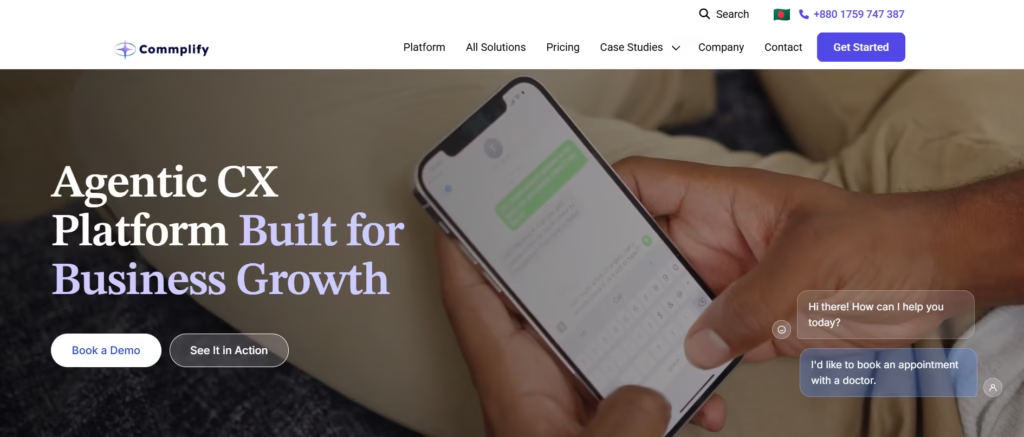
Commplify is an omnichannel AI customer experience platform that connects automated voice conversations with human support. Its AI Voice Intelligence uses conversational AI and intent recognition to understand callers, answer routine questions, and qualify inquiries.
When human assistance is needed, Commplify supports real-time call transfers with contextual handoffs. Agents can receive relevant conversation details to continue the interaction with less repetition. Its connected workflows also help businesses manage customer communication across voice, chat, email, and messaging channels.
Key Features
- Context-aware live transfers: Routes complex calls to human agents with relevant customer information.
- Intelligent call routing: Uses caller intent and configured workflow rules to guide escalation.
- Omnichannel AI platform: Connects voice and digital customer communication.
- CRM integration: Supports connected business systems and customer data synchronization.
- AI-powered call analytics: Provides transcripts, conversation summaries, and performance insights.
- Human-in-the-loop escalation: Involves staff when a request requires personal judgment or authorization.
Best For
Enterprises, BPO leaders, sales and SDR teams, and CX teams seeking AI reception within a connected customer engagement platform.
Pricing
AI voice calling starts at $0.10 per minute for web calls and $0.12 per minute for inbound US calls. Resolution-based pricing starts as low as $0.30 per resolution. Custom enterprise pricing is available. Human handoffs are included without an additional handoff fee, although optional telephony and other services may cost extra.
Why Choose Commplify?
Commplify’s omnichannel AI platform delivers smarter live transfers through intelligent call routing, context-aware warm handoffs, and seamless human escalation. Its AI voice intelligence helps businesses reduce missed opportunities, qualify leads, and improve customer experiences without losing conversation context.
2. Smith.ai: Best for Human-Backed Warm Transfers
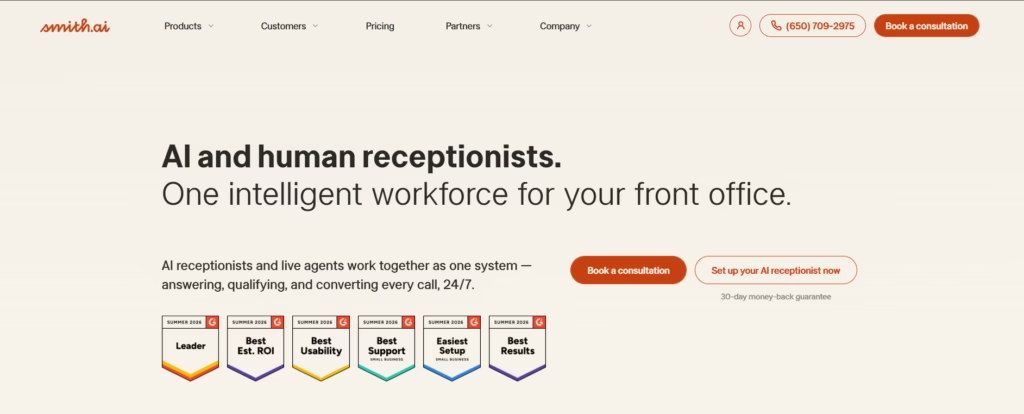
Smith.ai provides an AI receptionist backed by optional human receptionist services. It answers incoming calls, screens prospects, and collects customer information before routing requests.
Its warm transfer functionality helps connect qualified callers with team members. The system can provide caller context during the handoff. Smith.ai also offers access to its human receptionist network when a conversation requires additional assistance.
Key Features
- Warm call transfers: Connects callers to team members with relevant context.
- Human receptionist backup: Offers live assistance for selected escalation scenarios.
- Automated lead qualification: Collects prospect information before routing calls.
- Custom call playbooks: Defines business-specific answering and escalation instructions.
- CRM integration: Connects with tools such as Salesforce, HubSpot, and Clio.
- Call records: Provides recordings, transcripts, summaries, and analytics.
Best For
Law firms, professional service providers, small businesses, and teams that need AI reception with human backup.
Pricing
A free plan includes 25 calls per month. The Pro plan starts at $150 per month for 75 calls. Enterprise pricing starts at $500 per month. Some live receptionist services and additional call usage cost extra.
Consideration
Smith.ai is useful for businesses prioritizing lead intake and human-assisted reception. However, per-call pricing can increase costs as call volumes grow. Review the charges for optional human receptionist involvement.
3. RingCentral AI Receptionist: Best for Smart Call Routing
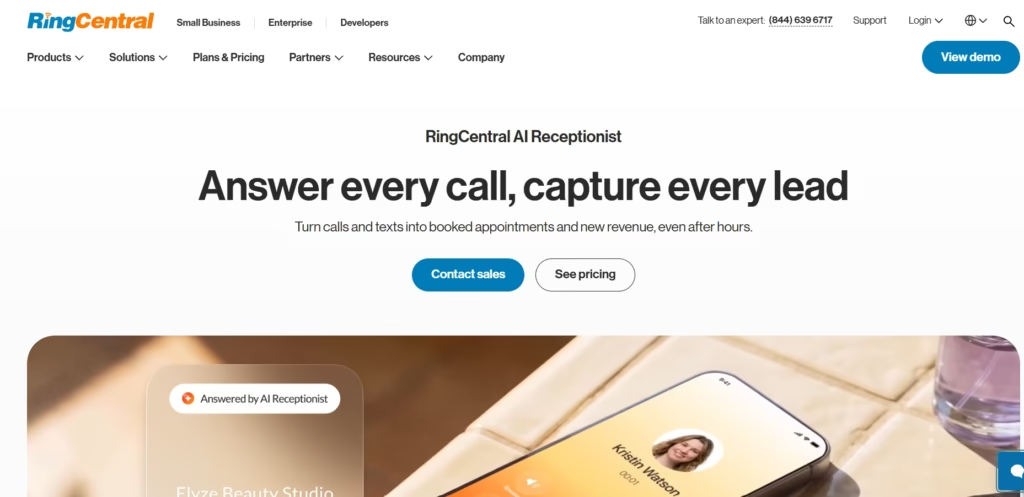
RingCentral AI Receptionist automates inbound call handling through natural language conversations. It allows customers to explain their needs without navigating traditional IVR menus.
The platform uses context-aware routing to connect callers with relevant departments, extensions, or external numbers. It can also provide call summaries to receiving agents. This helps teams understand requests before responding.
Key Features
- Context-based call routing: Directs calls using names, departments, locations, and keywords.
- AI-to-human handoffs: Transfers calls with relevant caller details and summaries.
- AI-powered IVR: Understands natural language instead of relying only on numbered menus.
- Automated lead capture: Collects contact details and qualification information.
- CRM integration: Supports customer information synchronization.
- Multilingual call handling: Responds to callers in supported languages.
Best For
Growing businesses, multi-location organizations, and teams seeking AI reception alongside an existing business phone system.
Pricing
Standalone AI receptionist plans start at $49 per month with 100 minutes included. RingEX customers can add an AI receptionist starting at $39 per month with 100 minutes included.
Consideration
RingCentral is a practical option for businesses with established phone systems. Before subscribing, check usage limits, external number routing, and the availability of contextual transfer information in your team’s applications.
4. Dialpad AI Receptionist: Best for Contact Center Handoffs
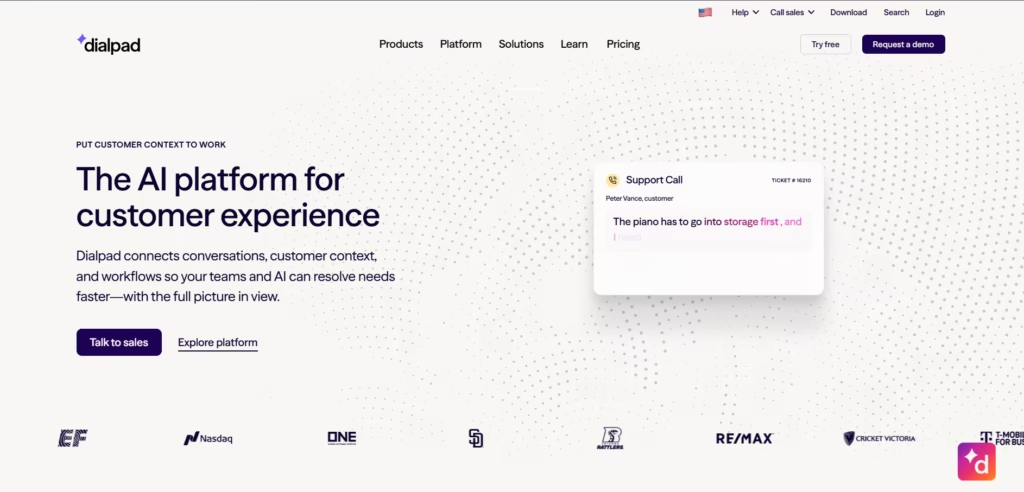
Dialpad offers AI-powered reception through its voice AI agents and contact center platform. Its conversational AI answers routine questions, collects caller information, and escalates complex requests to human agents.
Dialpad supports intent-based routing and context-aware handoffs. Its voice workflows can use routing conditions and connected customer information to direct calls. This helps CX teams manage escalations without losing the customer’s original request.
Key Features
- AI-to-human escalation: Connects callers with human agents when a request needs personal assistance.
- Contextual handoffs: Passes relevant conversation information to support teams.
- Intelligent routing: Uses customer intent and configurable workflow conditions.
- Real-time transcription: Captures spoken interactions for review and follow-up.
- Contact center analytics: Provides insights into agent activity and customer conversations.
- Omnichannel support: Connects voice and digital customer interactions.
Best For
Enterprise contact centers, customer support teams, and BPO operations that need AI automation alongside human agent workflows.
Pricing
Dialpad offers conversation-based pricing for its Agentic AI services through purchased AI Agent Credits. Contact sales for a quote. Its separate contact center plans start at $89 per user per month.
Consideration
Dialpad has several communication and AI products. Confirm which AI agent features, live transfer options, and integrations are included in your selected plan. Contact center seat pricing should not be confused with AI receptionist pricing.
5. CloudTalk: Best for Sales Call Transfers
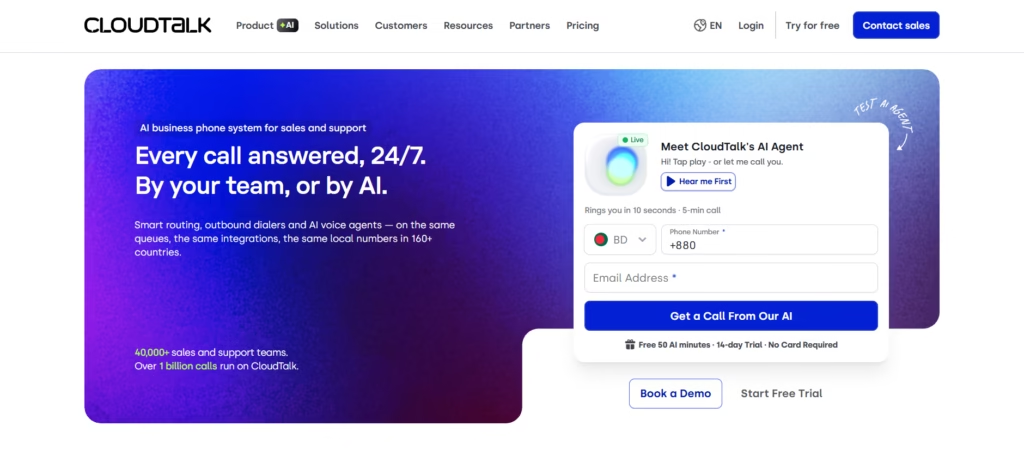
CloudTalk is a cloud-based calling platform for sales and customer support teams. Its AI voice agents help businesses automate inbound reception, answer common questions, and connect callers with human representatives.
The platform combines AI-powered caller screening with call routing, contact center tools, and CRM integrations. It also supports human handoffs when a conversation requires direct assistance.
Key Features
- AI receptionist: Answers routine inbound calls and collects customer information.
- Human call handoff: Escalates requests to human agents.
- Smart call routing: Supports skills-based routing, IVR, and configurable call flows.
- CRM integration: Connects call activity with supported sales and helpdesk tools.
- Multilingual voice AI: Handles conversations across supported languages.
- Call monitoring and analytics: Helps managers track call outcomes and operational performance.
Best For
Sales and SDR teams, outbound-focused contact centers, and customer support organizations that need AI-assisted phone workflows.
Pricing
CloudTalk advertises AI Voice Agent plans starting at $99 per month for 200 minutes. Its pricing page also lists a free initial AI Receptionist allowance of 50 minutes and higher-tier AI packages. Standard calling software subscriptions may be charged separately.
Consideration
CloudTalk offers both calling software and AI voice services. Businesses should calculate their combined costs before choosing a plan. Also, test how AI transfers work with existing call queues, agent availability rules, and CRM integrations.
6. Goodcall: Best for Simple Live Call Transfers
Goodcall is an AI receptionist platform designed to help businesses manage incoming phone calls. It uses conversational AI to answer questions, capture customer information, and handle routine requests.
Its configurable Operator workflow can transfer a caller to a business number or specific team member. Businesses can trigger this workflow when someone requests human assistance, or the AI cannot complete a request.
Key Features
- AI call answering: Handles incoming customer calls.
- Operator call transfer: Connects callers to configured human destinations.
- Custom routing workflows: Defines actions for different caller requests.
- Automated information collection: Captures basic customer details and inquiries.
- Fallback options: Supports message taking and callback workflows.
- After-hours handling: Applies configured actions outside normal business hours.
Best For
Small businesses, home service providers, independent professionals, and local teams that need straightforward AI call reception.
Pricing
Goodcall’s public pricing starts at $79 per month for its Starter plan. Growth starts at $129 per month. Plans have usage allowances and may charge for additional unique customers.
Consideration
Goodcall works well for businesses with straightforward routing needs. However, teams requiring complex skill-based routing or detailed contextual warm handoffs should verify those capabilities before implementation.
7. Rosie AI: Best for Warm Transfers and Backup Routing
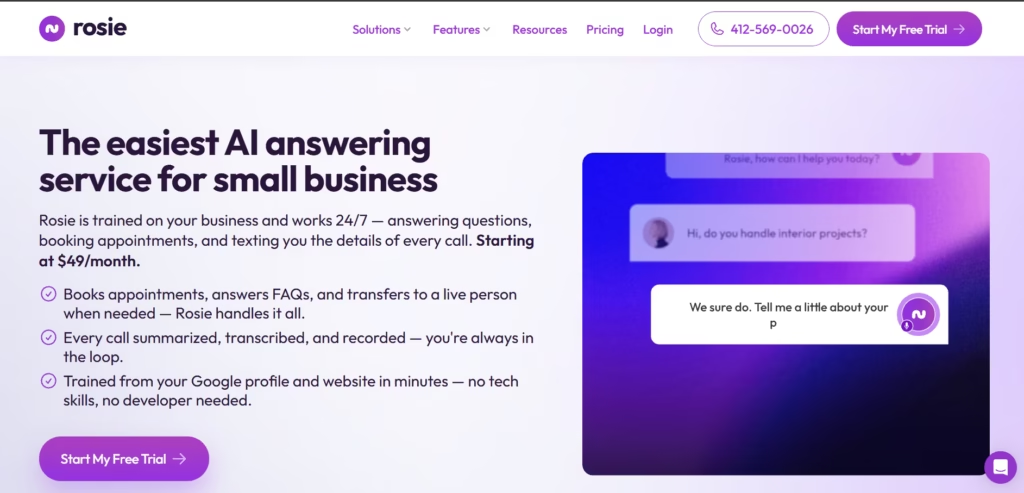
Rosie AI is a virtual receptionist that answers business calls, collects customer information, and helps schedule appointments.
Its live transfer capabilities allow callers to reach a human representative when needed. Rosie also supports warm transfers, where the receiving team member gets a briefing before the connection. Its higher-tier waterfall routing can try multiple phone numbers when the first destination does not answer.
Key Features
- Warm transfers: Briefs team members before connecting callers.
- Live call transfers: Connects callers directly with human representatives.
- Waterfall routing: Tries alternative phone numbers when needed.
- 24/7 AI reception: Answers customer calls beyond business hours.
- Appointment scheduling: Supports booking workflows and calendar connections.
- Call summaries: Provides recordings, transcripts, and customer interaction details.
Best For
Small businesses, home service companies, and appointment-based teams that need live call transfers with backup routing.
Pricing
Rosie starts at $49 per month for the Professional plan. However, warm and live transfers are included in its Scale plan at $149 per month. Waterfall transfers are available in its Growth plan at $299 per month.
Consideration
Rosie offers useful transfer capabilities for smaller operations. However, live transfers are not included in its entry-level plan. Businesses needing multiple fallback destinations should evaluate the Growth plan and its included minutes.
How Does Live Call Transfer Work in an AI Receptionist?
An AI receptionist does more than answer calls. It understands caller needs, collects essential information, and connects customers with the right human agent.
High-quality live transfer services in AI reception use conversational AI, smart routing logic, and contextual handoffs to make this process smoother.
Here’s how the AI-to-live-agent transition works:
Step 1: AI Answers and Understands the Caller
The virtual receptionist answers incoming calls, often on the first ring. It uses Natural Language Processing (NLP) and Speech-to-Text (STT) to understand spoken requests. Unlike traditional IVR menus, an AI-powered IVR allows callers to explain their needs naturally.
Step 2: AI Identifies the Need for Human Assistance
The system uses intent recognition and entity extraction to identify the caller’s request. It can also perform automated phone screening and lead qualification. Custom escalation triggers determine when human assistance is necessary.
Step 3: Smart Routing Finds the Right Agent
Intelligent call routing software directs calls based on urgency, department, and agent skills. Automatic Call Distribution (ACD) can help identify suitable agents. Availability checks reduce unnecessary waiting and failed transfer attempts.
Step 4: AI Transfers the Call With Context
During a warm transfer, the AI shares relevant caller details with the receiving agent. This contextual handoff may include conversation summaries, customer intent, and qualification details. CRM integrations with Salesforce, HubSpot, or Zendesk can provide additional customer history.
Step 5: The System Handles Unsuccessful Transfers
If the agent is unavailable, fallback mechanisms can route the call elsewhere. Options include voicemail overflow, alternative agents, and scheduled callbacks. After-hours AI call forwarding can also direct urgent requests to on-call staff.
Example: A qualified prospect calls about enterprise pricing. The AI receptionist collects their requirements and connects them with an available sales representative. The agent receives a short summary before answering. The prospect can continue the discussion without repeating everything.
8 Essential Features of High-Quality AI Receptionist Live Transfer Services
Not every AI receptionist delivers a smooth transition to human support. High-quality live transfer services in AI reception need more than basic call forwarding. They should connect callers to the right agents, preserve conversation context, and handle transfer failures.
Here are eight essential features to look for when choosing an AI receptionist with live transfer capabilities.
1. Intelligent Call Routing and Skill-Based Matching
Intelligent call routing helps an AI receptionist send callers to the most suitable agent. It uses intent recognition, smart routing logic, and skill-based matching to identify the right destination.
For example, a billing inquiry goes to the finance team. A qualified sales lead reaches an available sales representative.
Advanced systems may use Automatic Call Distribution (ACD) to route calls based on agent skills, departments, or priorities. This reduces unnecessary transfers and improves First Call Resolution (FCR).
2. Context-Aware Warm Handoffs
A warm transfer prepares the human agent before connecting the caller. Instead of forwarding a call without details, the AI receptionist shares important conversation information.
A context-aware call transfer may include the caller’s name, request, qualification details, and real-time call summary.
This human-in-the-loop AI handoff helps agents continue conversations without asking customers to repeat information. It also reduces Average Handling Time (AHT) and creates a smoother customer experience.
3. Real-Time Agent Availability Detection
Sending a caller to an unavailable agent creates frustration. Real-time agent availability detection helps prevent unnecessary waiting.
The system checks available agent status information before selecting a transfer destination. It may consider active calls, department assignments, or working hours.
When integrated with contact center software, this feature supports smarter routing decisions. It can also redirect calls when agents become unavailable.
The benefit: Fewer failed transfer attempts and a lower risk of call abandonment.
4. Automated Caller Screening and Lead Qualification
An AI receptionist can collect essential information before transferring a caller. This process is known as automated phone screening and transfer.
Using conversational AI and Natural Language Processing (NLP), the system asks relevant questions and identifies customer needs.
For sales teams, a smart lead qualification receptionist can collect:
- Customer name and company details.
- Product or service requirements.
- Budget and purchase timeline.
- Urgency and preferred contact information.
Businesses can then use predefined lead scoring rules to prioritize valuable opportunities. This helps SDR teams focus on qualified prospects and improve lead conversion opportunities.
5. CRM and Contact Center Integration
A reliable live transfer system should work with existing business tools. CRM integration helps agents access relevant customer information during handoffs.
Platforms such as Salesforce, HubSpot, and Zendesk can store customer records, support tickets, and previous interaction details.
Computer Telephony Integration (CTI) connects phone activity with business applications. It can support screen pops, call logging, and customer record matching.
For example, an agent may receive a transferred call with the customer’s support ticket already open.
This reduces manual work and supports better operational efficiency.
6. Reliable Fallback and Overflow Handling
What happens when the receiving agent does not answer? A dependable AI receptionist should have a backup plan.
Fallback mechanisms and voicemail overflow prevent unsuccessful transfers from becoming dead ends. Common options include:
- Routing calls to another available agent.
- Trying a secondary department or phone number.
- Sending callers to voicemail.
- Offering automated callback scheduling.
- Using after-hours AI call forwarding for urgent inquiries.
These features help businesses reduce call drop rates and maintain service continuity. While a zero-drop live transfer system is an ideal goal, actual reliability depends on network conditions and system configuration.
7. Low-Latency, High-Quality Voice Connections
Even intelligent call routing cannot deliver a good experience with poor audio quality. Delayed responses, distorted speech, and unstable connections can frustrate customers.
High-quality AI voice systems should minimize latency and maintain clear communication throughout the call. Key technical considerations include:
- VoIP and SIP trunking: Support voice connectivity and call transfers.
- WebRTC: Enables real-time audio communication in supported browser-based systems.
- Speech-to-Text (STT): Converts caller speech into text for AI processing.
- Real-time transcription: Captures conversation details for summaries and agent handoffs.
Businesses should test audio clarity, transfer delays, and connection stability during peak call volumes. These checks help identify problems before they affect customers.
8. Omnichannel Conversation Continuity
Customers often interact with businesses across several channels. They may start with web chat, follow up by email, and later call for support.
A multichannel AI system supports these communication channels. An omnichannel AI platform connects relevant customer information across them.
With proper integrations, an AI receptionist can access previous interactions and share useful context during a live transfer.
For example, a customer who discussed a billing issue through chat may call later for an update. The receiving agent can review the earlier conversation instead of asking the customer to explain the problem again.
This continuity helps eliminate repeated questions, supports personalized service, and improves overall Customer Experience (CX).
How Omnichannel AI Improves Live Transfer Services
A customer starts a conversation through live chat but later calls for help. Without connected systems, the human agent may ask them to explain everything again. This creates frustration and slows down resolution.
An omnichannel AI platform solves this problem by connecting customer conversations across voice, email, live chat, and messaging channels. Unlike multichannel AI, which manages channels separately, omnichannel AI helps maintain customer context throughout the journey.
Here’s how it improves high-quality live transfer services in AI reception:
- Preserves conversation context: CRM integrations with Salesforce, HubSpot, or Zendesk can give agents access to previous interactions, caller intent, and relevant customer details.
- Enables smarter call routing: Conversational AI and Natural Language Processing (NLP) identify customer needs. Intelligent routing then connects callers with suitable agents based on skills and availability.
- Supports seamless warm handoffs: Real-time call summaries and transcripts help human agents understand the issue before taking over. This reduces repeated questions during the AI-to-live-agent transition.
- Improves escalation reliability: Custom escalation triggers and fallback mechanisms help route complex requests to human support. If an agent is unavailable, the system can offer voicemail or a callback.
- Increases operational efficiency: Connected workflows reduce manual data entry and unnecessary transfers. They can also improve Average Handling Time (AHT) and First Call Resolution (FCR).
For example, a prospect asks about pricing through live chat and later calls for a demo. An integrated AI receptionist can share the earlier conversation with the sales agent during a warm transfer.
This creates a more connected customer experience (CX) and helps businesses handle AI-to-human transitions efficiently.
Real-World Use Cases for AI Receptionist Live Transfers
Different industries have different customer needs. However, they all face the same challenge: connecting callers with the right person at the right time.
High-quality live transfer services in AI reception help businesses automate routine inquiries, qualify callers, and provide human assistance when needed.
Here are five practical use cases.
Healthcare
Healthcare providers handle frequent calls about appointments, prescriptions, billing, and patient concerns. An AI receptionist can answer routine questions and collect basic information. For sensitive requests, intelligent call routing connects patients with authorized medical staff.
Example: A patient calls about a prescription issue. The AI identifies the request and transfers the call to an appropriate staff member with relevant details.
HealthPlus used Commplify’s AI voice automation to improve patient scheduling. Average scheduling wait time dropped from 6.5 minutes to 1.8 minutes. The system also handled 61% of calls without human intervention. This reduced routine administrative work while keeping human staff available for requests requiring their attention.
Real Estate
Real estate agents often miss calls during property tours and client meetings. These missed calls may result in lost opportunities.
A smart lead qualification receptionist can collect property preferences, budget ranges, and viewing requirements. It can then use skill-based routing to connect qualified prospects with available agents.
Example: A buyer calls about a property listing. The AI collects their budget and preferred location before transferring them to a suitable agent.
This helps sales teams prioritize serious buyers and improve lead conversion opportunities.
Legal Services
Law firms receive confidential inquiries that often require human judgment. An AI virtual receptionist can collect approved intake details and identify the type of legal assistance needed.
A context-aware warm transfer then connects callers with appropriate legal staff.
Example: A potential client calls about a contract dispute. The AI gathers basic information and transfers the call with a short summary.
This reduces repetitive screening while keeping sensitive legal discussions with qualified professionals.
Home Services
Plumbing, HVAC, and electrical companies often receive urgent calls outside business hours.
An AI receptionist provides 24/7 call answering, automated phone screening, and after-hours call forwarding. It can identify urgent requests and route them to on-call technicians.
Example: A homeowner reports a burst pipe. The AI identifies the urgency and attempts to connect the caller with an available technician. If no one answers, a fallback workflow captures the request for follow-up.
This helps service teams respond faster and reduce missed opportunities.
E-commerce and Customer Support
E-commerce businesses handle frequent calls about orders, refunds, deliveries, and payment issues. An AI receptionist can resolve routine inquiries and collect customer information. For complex requests, intelligent call routing connects customers with human agents through contextual warm handoffs.
Example: A customer calls about a damaged product. The AI collects order details and transfers the call to a support agent with a conversation summary. This helps reduce repeated questions and speed up resolution.
OmniRetail, a Middle Eastern omnichannel retailer, used Commplify’s AI voice automation to improve order support and customer service. The system resolved 64% of calls without human intervention. It also reduced the call abandonment rate from 12% to 4% and lowered support costs per interaction by 29%. These results demonstrate how AI automation and human escalation can improve operational efficiency and customer experience.
How to Measure the Quality of AI-to-Human Call Transfers
A successful live transfer means more than connecting a caller to a human agent. The transfer should be fast, reliable, and context-aware. But how can businesses measure its actual performance?
To evaluate high-quality live transfer services in AI reception, businesses should track these key performance indicators (KPIs).
| KPI | What It Measures |
|---|---|
| Transfer Completion Rate | Percentage of attempted transfers successfully connected to human agents. |
| Average Transfer Time | Time between the AI’s transfer request and the human agent’s connection. |
| First Call Resolution (FCR) | Percentage of customer issues resolved during the first contact. |
| Average Handling Time (AHT) | Average time spent handling customer calls, including talk time, hold time, and after-call work. |
| Call Abandonment Rate | Percentage of callers who disconnect before reaching the intended service. |
| Context Preservation Rate | Percentage of transfers where agents receive the required caller details and conversation context. |
| Lead Conversion Rate | Percentage of qualified leads who become customers. |
Suppose an AI receptionist attempts 500 live transfers in one month. Of those, 465 successfully connect to human agents.
Transfer Completion Rate = (465 ÷ 500) × 100 = 93%
This means 7% of transfer attempts failed. The business can review those calls to identify issues with agent availability, smart routing logic, or VoIP connectivity.
How to Choose the Right AI Receptionist With Live Transfer
Choosing an AI receptionist involves more than checking its call-answering capabilities. The right solution should offer reliable live transfers, intelligent routing, and smooth human handoffs.
To find high-quality live transfer services in AI reception, consider these essential factors:
- Live Transfer Quality: Look for warm transfers and contextual handoffs that share caller intent, summaries, and key details with human agents.
- Intelligent Call Routing: Prioritize smart routing logic, agent availability detection, and skill-based matching for accurate call escalation.
- CRM and Telephony Integration: Ensure compatibility with Salesforce, HubSpot, Zendesk, and existing VoIP or contact center systems.
- Fallback Mechanisms: Check for alternative routing, voicemail overflow, callbacks, and after-hours call forwarding.
- Voice Quality and Speed: Test audio clarity, AI response latency, and transfer connection times to minimize caller frustration.
- Omnichannel Support: Choose a platform that preserves customer context across voice, chat, email, and messaging channels.
- Performance Analytics: Monitor transfer success rates, Average Handling Time (AHT), First Call Resolution (FCR), and call abandonment rates.
- Pricing and Scalability: Compare subscription costs, usage fees, and the ability to handle increasing call volumes.
Bring AI Automation and Human Support Together
Don’t let failed call transfers turn valuable opportunities into lost customers. Every caller deserves a smooth experience, from the first AI response to the final human conversation.
With Commplify‘s omnichannel AI platform, you can automate routine calls, qualify leads, and connect customers with the right agents through intelligent routing and context-aware warm transfers. Keep conversations moving, reduce missed opportunities, and help your team focus on what matters most.
Final Thoughts
A great customer experience doesn’t end when an AI receptionist answers the call. It depends on what happens next.
High-quality live transfer services in AI reception help businesses connect callers with the right human agents without unnecessary delays or repeated questions. With intelligent call routing, context-aware warm transfers, and reliable fallback options, businesses can reduce missed opportunities and improve customer satisfaction.
Whether you’re managing sales, customer support, or contact center operations, choosing the right AI receptionist can make every interaction more efficient.
The key is finding the right balance between AI automation and human expertise. Prioritize seamless handoffs, reliable integrations, and measurable performance to turn everyday calls into better customer experiences and valuable business opportunities.
Frequently Asked Questions
Can an AI receptionist transfer calls to a live person?
Yes. Many modern AI receptionists can transfer incoming calls to a human representative when a caller requests assistance or meets a predefined escalation condition. Depending on the platform, transfers may use direct call forwarding, warm handoffs, or intelligent routing based on caller intent and available destinations.
What is the difference between warm transfer and cold transfer in AI reception?
A warm transfer involves briefing or consulting the receiving agent before connecting the caller. A cold transfer, also called a blind transfer, routes the call without that advance conversation. Warm transfers are particularly useful for complex inquiries because they help agents understand the caller’s needs before taking over.
How does an AI receptionist transfer calls without losing customer context?
A context-aware AI receptionist collects relevant information during the conversation and passes it to the receiving agent. This may include caller identity, intent, qualification details, transcripts, or real-time summaries. CRM and contact center integrations help make this information accessible, reducing the need for customers to repeat themselves.
Can AI receptionists route calls based on agent availability?
Yes, some AI reception systems can use agent availability, department assignments, and routing rules to determine transfer destinations. This may involve ACD or workforce integrations. However, the level of real-time visibility varies by provider. Businesses should verify whether the system checks actual availability or simply forwards calls to configured numbers.
What happens if a live agent is unavailable during an AI call transfer?
Depending on the platform and configuration, the system may try another agent, route the call to a different department, offer voicemail, or arrange a callback. Reliable fallback mechanisms are important because they prevent failed transfers from becoming dead ends for customers.
How much does an AI receptionist with live transfer cost?
Pricing depends on the provider, AI usage, call volume, transfer capabilities, and integrations. Some services charge monthly subscription fees, while others use per-minute or usage-based pricing. Advanced routing, premium telephony connections, and human receptionist services may involve additional charges. Compare total operational costs rather than relying on the advertised starting price alone.
This page was last edited on 26 October 2026, at 8:05 am