Digital customer service helps businesses provide faster, 24/7 support through AI chatbots, live chat, and omnichannel communication. It reduces response times, automates repetitive tasks, and turns everyday customer interactions into better experiences and growth opportunities.
How many customers are you losing while your support team struggles to keep up?
A customer asks about an order on WhatsApp. No reply. They switch to live chat, wait for an agent, and repeat the same issue. Meanwhile, another potential buyer leaves your website without getting an answer.
Now think about hundreds of customers facing these problems every day. The result? Missed sales, frustrated customers, and rising support costs.
But what if you could respond instantly, capture more leads, and automate repetitive tasks without hiring more agents?
That’s where digital customer service comes in. With AI chatbots, smart routing, and omnichannel support, businesses can offer faster, 24/7 assistance across multiple channels.
In this guide, you’ll explore its benefits, real-world examples, and essential strategies. You can also get the best practices to reduce costs, improve customer satisfaction, and deliver better support.
What Is Digital Customer Service?
Digital customer service is the process of assisting customers through digital channels, such as live chat, AI chatbots, email, social media, messaging apps, and self-service portals. It combines AI automation, human support, and omnichannel communication to provide fast, personalized, and accessible customer assistance.
Modern digital customer service platforms use conversational AI, natural language processing (NLP), CRM integrations, and intelligent routing to understand customer requests, automate routine tasks, and transfer complex issues to human agents.
For example, a customer can check an order through WhatsApp, receive an instant chatbot response, and connect with a human agent when needed without repeating the conversation.
The main goal is to reduce response times, improve customer satisfaction, and create a consistent digital customer experience (DCX) across multiple touchpoints.
Why Is Digital Customer Service Important for Modern Businesses?
Customers expect quick answers, easy communication, and support whenever they need it. They don’t want to wait on hold or repeat their problems across different channels. Digital customer service helps businesses meet these expectations while reducing agent workload and improving the overall digital customer experience (DCX).
An effective omnichannel service strategy connects live chat, email, WhatsApp, social media, and AI voice support. With conversational AI and CRM integration, businesses can automate routine inquiries, provide 24/7 self-service support, and transfer complex issues to human agents without losing conversation history.
For example, a potential buyer might ask about pricing through live chat after business hours. An AI chatbot can answer common questions, qualify the lead, and schedule a follow-up with the sales team. This helps businesses capture opportunities that might otherwise be missed.
Digital customer service also helps businesses:
- Improve customer satisfaction: Provide faster responses and consistent support across channels.
- Reduce operational costs: Automate repetitive tasks and allow agents to focus on complex issues.
- Increase customer retention: Offer personalized assistance and proactive customer updates.
- Improve team efficiency: Use intelligent routing and unified agent workspaces to reduce unnecessary transfers.
- Make data-driven decisions: Track first response time (FRT), first contact resolution (FCR), and customer satisfaction scores (CSAT) to identify service gaps.
Ultimately, digital customer service helps businesses move beyond reactive support. It creates a more customer-centric experience while making sales, support, and contact center operations more efficient.
Key Digital Customer Service Channels Businesses Should Use
Customers prefer different ways to connect with businesses. Some need instant answers, while others prefer flexible communication. An effective digital customer service strategy combines these channels to provide fast, personalized, and consistent support.
Common digital customer service channels include:
- Live chat. Provides real-time support through websites. Customers can ask questions, resolve issues, and connect with agents without making a phone call.
- Website chatbots. Use conversational AI and natural language processing (NLP) to answer FAQs, qualify leads, schedule appointments, and provide 24/7 automated customer support.
- Social media. Platforms like Facebook, Instagram, and X allow businesses to respond to customer inquiries, manage complaints, and engage with potential buyers through comments and direct messages.
- Messaging apps. WhatsApp and Facebook Messenger support asynchronous messaging, automated responses, appointment reminders, and customer follow-ups.
- Email. An asynchronous support channel for detailed inquiries, billing concerns, and technical issues. AI-powered helpdesk software can organize tickets and suggest relevant responses.
- SMS support. Delivers quick updates, booking confirmations, delivery alerts, and appointment reminders. It also supports automated customer notifications and simple two-way conversations.
- Self-service portals and knowledge bases. Help customers find answers through FAQs, troubleshooting guides, and support articles without contacting an agent.
- Mobile apps. Provide direct access to account management, order tracking, personalized notifications, and customer support features.
- In-app customer support. Offers embedded live chat, AI virtual assistants, and guided assistance within software applications. It helps users solve problems without leaving the platform.
- Voice, IVR, and video support. AI voice agents and interactive voice response (IVR) systems handle calls and route requests. Video support enables visual troubleshooting and personalized assistance.
Businesses don’t need every channel to deliver great service. The priority is to connect the channels customers already use through an omnichannel customer service platform. CRM integration and intelligent routing can help teams maintain conversation history, reduce repeated questions, and improve the overall digital customer experience.
7 Key Benefits of Digital Customer Service
Digital customer service helps businesses respond faster, reduce support costs, and improve customer relationships. With AI automation, omnichannel communication, and self-service tools, companies can handle more inquiries without overwhelming their support teams.
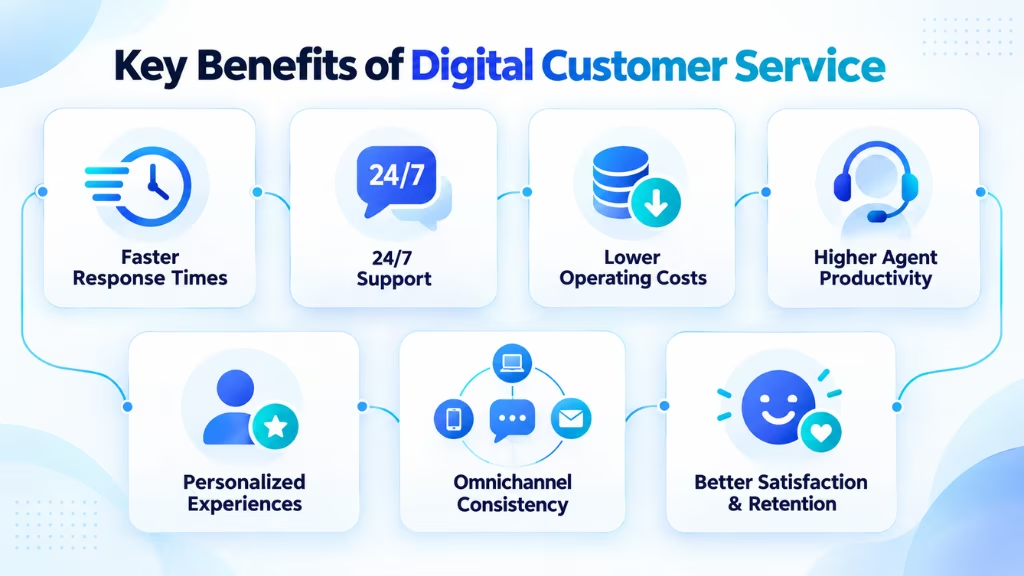
Here are seven key benefits of digital customer service for modern businesses.
1. Faster Customer Response Times
Customers expect quick answers, especially when they face urgent issues. AI chatbots, live chat, and intelligent routing help businesses respond without long waiting times.
Conversational AI uses natural language processing (NLP) and intent recognition to understand requests. It can answer common questions instantly or direct complex issues to the right agent.
This helps reduce first response time (FRT) and prevents customers from waiting in unnecessary queues.
2. 24/7 Customer Support Availability
Customer inquiries don’t stop when business hours end. Digital customer service allows businesses to offer round-the-clock assistance through AI virtual assistants, voice agents, and self-service portals.
For example, an AI chatbot can answer pricing questions, collect leads, or help customers book appointments after hours. Complex requests can be queued for human follow-up.
This helps businesses serve customers across different time zones without requiring every agent to work overnight.
3. Lower Customer Service Operating Costs
Handling every inquiry manually increases staffing needs and support expenses. Customer support automation platforms reduce repetitive tasks such as answering FAQs, checking order status, and creating support tickets.
AI-powered Tier-1 support can handle routine requests. Human agents can focus on issues that require deeper investigation.
This can reduce average handling time (AHT) and the cost per resolution. Actual savings depend on automation accuracy, maintenance costs, and the number of issues resolved successfully.
4. Higher Agent Productivity
Support agents often spend valuable time switching between tools, searching for customer details, and answering repeated questions.
An omnichannel customer service platform with CRM integration and a unified agent workspace brings customer information into one place.
Generative AI (GenAI) can summarize conversations, suggest responses, and retrieve relevant knowledge-base articles.
This reduces manual work and helps agents resolve more issues efficiently. It can also improve first contact resolution (FCR) by giving agents the context they need.
5. More Personalized Customer Experiences
Customers don’t want to explain their needs every time they contact a business. They expect support teams to recognize previous interactions and offer relevant assistance.
Digital customer service platforms use CRM integration, customer journey mapping, and customer data to provide more contextual support.
For example, an AI assistant can identify a customer’s recent purchase and provide relevant order updates or troubleshooting steps.
This creates a more personalized digital customer experience (DCX) while reducing repeated questions and unnecessary customer effort.
6. Consistent Omnichannel Customer Support
Customers often switch between WhatsApp, email, live chat, social media, and phone calls. Disconnected systems can force them to repeat the same issue.
An omnichannel service strategy connects these digital touchpoints through shared conversation history and customer information.
For example, a customer can start with a website chatbot and continue with a human agent through live chat. An automated agent handoff can transfer the conversation context.
This creates a seamless omnichannel customer experience and helps businesses maintain consistent service across channels.
7. Improved Customer Satisfaction and Retention
Fast responses alone don’t guarantee happy customers. Businesses must also resolve issues accurately and make the support process easy.
Digital customer service combines proactive customer engagement, personalized assistance, and AI-powered self-service to improve the overall experience.
For example, automated delivery updates can inform customers about delays before they contact support.
Businesses can measure results through customer satisfaction scores (CSAT), customer effort scores (CES), and customer retention rates.
When customers receive reliable support with less effort, they’re more likely to trust the business and continue using its services.
Real-World Digital Customer Service Examples Across Industries
Digital customer service helps businesses manage customer inquiries, automate repetitive tasks, and provide faster support. However, its applications vary by industry. From online shopping to healthcare and financial services, businesses use AI-powered digital customer service to improve customer experiences and reduce manual workloads.
Here are five practical examples of how digital customer service works across different industries.
E-commerce and Retail
Retailers often struggle with high volumes of order inquiries, delivery updates, and return requests. AI chatbots and voice agents can handle routine questions through connected order management systems. Complex requests can be transferred to human agents.
Commplify helped OmniRetail, an anonymized retail client in the Middle East, automate order tracking, returns, and product availability inquiries through AI-powered voice support.
The retailer also reduced call abandonment from 12% to 4%. Customer satisfaction (CSAT) increased from 78% to 86%. These results show how connected AI automation can improve post-purchase support during busy retail periods.
Healthcare and Appointment-Based Services
Healthcare providers receive frequent calls about appointments, cancellations, and scheduling changes. AI virtual receptionists can manage routine booking requests, send SMS reminders, and update scheduling systems. Sensitive medical questions should still reach qualified professionals.
Commplify reports helping healthcare client HealthPlus automate patient scheduling with AI-powered voice assistance.
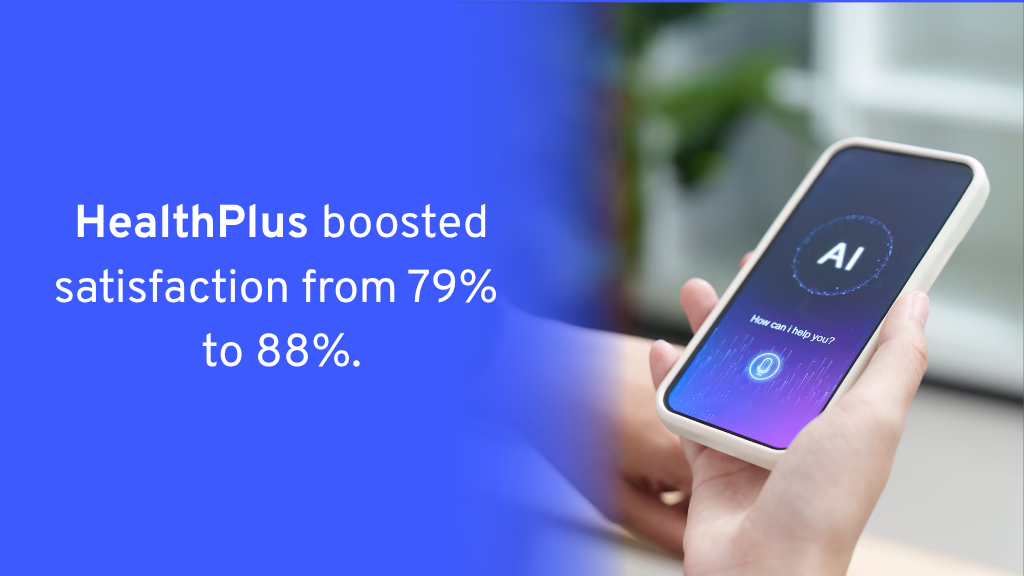
According to Commplify’s published example, average scheduling wait time decreased from 6.5 minutes to 1.8 minutes. Appointment no-shows dropped from 14% to 8%, while scheduling workload decreased from 38 to 16 hours per week per site.
The solution also handled 61% of calls without human intervention and improved patient satisfaction from 79% to 88%.
These results illustrate how digital customer service can reduce administrative pressure and improve patient access.
Banking and Financial Services
Banks handle thousands of requests related to payments, accounts, cards, and loans. Conversational AI and intelligent call routing can automate routine inquiries. Secure authentication and human escalation remain essential for sensitive transactions.
Commplify implemented AI voice automation for GlobalFin Bank, an anonymized banking client in Southeast Asia. The system supported routine banking requests, loan prequalification, and intelligent routing.
Average call answer time fell from 95 seconds to 18 seconds. The lead qualification rate for loan and card inquiries also increased from 11% to 27%.
This shows how AI-powered digital customer service can support both customer assistance and sales opportunities.
SaaS and Technology Companies
SaaS businesses often receive support requests about account access, integrations, billing, and technical errors. An AI-powered knowledge base and in-app chatbot can resolve common issues without involving human agents.
For example, a customer reports an integration error through in-app chat. Conversational AI uses intent recognition to identify the problem and suggest troubleshooting steps. If the issue remains unresolved, the system creates a helpdesk ticket and transfers the request to a technical specialist.
CRM integration and a unified agent workspace help the specialist review earlier troubleshooting attempts.
Business value: Faster technical support, fewer repetitive tickets, and improved first contact resolution (FCR).
Real Estate and Professional Services
Real estate agencies and professional service providers often receive inquiries through websites, WhatsApp, email, and social media. Slow responses can cause businesses to miss potential customers.
An omnichannel AI chatbot can answer property questions, collect buyer preferences, and schedule appointments. CRM integration helps sales teams track qualified leads and manage follow-ups.
For example, a buyer sends a property inquiry through Facebook Messenger. An AI assistant shares approved listing details and collects the buyer’s requirements. The system then routes the lead to the right sales agent.
Business value: Faster lead qualification, fewer missed inquiries, and more organized sales follow-ups.
How to Build an Effective Digital Customer Service Strategy
An effective digital customer service strategy connects customer communication channels, AI automation, and human support. It helps businesses respond faster, reduce manual work, and deliver a consistent customer experience.
Start by identifying common customer requests through customer journey mapping. Then, connect the right digital channels with your CRM, helpdesk software, and AI-powered support tools.
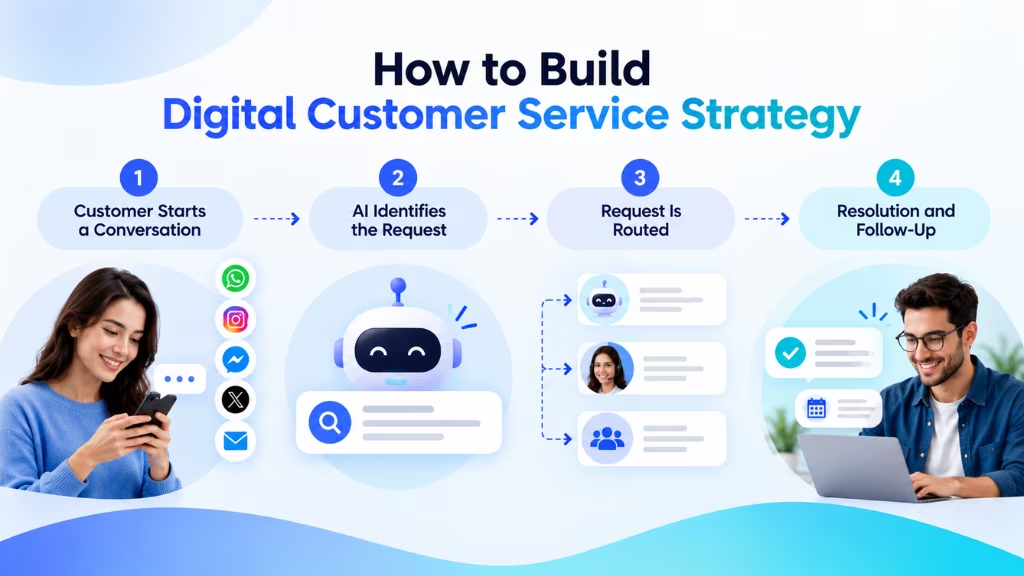
Here’s how a typical digital customer service workflow operates in four steps.
Step 1: Customer Starts a Conversation
A customer contacts your business through live chat, WhatsApp, email, social media, or an AI voice agent. An omnichannel customer service platform captures the request and retrieves available customer information through CRM integration.
For example, a customer asks about a delayed order through WhatsApp. The system records the message and checks for relevant order details.
Step 2: AI Identifies the Request
Conversational AI uses natural language processing (NLP) and intent recognition to understand the customer’s question. It identifies the request type, such as billing, order tracking, technical support, or appointment scheduling.
For example, the AI recognizes “Where is my order?” as a delivery inquiry. It then retrieves relevant information from the connected order management system.
Step 3: Request Is Routed
The system determines whether AI can resolve the request or human assistance is needed. Intelligent routing directs routine questions to automated self-service. Complex or sensitive issues are transferred to qualified support agents.
For example, an AI chatbot shares the delivery status. If the package is missing, it initiates an automated agent handoff with the conversation history.
Step 4: Resolution and Follow-Up
The AI assistant or human agent resolves the issue and updates the ticketing system. The platform can then send a confirmation, request feedback, or provide proactive updates through the customer’s preferred channel.
For example, after resolving a delivery complaint, the system sends an SMS confirmation and a customer satisfaction (CSAT) survey.
Businesses can track first response time (FRT), first contact resolution (FCR), and customer satisfaction scores (CSAT) to measure performance and improve future interactions.
10 Digital Customer Service Best Practices to Improve Customer Experience
Providing support across multiple channels is not enough. Customers also expect quick responses, accurate answers, and smooth conversations. Following the right digital customer service best practices helps businesses reduce customer effort, improve satisfaction, and manage support more efficiently.
Here are ten practical ways to improve your digital customer service strategy.
1. Offer Consistent Support Across Digital Channels
Customers should receive the same quality of support through live chat, WhatsApp, email, social media, and phone calls. Use an omnichannel customer service platform to connect these channels. Integrate your CRM to maintain customer information and conversation history. This helps agents provide consistent answers without asking customers to repeat their issues.
2. Use AI Chatbots for Faster First Responses
Deploy AI chatbots and virtual assistants to handle common inquiries, such as order tracking, FAQs, and appointment booking. Conversational AI uses natural language processing (NLP) and intent recognition to understand requests. Connect chatbots to approved knowledge bases for accurate responses. This helps reduce first response time (FRT) and provides faster Tier-1 support.
3. Make Human Support Easily Accessible
AI cannot resolve every customer issue. Customers should be able to reach human agents without unnecessary steps. Set up automated agent handoff and intelligent routing for complex requests, complaints, and sensitive matters. Transfer the conversation history and relevant customer details during escalation. This helps Tier-2 and Tier-3 agents resolve issues without starting over.
4. Personalize Support Using Customer Context
Customers appreciate support that recognizes their needs and previous interactions. Use CRM integration and customer journey mapping to understand purchase history, past tickets, and preferences. For example, an AI assistant can provide relevant troubleshooting steps based on a customer’s product. Use only the customer data needed for the request. This helps create a more personalized digital customer experience (DCX).
5. Build an Easy-to-Use Self-Service Experience
Create a 24/7 self-service customer support portal with FAQs, troubleshooting guides, and searchable knowledge bases. Organize information around common customer problems. Add AI-powered search to help users find answers faster. Review unanswered questions regularly and update outdated content. Effective self-service reduces repetitive tickets and gives customers more control.
6. Provide Proactive Customer Updates
Don’t make customers contact support for every update. Use proactive customer service messaging to share delivery alerts, appointment reminders, service interruptions, and ticket progress. Send notifications through SMS, email, or messaging apps based on customer preferences. Keep messages timely and relevant. This can prevent unnecessary inquiries and improve customer trust.
7. Prioritize Customer Data Privacy and Security
Digital customer service platforms often handle sensitive customer information. Protect this data with encryption, secure authentication, and role-based access controls. Review third-party integrations and limit access to necessary information. Follow applicable regulations, such as GDPR, HIPAA, or PCI DSS, where required. Strong security practices help protect customer privacy and maintain trust.
8. Set Clear Expectations for Response and Resolution Times
Customers should know when to expect an answer. Establish service level agreements (SLAs) for different channels and request types. Use automated acknowledgments to confirm that inquiries have been received. Share realistic resolution timelines and provide updates when delays occur. Monitor first response time (FRT) and average handling time (AHT) to identify service bottlenecks.
9. Monitor Customer Feedback and Service Performance
Track service quality using customer satisfaction scores (CSAT), first contact resolution (FCR), and customer effort scores (CES). Use real-time customer support analytics to identify common complaints and unresolved issues. Review chatbot performance, agent productivity, and customer feedback together. This helps contact center managers identify service gaps and make informed improvements.
10. Continuously Improve AI and Human Support Workflows
Customer needs change over time. Review chatbot conversations, failed resolutions, and agent feedback regularly. Improve natural language understanding (NLU), intent recognition, and intelligent message routing based on real customer interactions. Update knowledge bases and refine automation rules. Test changes before full deployment. This keeps AI-powered digital customer service accurate, efficient, and reliable.
Common Digital Customer Service Challenges
Despite its benefits, digital customer service comes with several challenges. Businesses often struggle to manage multiple channels, maintain AI accuracy, and deliver consistent customer experiences.

Common digital customer service challenges include:
- Managing disconnected communication channels that cause lost conversation history and repeated customer questions.
- Preventing inaccurate AI chatbot responses caused by outdated knowledge bases and poor intent recognition.
- Ensuring smooth human agent handoffs through intelligent routing and complete conversation context.
- Protecting sensitive customer information across digital channels, CRM systems, and third-party integrations.
- Handling high support volumes and reducing agent workload without compromising service quality.
- Maintaining consistent support quality across live chat, email, social media, and messaging apps.
- Measuring service performance through first contact resolution (FCR), customer satisfaction (CSAT), and customer effort scores (CES).
Overcoming these challenges requires a clear digital customer service strategy, reliable AI automation, and connected customer support channels. This helps businesses reduce customer effort and improve the overall digital customer experience (DCX).
How to Choose the Right Digital Customer Service Platform
The right digital customer service platform should make customer support faster, easier, and more efficient. But not every platform offers the same capabilities. Before choosing one, identify your customer needs, support challenges, and existing business tools.
Here are the key factors to consider when selecting digital customer service software:
- Omnichannel communication: Choose a platform that connects live chat, email, WhatsApp, social media, SMS, and voice support in one unified workspace.
- AI-powered automation: Look for conversational AI, NLP, AI chatbots, and virtual assistants that can answer FAQs, automate routine tasks, and provide 24/7 customer support.
- CRM and third-party integrations: Ensure the platform connects with your CRM, helpdesk software, ticketing systems, and business applications through APIs.
- Intelligent routing and human handoff: Prioritize automated request routing and smooth agent transfers with complete conversation history.
- Self-service capabilities: Check for AI-powered knowledge bases, customer portals, and automated support workflows that reduce repetitive inquiries.
- Customer personalization: Look for customer journey tracking and access to relevant interaction history to deliver personalized support across channels.
- Performance analytics: Choose software that tracks first response time (FRT), first contact resolution (FCR), customer satisfaction (CSAT), and agent productivity.
- Security and scalability: Evaluate data encryption, access controls, service reliability, and the ability to handle growing customer inquiries.
- Pricing and ease of use: Compare subscription costs, usage-based fees, setup requirements, and workflow customization options.
Before making a decision, test the platform with real customer scenarios. Check how accurately its AI handles requests, how easily agents can take over conversations, and how well it integrates with your existing systems.
Future of Digital Customer Service: AI, Automation, and Personalization
The future of digital customer service is becoming more intelligent, automated, and personalized. Businesses are moving beyond basic chatbots to conversational AI, generative AI (GenAI), and agentic AI that can understand customer needs and complete tasks such as booking appointments, updating CRM records, and resolving routine support requests.
Machine learning and sentiment analysis will help businesses predict customer needs and provide proactive support. Meanwhile, omnichannel customer service platforms will connect live chat, WhatsApp, email, and AI voice agents to maintain conversation history across channels.
Platforms like Commplify reflect this shift by bringing AI voice intelligence, customer engagement, and workflow automation into a connected experience.
The goal isn’t to replace human agents. It’s to combine AI automation with human expertise to reduce response times, improve customer satisfaction, and deliver a more seamless digital customer experience.
Final Thoughts
Great customer service isn’t just about answering questions. It’s about making every interaction faster, easier, and more valuable for customers.
Digital customer service helps businesses achieve this through AI automation, omnichannel communication, and personalized support. From reducing response times to improving agent productivity, the right strategy can turn everyday customer interactions into opportunities for stronger relationships and business growth.
However, success doesn’t come from adding more tools. It comes from connecting the right channels, automating repetitive tasks, and keeping human support accessible when needed.
Start by identifying your biggest customer service challenges. Choose a platform that fits your needs, measure what matters, and keep improving your workflows.
The businesses that make customer support effortless today will be better positioned to earn customer trust and loyalty tomorrow.
Frequently Asked Questions
What is digital customer service, and how does it work?
Digital customer service helps businesses support customers through online channels such as live chat, email, messaging apps, social media, and AI chatbots. It works by receiving customer requests, identifying their needs, providing automated or human assistance, and tracking the resolution.
What are the main benefits of digital customer service?
The main benefits include faster response times, 24/7 support availability, lower operational costs, improved agent productivity, personalized interactions, consistent omnichannel experiences, and stronger customer satisfaction. Actual results depend on implementation quality and the effectiveness of support workflows.
What is the difference between digital and omnichannel customer service?
Digital customer service refers to providing support through digital communication channels. Omnichannel customer service connects those channels to maintain consistent customer information and conversation history. Digital service focuses on where customers receive help, while omnichannel service focuses on how those interactions work together.
How does AI improve digital customer service?
AI improves digital customer service by automating routine inquiries, recognizing customer intent, retrieving relevant information, assisting human agents, and routing requests intelligently. Generative AI can also create contextual responses, while AI voice agents support automated phone conversations.
What are some examples of digital customer service?
Common examples include AI chatbots answering product questions, WhatsApp appointment reminders, live chat for technical assistance, automated order tracking, self-service knowledge bases, AI receptionists handling incoming calls, and in-app support for software users.
What are the best digital customer service channels?
The best channels depend on customer preferences and business requirements. Live chat and AI chatbots work well for immediate assistance. Email supports detailed requests. Messaging apps enable asynchronous communication, while voice and video are useful for complex issues. An omnichannel approach can connect these interactions.
How can businesses improve digital customer service?
Businesses can improve digital customer service by connecting communication channels, introducing reliable AI automation, maintaining accurate knowledge bases, offering easy human escalation, personalizing interactions, and monitoring service performance. Regular workflow improvements help maintain quality as customer needs change.
What features should digital customer service software have?
Effective digital customer service software should offer omnichannel messaging, AI chatbots, intelligent routing, CRM integrations, workflow automation, human handoff, analytics, and appropriate security controls. Additional features may include AI voice agents, multilingual support, API access, and no-code workflow builders.
This page was last edited on 27 October 2026, at 8:12 am