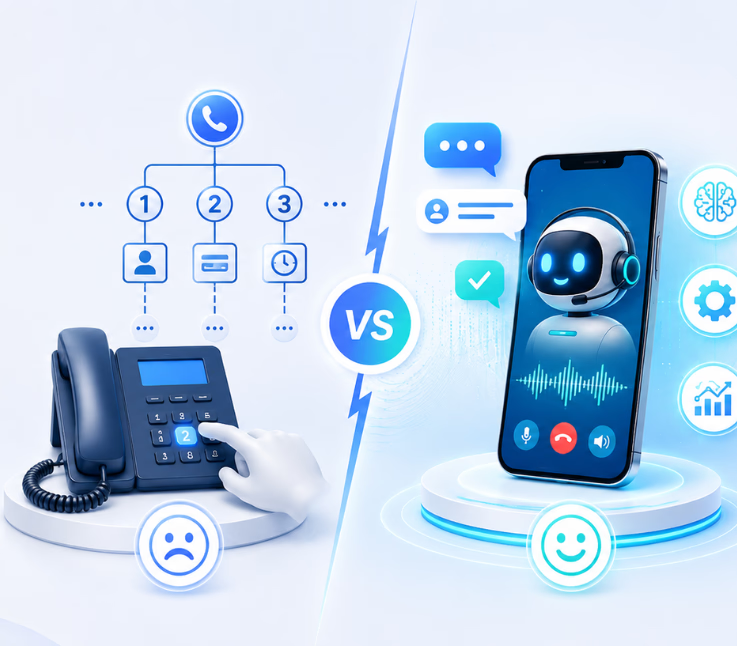
IVR uses touch-tone or menu navigation for call routing. AI phone agents use natural language, resolve complex tasks, automate more, integrate channels, and improve CSAT. In 2026, AI agents are often the better fit for customer-focused organizations.
Legacy IVRs still handle millions of calls every day, but too many callers hang up before they get help. Customers want fast, simple answers—not endless menus or dead ends. I have watched call abandonment and missed sales rise with outdated phone systems.
CX leaders now face a tough question: Is your IVR holding you back, or is it time for a smarter approach? Rising operational costs, pressure to boost CSAT, and the need to provide service on every channel all point to change.
In this guide, you will get a detailed IVR vs AI phone agent comparison across the metrics that matter. You will see the real business difference, learn when each works best, and get a roadmap for migrating to modern, omnichannel CX.
A Detailed IVR vs AI Phone Agent Comparison
Choosing between a traditional IVR system and an AI phone agent is no longer just a technology decision—it directly impacts customer satisfaction, operational efficiency, and business growth. While both solutions automate inbound phone calls, they differ significantly in how they understand customers, resolve issues, and deliver personalized experiences.
If you’re evaluating IVR vs AI phone agent, this detailed comparison will help you determine which solution best fits your business needs.
| Feature | Traditional IVR | AI Phone Agent |
|---|---|---|
| Customer Interaction | Menu-based (Press 1, Press 2) | Natural conversation using voice |
| Understanding | Keyword or keypad input | Context-aware conversational AI |
| Personalization | Very limited | Highly personalized using customer data |
| Call Routing | Rule-based | Intelligent intent detection |
| Self-Service | Basic | Advanced problem resolution |
| Handles Complex Queries | No | Yes |
| Multi-Language Support | Limited | Real-time multilingual conversations |
| Available 24/7 | Yes | Yes |
| Learning Capability | Static | Continuously improves through AI |
| Customer Experience | Moderate | Human-like and engaging |
What Is a Traditional IVR?
Interactive Voice Response (IVR) is an automated phone system that interacts with callers using pre-recorded voice prompts and keypad selections.
A typical conversation looks like this:
“Press 1 for Sales.”
“Press 2 for Billing.”
“Press 3 for Technical Support.”
The system follows predefined decision trees and cannot understand conversations beyond programmed commands.
Advantages of IVR
- Affordable for basic call routing
- Reduces receptionist workload
- Available around the clock
- Simple to implement
- Reliable for repetitive tasks
Limitations of IVR
- Long menu navigation frustrates callers
- Cannot understand natural speech
- Limited personalization
- Frequently transfers customers to human agents
- Difficult to scale for complex customer journeys
What Is an AI Phone Agent?
An AI phone agent is an intelligent virtual representative powered by conversational AI, Natural Language Processing (NLP), Large Language Models (LLMs), speech recognition, and business automation.
Instead of asking customers to press buttons, it allows them to simply speak naturally.
For example:
Customer:
“I need to change my delivery address.”
AI Phone Agent:
“Certainly. Let me verify your identity and update your shipping address for your current order.”
The AI understands context, asks follow-up questions, accesses business systems, and completes tasks without requiring human intervention.
IVR vs AI Phone Agent: Feature-by-Feature Comparison
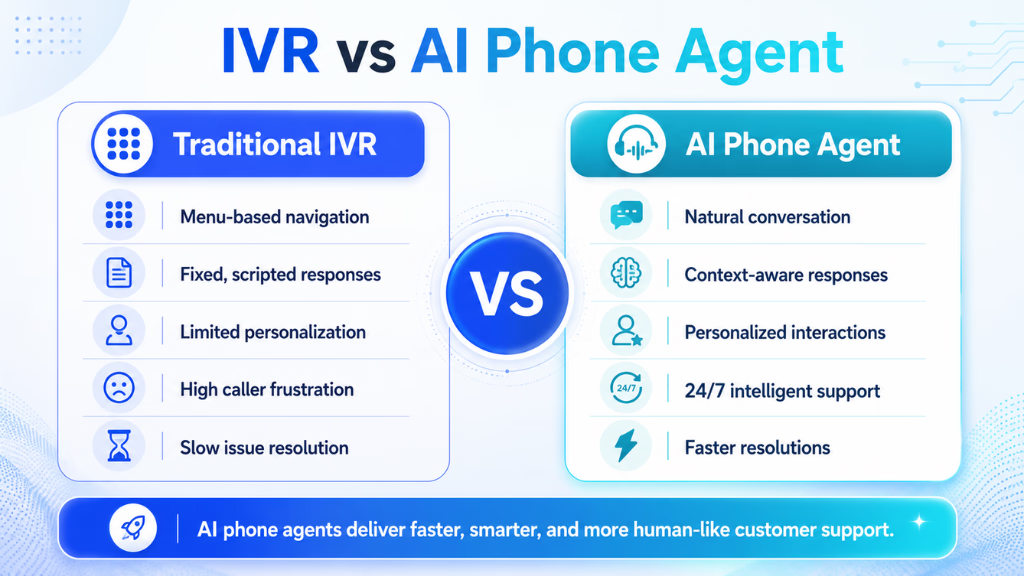
While both IVR and AI phone agents are designed to automate customer phone interactions, their capabilities differ significantly in terms of intelligence, flexibility, and customer experience. The following feature-by-feature comparison highlights the key differences, helping you understand which solution is better suited to modern business communication and long-term customer engagement.
1. Customer Interaction Experience
Traditional IVR forces customers to navigate multiple menus before reaching the right department.
Example:
- Press 1
- Press 3
- Press 2
- Wait on hold
The process can become frustrating, especially when callers are unsure which option to select.
AI phone agents eliminate menu trees altogether.
Customers simply explain what they need in their own words, and the AI immediately understands the intent and guides the conversation naturally.
Winner: AI Phone Agent
2. Understanding Customer Intent
IVR systems rely on predefined options or simple voice recognition.
If a customer says something unexpected, the system often responds:
“I’m sorry. I didn’t understand your selection.”
AI phone agents analyze the entire conversation rather than isolated keywords.
They understand:
- Intent
- Context
- Previous responses
- Customer history
- Conversation flow
This dramatically reduces misunderstandings and repeated questions.
Winner: AI Phone Agent
3. Speed of Issue Resolution
Traditional IVR spends much of the call routing customers through menus before they reach someone who can help.
AI phone agents identify the customer’s intent immediately and either resolve the request or connect them to the correct specialist with complete context.
This significantly shortens average handling time.
Winner: AI Phone Agent
4. Personalization
IVR provides the same experience to every caller.
An AI phone agent can personalize every interaction by accessing:
- Customer name
- Purchase history
- Previous conversations
- Membership level
- Subscription status
- Open support tickets
- Order information
This creates a much more engaging customer experience.
Winner: AI Phone Agent
5. Handling Complex Conversations
IVR systems work well for simple actions like:
- Checking business hours
- Hearing account balances
- Routing calls
- Confirming appointments
However, they struggle with conversations involving multiple requests or nuanced questions.
AI phone agents can manage:
- Billing disputes
- Product recommendations
- Appointment scheduling
- Order modifications
- Technical troubleshooting
- Service renewals
- Lead qualification
without forcing customers into rigid workflows.
Winner: AI Phone Agent
6. Integration With Business Systems
Most IVR platforms connect to only a limited set of systems and often require custom development.
Modern AI phone agents integrate seamlessly with:
- CRM platforms
- Helpdesk software
- Appointment calendars
- Payment gateways
- ERP systems
- Knowledge bases
- Ticketing platforms
This enables them to perform real business actions rather than simply routing calls.
Winner: AI Phone Agent
7. Scalability
During peak hours, IVR can queue callers but still relies heavily on human agents for issue resolution.
AI phone agents can manage thousands of simultaneous conversations while maintaining consistent service quality.
This makes them ideal for businesses experiencing seasonal spikes or rapid growth.
Winner: AI Phone Agent
8. Customer Satisfaction
Customers increasingly expect conversational, fast, and personalized support.
IVR often causes frustration due to:
- Long menus
- Repeated information
- Incorrect routing
- Excessive transfers
AI phone agents reduce customer effort by understanding requests instantly and resolving issues in fewer steps, leading to higher satisfaction and loyalty.
Winner: AI Phone Agent
9. Operational Costs
Traditional IVR reduces some staffing costs but still depends on human agents for many customer interactions.
AI phone agents automate a much larger share of conversations, including sales, support, scheduling, and follow-ups. By resolving more calls without human intervention, businesses can lower operational expenses while scaling customer service more efficiently.
Winner: AI Phone Agent
10. Continuous Improvement
One of the biggest differences lies in adaptability.
IVR systems remain largely unchanged unless developers manually update call flows.
AI phone agents continuously improve by learning from conversation patterns, identifying common customer intents, refining responses, and leveraging updated knowledge sources. Over time, they become more accurate and effective without requiring complete workflow redesigns.
Winner: AI Phone Agent
When Should You Use a Traditional IVR?
A traditional IVR may still be the right choice if your business:
- Has a very limited budget
- Only needs basic call routing
- Receives low call volumes
- Handles straightforward customer requests
- Doesn’t require personalized conversations
For small organizations with simple communication needs, IVR remains a practical entry-level solution.
When Should You Choose an AI Phone Agent?
An AI phone agent is a better fit if your business:
- Receives a high volume of inbound calls
- Wants to automate customer support
- Needs intelligent appointment scheduling
- Handles sales inquiries and lead qualification
- Supports customers in multiple languages
- Requires 24/7 availability
- Wants to reduce operational costs while improving customer experience
Industries such as healthcare, financial services, real estate, eCommerce, SaaS, logistics, hospitality, and BPOs often gain the greatest value from AI-powered phone agents due to their ability to manage complex, high-volume interactions efficiently.
Why Modern Businesses Are Replacing IVR with AI Phone Agents
Customer expectations have evolved. People no longer want to navigate lengthy phone menus or repeat information multiple times before reaching the right department. They expect fast, conversational, and personalized assistance from the moment they call.
AI phone agents meet these expectations by combining natural language understanding, automation, and seamless integration with business systems. Rather than acting as a simple call router, they function as intelligent virtual representatives capable of resolving issues, qualifying leads, booking appointments, processing requests, and escalating conversations only when necessary.
For organizations focused on improving customer experience while reducing operational costs, AI phone agents provide a more scalable and future-ready solution than traditional IVR systems.
Top AI Phone Agent Platform: Commplify
If you’re looking to move beyond traditional IVR, Commplify is a powerful omnichannel AI customer experience platform that offers intelligent AI phone agents for businesses of all sizes.
With Commplify, you can:
- Automate inbound and outbound phone conversations
- Provide 24/7 multilingual customer support
- Qualify leads and transfer high-intent callers to sales teams
- Schedule appointments automatically
- Integrate with CRM, helpdesk, and business applications
- Deliver personalized, human-like conversations at scale
Unlike traditional IVR systems, Commplify enables businesses to create seamless voice experiences that improve customer satisfaction while reducing support costs and increasing operational efficiency.
Conclusion
The core difference in the IVR vs AI phone agent debate is not about menus or features—it is about outcomes. IVR still fits limited scenarios but falls short as call volumes and expectations rise. AI phone agents bring new capability—higher containment, better CSAT, and complete workflow integration.
If your calls are simple and infrequent, IVR might still be enough. But for most growing, customer-focused teams, it is time to plan an upgrade. Look for solutions that can unify voice, SMS, WhatsApp, chat, and email into real omnichannel workflows—like Commplify. Take time to pilot, train, and phase in deployment, and put analytics at the core of your team’s process.
Ask your vendor: Can we run side-by-side pilots? Will all escalations transfer context? How are compliance and data handled? Will analytics drive ongoing improvement?
The change to AI-driven CX is happening. Those who plan it right will deliver stronger, faster, lower-cost customer service—across every channel.
FAQs
What is the difference between IVR and AI phone agents?
IVR uses menu trees and keypad navigation for routing. AI phone agents use natural language, can solve complex tasks, automate more, and connect across channels for higher customer satisfaction.
What are the main benefits of switching from IVR to AI phone agents?
Higher task resolution, lower abandonment, better CSAT, deeper analytics, automation of complex workflows, reduced manual work, and improved omnichannel integration.
Does AI phone automation cost more than IVR?
Upfront costs can be similar or higher. Over time, AI reduces labor costs and boosts ROI through containment and task automation, especially as call volume grows.
How do customer satisfaction and abandonment rates compare?
AI phone agents typically raise CSAT by 10-30 percent and lower abandonment by 20-40 percent, depending on use case and fine-tuning.
Can AI phone agents perform tasks as well as a human agent?
AI phone agents handle many routine and medium-complexity tasks as well as humans and escalate to live staff when nuance or compliance is needed.
What are the risks and challenges in replacing IVR with AI phone agents?
AI requires careful intent mapping, strong escalation paths, compliance checks, and ongoing monitoring. Poor tuning can create frustration, just like bad IVR.
How does AI escalate calls to human agents compared to IVR?
AI phone agents transfer the full conversation context to humans, making the handoff smoother and improving issue resolution.
Do AI phone agents work with existing business phone systems?
Most modern AI phone agent platforms integrate with popular phone services through API or SIP, allowing replacement or augmentation of existing IVR.
When is IVR still a better or sufficient choice?
IVR is sufficient if tasks are simple, volumes are low, or budgets are very tight. It is not as effective for complex or high-stakes customer service.
What features should I look for in an AI phone agent platform?
Look for natural language understanding, omnichannel support, workflow automation, analytics, AI-human escalation, integration with core systems, and compliance controls.
How long does deployment and migration take?
A small pilot can launch within weeks. Full migration, including all channels and integrations, may take 1-3 months, depending on scope and readiness.
How is customer data handled and secured in AI phone agent solutions?
Reputable platforms apply encryption, data isolation, access control, and compliance requirements (e.g., HIPAA, PCI) to secure customer data throughout the conversation lifecycle.
This page was last edited on 29 July 2026, at 3:21 am