AI agents for customer service in insurance automate claims, policy queries, billing, and support across voice, chat, email, SMS, and messaging. They boost efficiency, customer satisfaction, and compliance while allowing human escalation whenever needed.
Insurance service is under intense pressure. Claims queues are long, customer expectations keep rising, and strict compliance never eases up. CX and operations leaders know their contact centers need to do more with less—but legacy tools are at their limit.
In my experience, trying to stitch together siloed channels and disconnected bots only adds friction. The real issue is delivering control, empathy, and efficiency at scale, in every channel, for every policyholder.
This guide explains how modern AI agents unify insurance customer service—automating where it makes sense, escalating when needed, and creating a full omnichannel experience your policyholders and teams trust. Read on for use cases, practical workflows, pitfalls, and the metrics that matter.
What Are AI Agents for Customer Service in Insurance?
AI agents for customer service in insurance are intelligent software systems designed to communicate with policyholders, answer questions, complete routine service tasks, and support insurance representatives.
Unlike basic chatbots that follow predefined scripts, modern AI agents can understand natural language, recognize customer intent, retrieve relevant policy information, and guide users through multi-step processes. They can operate across websites, mobile apps, messaging platforms, email, and voice channels.
For example, an insurance AI agent can help a customer check policy coverage, request a document, update contact information, report a claim, or understand the next steps in the claims process. When a case requires human judgment, the AI agent can transfer the interaction to the appropriate employee along with the conversation history and relevant customer details.
The goal is not simply to automate conversations. The goal is to provide faster, more consistent, and more accessible customer service while allowing insurance teams to focus on complex or sensitive cases.
How AI Agents Work in Insurance Customer Service
AI agents combine several technologies to understand requests and deliver appropriate responses.
1. Customer Intent Recognition
The AI agent first analyzes the customer’s message or spoken request to determine what they need. It may identify intents such as:
- Checking policy status
- Asking about coverage
- Reporting an accident
- Requesting proof of insurance
- Updating personal information
- Tracking a claim
- Asking about a payment
- Renewing or cancelling a policy
Intent recognition allows the system to direct the customer to the correct workflow without requiring them to navigate complicated menus.
2. Customer and Policy Verification
Before sharing sensitive information or making account changes, the AI agent can verify the customer’s identity. Depending on the insurer’s requirements, verification may include account credentials, one-time passcodes, security questions, or other authentication methods.
After verification, the agent can securely retrieve relevant policy, billing, or claims information from connected systems.
3. Data Retrieval and Response Generation
The AI agent searches approved insurance databases, knowledge bases, policy documents, and customer records to find accurate information.
It then provides a response in clear, conversational language. Instead of presenting long and complicated policy wording, the agent can explain the relevant information in a simpler format while directing the customer to official documents when necessary.
4. Workflow Automation
An AI agent can do more than answer questions. It can initiate or complete approved customer service workflows, including:
- Sending policy documents
- Updating an address or phone number
- Scheduling a callback
- Creating a claim notification
- Collecting initial claim information
- Processing simple payment requests
- Recording customer consent
- Opening a service ticket
- Sending renewal reminders
This allows customers to complete common tasks without waiting for a representative.
5. Human Agent Escalation
Some insurance requests involve emotional conversations, unusual circumstances, legal concerns, or complex policy interpretation. In these cases, the AI agent should recognize its limitations and transfer the customer to a qualified human representative.
A well-designed escalation process sends the human agent the customer’s information, conversation summary, identified intent, and completed steps. This prevents the customer from having to repeat the entire issue.
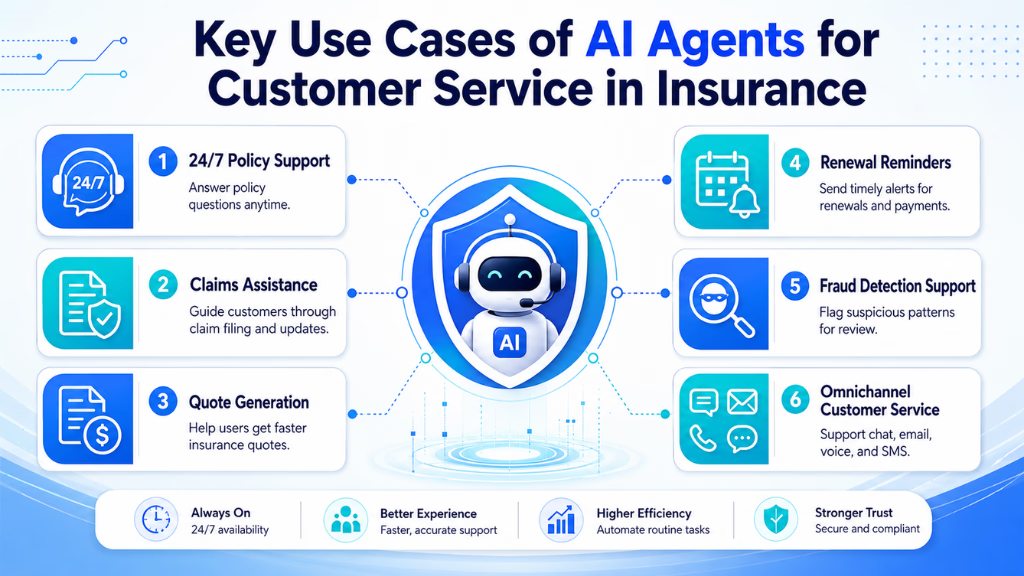
Key Use Cases of AI Agents for Customer Service in Insurance
AI agents can support customers throughout the insurance lifecycle, from initial research to policy renewal and claims resolution.
Policy Information and Coverage Questions
Customers frequently contact insurers to understand what their policy includes. An AI agent can answer common questions about deductibles, coverage limits, exclusions, waiting periods, beneficiaries, and renewal dates.
For instance, a customer may ask whether roadside assistance is included in an auto insurance policy or whether a specific medical service is covered by a health plan. The agent can retrieve the relevant policy information and provide an easy-to-understand explanation.
For questions requiring formal interpretation, the agent can direct the customer to the official policy wording or connect them with a licensed representative.
Insurance Quote Assistance
AI agents can guide prospective customers through the early stages of requesting a quote. They can collect basic information, explain available policy options, answer preliminary questions, and schedule a conversation with a sales or underwriting specialist.
This reduces form abandonment and helps customers understand which information they need before continuing the application.
The AI agent should not make unauthorized underwriting decisions. Instead, it supports the data-collection process and routes qualified inquiries to the appropriate team.
Claims First Notice of Loss
First notice of loss is one of the most valuable applications of AI agents in insurance customer service. The agent can guide policyholders through the initial claim-reporting process at any time of day.
It may collect information such as:
- Policyholder details
- Date and location of the incident
- Type of damage or loss
- People or property involved
- A basic description of what happened
- Supporting photos or documents
- Preferred contact method
Once the information is collected, the AI agent can create a claim record, provide a reference number, and explain the next steps.
Claims Status Updates
Claimants often contact insurance companies simply to ask for an update. These repetitive inquiries can create significant pressure on claims teams.
An AI agent can retrieve real-time claim information and tell the customer whether the claim is under review, waiting for documentation, assigned to an adjuster, approved, or scheduled for payment.
It can also notify customers when additional information is required, helping reduce unnecessary delays.
Billing and Payment Support
Insurance AI agents can answer questions about premiums, due dates, payment history, failed transactions, refunds, and billing schedules.
Depending on the connected payment system and the insurer’s policies, an agent may also help a customer make a payment, update a payment method, request a receipt, or set up automatic payments.
For disputes, unusual charges, or financial hardship cases, the conversation can be escalated to a human billing specialist.
Policy Changes and Document Requests
Customers often need to make simple changes to their policies or request important documents. AI agents can streamline tasks such as:
- Updating contact details
- Adding or removing a vehicle
- Requesting a certificate of insurance
- Downloading an insurance card
- Changing communication preferences
- Adding a beneficiary
- Requesting policy copies
Some policy changes may require underwriting review or representative approval. The AI agent can still collect the necessary information and initiate the request.
Renewal and Retention Support
AI agents can proactively remind customers about upcoming renewals, explain changes to their policy, and guide them through the renewal process.
They can also identify signs that a customer may cancel, such as repeated questions about premiums or coverage. The agent can offer relevant self-service options or connect the customer with a retention specialist before the policy lapses.
Emergency and After-Hours Assistance
Insurance problems do not always happen during normal business hours. Customers may need help after an accident, property loss, travel emergency, or unexpected health event.
A 24/7 AI agent can provide immediate guidance, collect essential information, and connect the customer with emergency services, roadside assistance, or an on-call insurance representative when appropriate.
The agent should clearly distinguish between insurance support and emergency services, especially when a customer’s immediate safety may be at risk.
Benefits of AI Agents for Insurance Customer Service
AI agents help insurance companies deliver faster, more consistent, and more accessible customer support across policy, billing, and claims interactions. By automating routine requests and assisting human representatives, they can improve customer satisfaction, reduce operational workload, and maintain reliable service during periods of high demand.
Faster Customer Response Times
AI agents can respond almost instantly, eliminating long queues for routine questions. Customers can receive policy details, claim updates, and documents without waiting for a representative.
Faster responses can improve satisfaction, especially during stressful situations such as accidents or claims.
24/7 Customer Availability
Customers may need assistance outside traditional office hours. AI agents provide continuous access to basic insurance services, allowing customers to report incidents, check information, or request support at any time.
Round-the-clock availability is especially useful for insurers serving customers across multiple time zones.
Reduced Workload for Insurance Teams
Many insurance contact centers receive high volumes of repetitive inquiries. Automating these interactions gives employees more time to handle complex claims, sensitive customer situations, policy exceptions, and cases requiring professional judgment.
AI agents can also reduce the time representatives spend searching for information or completing administrative tasks.
Consistent Customer Service
Human responses may vary depending on experience, workload, or access to information. AI agents use approved knowledge sources and standardized workflows, helping insurers provide more consistent answers.
Consistency is particularly important when communicating policy terms, compliance information, and required disclosures.
Improved Claims Communication
Customers often become frustrated when they do not know what is happening with a claim. AI agents can provide proactive updates and explain pending actions, reducing uncertainty throughout the claims journey.
Regular communication may also reduce repeated calls to claims representatives.
Scalable Support During High-Demand Periods
Insurance companies may experience sudden increases in customer inquiries after severe weather, major accidents, policy renewal periods, or billing changes.
AI agents can manage large numbers of simultaneous conversations without requiring the insurer to immediately expand its customer service workforce.
Personalized Customer Interactions
When securely connected to customer data, an AI agent can personalize conversations based on policy type, claim history, communication preferences, and previous interactions.
For example, instead of providing a general response, the agent can explain the customer’s specific renewal date or identify which documents are missing from an active claim.
AI Agents vs Traditional Insurance Chatbots
Traditional insurance chatbots usually rely on decision trees, buttons, and predefined responses. They work well for simple frequently asked questions but may struggle when customers use unexpected language or ask follow-up questions.
AI agents are more advanced because they can understand conversational requests, remember context within an interaction, connect with multiple business systems, and complete multi-step tasks.
| Capability | Traditional Chatbot | AI Customer Service Agent |
|---|---|---|
| Predefined FAQ responses | Yes | Yes |
| Natural language understanding | Limited | Advanced |
| Multi-step task completion | Limited | Yes |
| Policy and claims system integration | Basic | Advanced |
| Conversation context | Limited | Stronger |
| Personalized responses | Basic | Data-driven |
| Human escalation | Rule-based | Context-aware |
| Voice support | Rare | Often available |
However, greater capability also requires stronger governance. Insurers must carefully control which data the agent can access, which actions it can perform, and when human approval is required.
Challenges of Using AI Agents in Insurance
While AI agents can improve speed, availability, and operational efficiency, implementing them in insurance also creates important challenges. Insurers must carefully manage data privacy, regulatory compliance, response accuracy, system integration, and customer trust to ensure automated support remains secure, reliable, and appropriate for sensitive insurance interactions.
Data Privacy and Security
Insurance companies manage sensitive personal, financial, medical, and claims information. AI agents must follow strict security controls when accessing, processing, or sharing this data.
Organizations should implement encryption, role-based access, authentication, audit logs, and data-retention policies. Customers should also be informed about how their information is being used.
Regulatory and Compliance Requirements
Insurance is a highly regulated industry. Customer communications may be subject to regional insurance laws, consumer protection requirements, privacy regulations, and recordkeeping obligations.
AI-generated responses must be reviewed and controlled to prevent misleading statements, unauthorized advice, or missing disclosures.
Incorrect or Misleading Responses
An AI agent may provide an inaccurate answer when its knowledge source is incomplete, outdated, or unclear. In insurance, even a small mistake about coverage or claim eligibility can create serious consequences.
Insurers should limit responses to verified information, monitor agent performance, and require human escalation for uncertain or high-risk questions.
Complex Policy Language
Insurance policies contain detailed definitions, exclusions, conditions, and endorsements. An AI agent may simplify this information for the customer, but it should avoid changing the legal meaning.
Whenever appropriate, the agent should reference the official policy document and make it clear that the policy wording remains the authoritative source.
Customer Trust
Some customers may be uncomfortable discussing claims, health information, or financial matters with an AI system. Insurers should clearly disclose when a customer is interacting with AI and provide an easy way to reach a human representative.
Trust increases when the system is transparent, accurate, secure, and respectful.
Integration With Legacy Insurance Systems
Many insurers rely on older policy administration, billing, and claims platforms. Connecting an AI agent to these systems can be technically difficult.
Successful deployment may require APIs, middleware, data mapping, identity management, and carefully designed integration workflows.
Best Practices for Implementing AI Agents in Insurance
Implementing AI agents in insurance requires a careful balance of automation, accuracy, security, and human oversight. Insurers should begin with clearly defined use cases, connect agents to reliable data sources, establish strict compliance controls, and ensure customers can easily reach a human representative when needed.
The following best practices can help organizations deploy AI agents safely and effectively.
Start With High-Volume, Low-Risk Tasks
Insurance companies should begin with common customer requests that follow predictable processes. Good starting points include document retrieval, claim status updates, payment reminders, and frequently asked policy questions.
After the system proves reliable, insurers can gradually introduce more complex workflows.
Use Approved and Updated Knowledge Sources
The AI agent should only retrieve information from verified policy documents, customer databases, approved knowledge bases, and current compliance resources.
Knowledge sources should be reviewed regularly to remove outdated information and incorporate policy or regulatory changes.
Define Clear Automation Boundaries
Insurers must decide which tasks the AI agent can complete independently and which require human approval.
For example, the agent may provide a claim status update but should not independently deny a complex claim. It may collect information for a policy adjustment but require an authorized employee to finalize the change.
Build a Seamless Human Handoff Process
Customers should be able to request a human representative at any point. The AI agent should also escalate automatically when it detects confusion, repeated failure, customer frustration, sensitive circumstances, or a high-risk request.
The transfer should include the full interaction context so that the human representative can continue without restarting the conversation.
Maintain Transparency
Customers should know when they are speaking with an AI agent. The system should explain its role, limitations, and available escalation options.
Transparent communication helps establish trust and prevents customers from assuming that the AI system has authority it does not actually possess.
Monitor Accuracy and Customer Outcomes
Insurers should continuously review conversation quality, escalation rates, task completion, customer satisfaction, and incorrect responses.
Monitoring should focus not only on reducing contact volume but also on whether customers receive accurate information and successfully resolve their issues.
Protect Sensitive Customer Information
The AI agent should only access the minimum amount of data required to complete a task. Sensitive data should be masked when possible, and employees should have clear controls over who can view conversation histories.
Security testing and compliance reviews should be completed before deployment and repeated regularly.
How to Choose an AI Agent Platform for Insurance
When evaluating an AI customer service solution, insurance providers should consider whether the platform offers:
- Natural language and voice capabilities
- Integration with policy, billing, CRM, and claims systems
- Secure identity verification
- Omnichannel customer support
- Multilingual communication
- Human agent handoff
- Conversation summaries
- Role-based data access
- Audit trails and reporting
- Custom workflow automation
- Knowledge-base management
- Compliance and security controls
- Analytics for customer satisfaction and resolution rates
The best platform is not necessarily the one with the most features. It is the one that fits the insurer’s customer journeys, data environment, compliance obligations, and operational goals.
Measuring the Performance of Insurance AI Agents
Insurance companies should track both operational efficiency and customer outcomes.
Important performance indicators include:
- Average response time
- First-contact resolution rate
- Self-service completion rate
- Human escalation rate
- Average handling time
- Customer satisfaction score
- Claim-status inquiry reduction
- Automation success rate
- Response accuracy
- Abandonment rate
- Cost per customer interaction
- Percentage of unresolved conversations
Insurers should also review complaints, incorrect coverage explanations, failed handoffs, and customer feedback. A high automation rate is not valuable when customers receive incomplete or inaccurate support.
The Future of AI Agents in Insurance Customer Service
AI agents are expected to become more deeply integrated into insurance operations. Instead of functioning only as website chat tools, they will increasingly support complete customer journeys across voice, messaging, email, and mobile applications.
Future systems may proactively notify customers about missing documents, renewal deadlines, claim progress, coverage gaps, and weather-related risks. They may also assist human representatives by summarizing customer histories, recommending next actions, and retrieving policy information during live conversations.
However, human expertise will remain essential. Insurance often involves financial consequences, emotional situations, regulatory requirements, and complex judgment. The most effective model will combine AI-powered speed and availability with human empathy, accountability, and professional decision-making.
How Commplify Supports AI-Powered Insurance Customer Service
Commplify is an omnichannel AI customer experience platform that helps insurance companies manage and automate customer interactions across voice, chat, and email from a unified orchestration layer. It can support policyholders throughout important service journeys while maintaining shared context across channels.
Insurance providers can use Commplify to create AI-powered workflows for common customer requests, such as:
- Answering general policy and coverage questions
- Providing claim and service-status updates
- Collecting information for insurance inquiries
- Routing billing or payment-related requests
- Sending reminders and follow-up communications
- Qualifying prospective customers
- Transferring complex or sensitive cases to human representatives
Commplify combines intent detection, knowledge grounding, workflow automation, intelligent routing, and human handoff capabilities. This allows an AI agent to understand why a policyholder is contacting the insurer, retrieve information from approved knowledge sources, complete permitted actions, and escalate the interaction when human expertise is necessary.
The platform also offers governance features such as role-based access controls, audit logs, policy rules, quality scoring, and controlled retrieval. These capabilities can help insurers build more consistent and accountable AI-assisted service processes, although every implementation must still be configured according to the organization’s security, privacy, and regulatory requirements.
By bringing AI-driven conversations, automated workflows, enterprise data, and human support together, Commplify can help insurance companies reduce repetitive workloads and deliver faster, more connected customer experiences without removing human representatives from situations that require empathy, judgment, or specialized knowledge.
Explore how Commplify can help modernize insurance customer service with secure, omnichannel AI agents and intelligent automation.
Conclusion
AI agents for customer service in insurance now deliver more than efficiency—they build resilience, control, and trust in every policyholder journey. Omnichannel AI, grounded in workflow automation and compliance, is moving insurance CX from reactive to proactive.
Platforms that unify email, voice, SMS, WhatsApp, and chat—with robust workflow and AI-to-human escalation—are proving this is not about replacing people, but giving teams superpowers and context.
The best outcomes come when AI automates what it should, humans focus on what only they can, and both work from the same unified data and workflow. In my experience, insurers who adopt this model see a meaningful lift in CSAT and a fall in operational cost.
The future promises even tighter integration between policy, claims, sentiment analysis, and every channel. Smart leaders are getting started now.
FAQs
What are AI agents in insurance customer service?
AI agents in insurance customer service are virtual assistants that automate tasks like claims, policy inquiries, and billing support, handling interactions across voice, chat, SMS, email, and messaging channels.
How do AI agents differ from chatbots, RPA, or generative AI in insurance?
AI agents offer advanced, context-aware conversations, workflow automation, omnichannel continuity, and smart escalation—beyond the limited, script-based responses of traditional chatbots, basic RPA, or generative AI.
What insurance processes can be automated with AI agents?
Claims triage, First Notice of Loss, policy inquiries, document delivery, billing questions, payment reminders, fraud flagging, and multilingual support can be automated with AI agents in insurance.
Will AI agents replace human insurance agents?
AI agents automate routine tasks but escalate complex or sensitive cases to human agents. The human role shifts to handling exceptions, empathy-driven support, and compliance oversight.
Can AI agents handle multi-channel and multi-language support in insurance?
Yes, modern AI agents handle inquiries across voice, chat, SMS, email, WhatsApp, and support multiple languages for global insurance operations.
What are the main benefits and drawbacks of deploying AI for insurance CX?
Benefits include faster response, cost control, higher CSAT, and 24/7 support. Drawbacks can be integration complexity, risk of automation errors, and the need for careful compliance and escalation design.
How can insurers ensure compliance and data security with AI agents?
Choose platforms with compliance-ready records, secure data handling, role controls, and audit trails. Always align workflows to industry regulations like GDPR and HIPAA.
What operational metrics should be tracked for AI agent performance in insurance?
Track AI-handled ratio, escalation rates, first-contact resolution, CSAT, sentiment, channel breakdowns, missed-call recovery, and compliance logging.
What are real-world examples of insurance firms successfully using AI agents?
Insurers are using AI agents to cut claim response times, automate policy updates, recover missed calls via SMS, and improve CSAT—all while maintaining compliance and human oversight.
How can insurance companies get started with AI agent implementation?
Start with a pilot focused on a high-volume workflow, integrate with existing systems, define clear escalation triggers, measure outcomes, train staff, and scale in phases.
This page was last edited on 30 July 2026, at 6:02 am