The best AI call center voice agents for 2026 support humanlike calls, connect with voice, chat, SMS, and email, offer fast responses, workflow automation, compliance, and analytics. Top picks include Retell AI, PolyAI, Cognigy, arahi.ai, and Commplify.
Your phone lines are clogged, teams are burned out, and callers hate your IVR. I have seen this happen when teams cling to old telephony or rely on bots that frustrate more than they help.
The real issue is not just scaling calls, but doing it with accuracy, compliance, and care—across every customer channel, not just the phone. AI voice agents are now the backbone of modern call centers.
This article will show you which AI voice agent platforms stand out in 2026, how they compare, and what to look for if you want calls that actually help your customers, not hurt your brand.
Best AI Call Center Voice Agents: Quick Comparison
The best AI call center voice agents do much more than answer calls with a synthetic voice. Modern platforms can understand conversational intent, access customer information, perform actions in connected systems, route calls intelligently, summarize conversations, and transfer customers to human agents when automation is no longer appropriate.
However, the platforms below are not identical. Some provide complete customer experience and contact-center automation, while others give developers infrastructure for building highly customized voice agents. We compared them based on conversational quality, workflow automation, integrations, scalability, human handoff, analytics, governance, and suitability for real-world call center operations.
| Platform | Best For | Key Strength |
|---|---|---|
| Commplify | Omnichannel AI customer experience | Unified voice, messaging, workflows, routing, and analytics |
| Retell AI | Flexible voice automation | Developer-friendly inbound and outbound voice agents |
| PolyAI | Large enterprise call centers | Natural enterprise customer-service conversations |
| Synthflow | No-code voice automation | Rapid deployment of inbound and outbound agents |
| ElevenLabs ElevenAgents | Natural AI voices | Expressive multilingual voice experiences |
| NiCE Cognigy | Enterprise contact centers | Advanced orchestration, governance, and integrations |
| Replicant | High-volume customer service | Contact-center-focused conversation automation |
| Bland AI | Programmable phone automation | Flexible enterprise phone-agent infrastructure |
| Five9 | Existing contact center transformation | AI integrated into broader contact-center operations |
| Vapi | Developers building custom agents | Highly configurable voice AI infrastructure |
1. Commplify — Best Overall AI Call Center Voice Agent
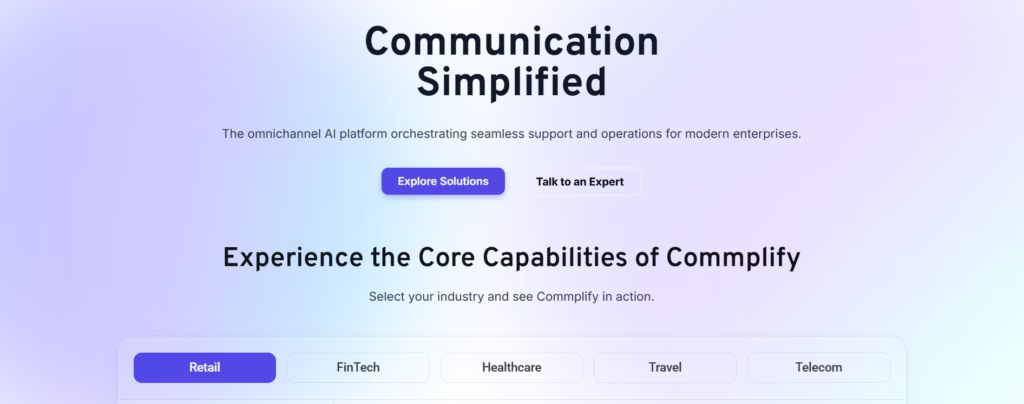
Best for: Businesses that want AI voice agents combined with omnichannel customer experience automation.
Commplify takes the top position because it approaches voice automation as part of the complete customer journey rather than treating phone conversations as an isolated channel. Its platform brings calls, chats, emails, and messaging interactions into a shared AI orchestration layer, allowing businesses to maintain context as customers move between channels.
This makes Commplify particularly valuable for call centers where an AI agent needs to do more than answer FAQs. Agents can identify customer intent, follow business-specific workflows, connect conversations with existing processes, route interactions intelligently, and involve human agents when required. Commplify says its agents can be configured around actual business processes rather than relying only on generic scripts.
Key Features
- AI-powered inbound and outbound customer interactions
- Real-time customer intent and context detection
- Workflow-aware AI agents
- Omnichannel support across voice and digital channels
- Intelligent routing and human-agent fallback
- Centralized knowledge and customer data orchestration
- Workflow automation
- Quality control and governance capabilities
- Conversation analytics and CX insights
- Consistent customer context across channels
Why Commplify Stands Out
Many AI voice platforms concentrate primarily on making automated phone conversations sound natural. Commplify addresses a broader operational problem: what should happen before, during, and after the conversation?
For example, instead of simply answering a customer’s billing question, an AI agent can identify the customer’s intent, retrieve relevant information, follow an approved workflow, complete permitted actions, and escalate the interaction when human judgment is required.
Its combination of voice automation, digital channels, orchestration, analytics, and human fallback makes it particularly suitable for businesses looking to modernize the overall customer experience rather than deploy another standalone call bot.
Best choice for: Customer service organizations, enterprises, BPOs, sales teams, and businesses looking for a unified AI CX platform.
2. Retell AI — Best for Flexible AI Phone Agent Development
Best for: Companies and developers that want highly configurable inbound and outbound AI calling.
Retell AI is a dedicated voice-agent platform designed for building, deploying, and managing AI phone agents. Its agents can automate both inbound and outbound conversations while connecting with external business systems to perform actions during calls.
It is particularly attractive to teams that already have their own applications, workflows, or CRM environment and want voice automation that can be embedded into them.
Key Features
- Inbound and outbound AI calling
- Natural conversational voice interactions
- API-based integrations
- Custom workflows
- Call monitoring
- Agent testing
- Enterprise deployment capabilities
- Multiple model and voice configuration options
- Function calling for performing external actions
Why Choose Retell AI?
Retell provides considerable control over how an agent behaves. Developers can connect voice conversations with scheduling systems, customer databases, CRMs, lead-management workflows, or custom applications.
That makes it a strong option for organizations that want to create a specialized AI calling experience rather than adopt an entire CX platform.
Best choice for: SaaS companies, technology teams, appointment businesses, sales operations, and developers.
3. PolyAI — Best for Large Enterprise Customer Service
Best for: Enterprises handling large volumes of complex customer-service calls.
PolyAI has built its offering specifically around enterprise conversational voice experiences. Its platform focuses heavily on creating natural voice interactions that allow customers to explain what they need without navigating traditional menu-based IVR systems.
PolyAI is particularly relevant for industries where phone support remains a major customer channel, including hospitality, financial services, utilities, travel, and other high-volume service operations.
Key Features
- Enterprise conversational AI
- Natural language understanding
- Voice-first customer service
- Complex multi-turn conversations
- Contact-center integrations
- Multilingual capabilities
- Customer intent recognition
- Enterprise-scale deployment
Why Choose PolyAI?
PolyAI’s biggest strength is its focus on conversation quality within demanding enterprise environments. Instead of asking customers to navigate rigid IVR trees, its voice agents are designed to understand naturally expressed customer requests.
Organizations whose primary priority is upgrading an outdated call-center self-service experience may therefore find PolyAI particularly attractive.
Best choice for: Large enterprises with complex and high-volume customer-service operations.
4. Synthflow — Best No-Code AI Voice Agent Platform
Best for: Teams that want to deploy voice automation without extensive development.
Synthflow provides an end-to-end platform for creating AI voice agents for inbound and outbound calls. Its platform includes capabilities for contextual routing, appointment booking, voicemail detection, SMS follow-ups, CRM/ERP integrations, and multilingual conversations.
The emphasis on visual and no-code deployment makes it particularly appealing to operational teams that cannot dedicate substantial engineering resources to a voice AI project.
Key Features
- No-code AI voice agent development
- Inbound and outbound calls
- Appointment scheduling
- Contextual call routing
- CRM and ERP integrations
- SMS follow-ups
- Voicemail detection
- Multilingual support
- Enterprise phone automation
Why Choose Synthflow?
Synthflow strikes a useful balance between customization and accessibility. Businesses can automate fairly sophisticated phone workflows without developing the entire speech and telephony infrastructure themselves.
Best choice for: Service businesses, operations teams, sales teams, agencies, and enterprises prioritizing fast deployment.
5. ElevenLabs ElevenAgents — Best for Natural and Expressive AI Voices
Best for: Businesses where voice quality and multilingual communication are major priorities.
ElevenLabs has expanded beyond text-to-speech into a broader AI-agent platform called ElevenAgents. Businesses can build agents for websites, applications, and call centers while taking advantage of ElevenLabs’ extensive voice technology.
Its call-center offering supports customer-service workflows such as account inquiries, order tracking, routing, and other interactions connected to CRM or ticketing systems.
Key Features
- Expressive AI voices
- Voice and chat agents
- Multilingual conversations
- Custom and cloned voices
- Knowledge-based answering
- APIs and SDKs
- CRM and help-desk integrations
- Conversation monitoring
- Enterprise security options
- Human escalation workflows
Why Choose ElevenLabs?
Voice quality is one of the most important factors affecting whether customers tolerate an automated call. ElevenLabs is particularly strong for organizations that want agents capable of delivering more expressive, brand-appropriate conversations.
It also offers APIs and SDKs for organizations wanting to incorporate voice agents directly into their own products or services.
Best choice for: Global customer support, branded voice experiences, developers, and multilingual call centers.
6. NiCE Cognigy — Best for Complex Enterprise Contact Centers
Best for: Large organizations requiring sophisticated automation, integrations, and governance.
NiCE Cognigy is designed specifically for enterprise contact-center AI. Its Voice AI Agents combine conversational and routing intelligence and can be deployed alongside existing contact-center infrastructure rather than requiring organizations to replace their entire technology stack.
Its platform combines generative AI, conversational AI, real-time memory, integrations, and orchestration for complex customer journeys. Cognigy reports support for more than 100 languages and more than 110 prebuilt tools and integrations.
Key Features
- Enterprise Voice AI Agents
- Generative and conversational AI
- Advanced routing
- Real-time contextual memory
- Extensive integrations
- Omnichannel automation
- AI agent orchestration
- Agent-assistance capabilities
- Enterprise governance
- Multilingual support
Why Choose Cognigy?
Cognigy becomes especially valuable when voice AI must operate inside a complicated enterprise environment involving multiple applications, business rules, contact-center systems, and customer journeys.
Best choice for: Banks, insurers, telecommunications companies, retailers, and multinational contact centers.
7. Replicant — Best for High-Volume Call Center Automation
Best for: Customer-service organizations looking to automate repetitive call volume.
Replicant focuses specifically on contact-center conversation automation. Its voice AI is designed to handle routine customer calls while allowing human employees to concentrate on conversations that require judgment or empathy.
The company emphasizes high-volume automation and natural conversation handling rather than offering voice technology as a general development component.
Key Features
- AI-powered voice customer service
- High-concurrency call handling
- Multilingual support
- Natural conversation flows
- Contact-center integrations
- Automated customer-service workflows
- Performance monitoring
- Human-agent escalation
Why Choose Replicant?
Replicant is purpose-built around the operational realities of contact centers. That makes it attractive for businesses whose primary objective is reducing repetitive Tier-1 calls, improving availability, and absorbing sudden increases in call volume.
Best choice for: Large customer-service teams, transportation, retail, utilities, insurance, and other high-volume call centers.
8. Bland AI — Best for Programmable Enterprise Phone Automation
Best for: Businesses wanting flexible infrastructure for building customized AI phone agents.
Bland AI provides an enterprise voice AI platform for creating, running, and monitoring automated phone agents at scale.
The platform gives organizations considerable control over conversation logic and automated calling workflows, making it useful for scenarios ranging from customer service to scheduling and business process automation.
Key Features
- AI phone agents
- Inbound and outbound workflows
- Custom conversation logic
- Enterprise phone automation
- API integrations
- Call monitoring
- Scalable deployment
- Custom agent configuration
Why Choose Bland AI?
Bland AI is well suited to organizations that have technical resources and want greater control over how automated phone conversations connect to their internal processes.
Best choice for: Developers, technology companies, sales automation teams, and enterprises building custom phone workflows.
9. Five9 Voice AI Agents — Best for Existing Contact Center Transformation
Best for: Companies that want voice AI integrated with a broader contact-center ecosystem.
Five9 combines AI voice agents with its established contact-center platform. Its Voice AI Agents use an orchestrator-and-sub-agent approach in which specialized agents can perform individual tasks such as identity verification or retrieving information from connected systems.
Five9 also combines customer-facing AI with capabilities such as agent assistance, automated summaries, guidance, routing, and broader contact-center operations.
Key Features
- Agentic voice automation
- Multi-agent orchestration
- Identity and workflow automation
- Human-agent transfer
- AI-assisted human agents
- Conversation summaries
- Contact-center analytics
- Governance and monitoring
- Integration with Five9 contact-center infrastructure
Why Choose Five9?
Organizations already using Five9—or looking for both traditional contact-center capabilities and AI automation under a broader platform—can avoid stitching together numerous separate products.
Best choice for mid-sized and enterprise contact centers modernizing an existing call-center technology stack.
10. Vapi — Best for Developers Building Custom Voice Agents
Best for: Engineering teams that want maximum flexibility.
Vapi describes itself as a developer platform for voice AI agents. It manages components such as telephony and voice infrastructure while letting development teams customize models, tools, conversation behavior, APIs, and integrations.
Its platform supports extensive integrations and allows businesses to connect agents to authenticated internal APIs so they can retrieve information or perform actions during conversations.
Key Features
- Developer-focused APIs
- Inbound and outbound calling
- Configurable speech and AI models
- Telephony infrastructure
- Custom tool calling
- Internal API connections
- Automated voice-agent testing
- Custom workflows
- Production monitoring
Why Choose Vapi?
Vapi is less of a ready-made call-center solution and more of a foundation for building one. That distinction makes it powerful for engineering teams but potentially more technical than an all-in-one CX platform.
Best choice for: SaaS developers, startups, engineering teams, and companies building proprietary voice AI products.
What Features Should the Best AI Call Center Voice Agent Have?
Choosing a voice agent based only on how human its voice sounds is a mistake. Call-center automation ultimately succeeds or fails based on whether the agent can resolve the customer’s problem.
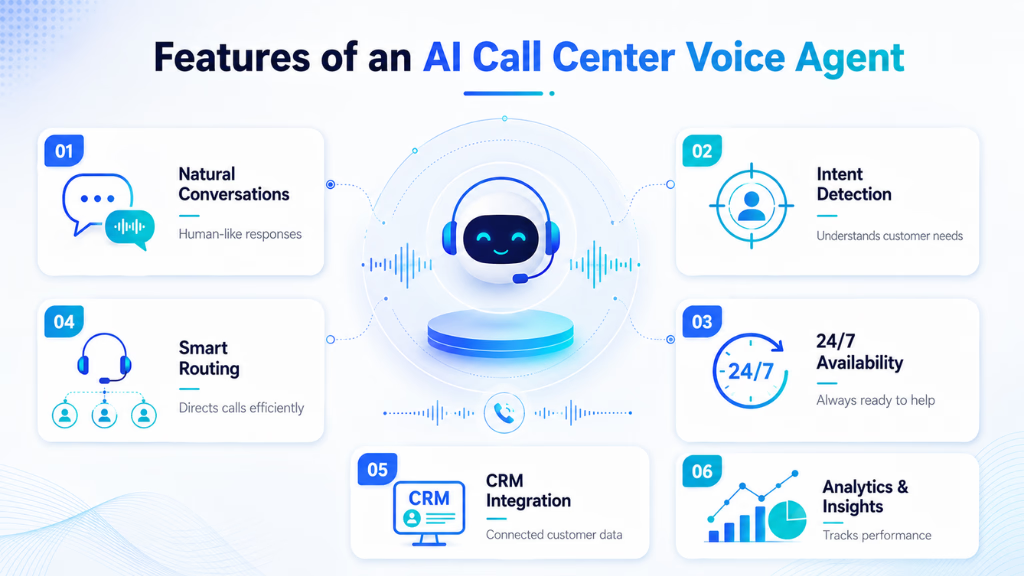
Natural Conversation and Low Latency
Customers expect quick responses, interruption handling, natural turn-taking, and the ability to change direction during a conversation. Long pauses or rigid scripted responses make an AI agent feel like a traditional IVR.
Intent and Context Understanding
A strong voice agent should understand why a customer is calling rather than simply recognizing keywords. It should also remember previous information during the conversation so customers do not repeatedly explain themselves.
Business System Integration
Useful voice agents need access to the systems where work actually happens, including:
- CRM platforms
- Help-desk software
- Appointment systems
- Order-management systems
- Billing platforms
- Customer databases
- Internal APIs
Without integrations, even an impressive conversational agent may only provide information rather than resolve issues.
Workflow Automation
Look for agents capable of performing actions such as:
- Scheduling appointments
- Updating customer records
- Checking order status
- Qualifying leads
- Creating support tickets
- Sending confirmations
- Processing permitted account requests
- Triggering follow-up workflows
Intelligent Human Handoff
AI should not try to automate every conversation. Complex complaints, sensitive situations, unusual requests, and high-value interactions may need human judgment.
The best platforms recognize these situations and transfer the call while preserving customer context.
Analytics and Quality Monitoring
Organizations also need visibility into what happens after deployment. Useful metrics include containment or resolution rates, transfers, average call duration, common intents, unsuccessful conversations, customer sentiment, and workflow completion.
These insights allow teams to continuously improve automation instead of treating deployment as a one-time project.
Security and Governance
Call centers often handle personally identifiable, financial, healthcare, or account-related information. Enterprise deployments therefore need appropriate controls around access, data handling, guardrails, monitoring, retention, and regulatory requirements.
Which AI Call Center Voice Agent Is Best for Your Business?
There is no universal platform for every use case.
Choose Commplify when you want AI voice automation connected to a broader omnichannel customer experience platform. Its combination of voice, messaging, customer intent, workflow orchestration, analytics, and human fallback makes it particularly suitable for organizations trying to automate complete customer journeys rather than isolated calls.
Choose Retell AI, Bland AI, or Vapi when your engineering team wants greater control over the underlying voice-agent implementation. Choose PolyAI, Cognigy, Replicant, or Five9 when large-scale enterprise contact-center deployment is the priority. Synthflow is particularly useful for organizations wanting no-code or low-code implementation, while ElevenLabs stands out when expressive voice quality and multilingual experiences are central requirements.
Ultimately, the best AI call center voice agent is the one that can combine natural conversation with reliable task completion. Voice quality may create a good first impression, but integrations, orchestration, governance, analytics, and the ability to move customers smoothly between AI and human assistance determine whether the technology actually improves call-center performance.
Conclusion
AI voice agents are now essential CX infrastructure. The best AI call center voice agent depends on your mix of call volume, compliance risk, integration needs, and how you want to unify customer channels.
In my POV, real business value comes when voice, chat, SMS, and email are managed together—with analytics and workflow to match. Platforms like Commplify—combining AI voice with full omnichannel coverage—help teams move from just “handling calls” to actually improving the customer journey at every touchpoint.
As AI voice matures, expect even greater improvements in natural speech, multilingual support, and live analytics. Call centers who modernize now will lead in both cost efficiency and genuine customer care.
FAQs
What is an AI call center voice agent?
An AI call center voice agent is software that answers and handles phone calls using speech-to-text, language models, and workflow logic, automating customer conversations just like a human agent.
How do AI voice agents differ from traditional IVR or bots?
AI voice agents understand natural language, handle multi-turn conversations, and trigger workflows, while IVR and simple bots rely on keypad menus and scripted flows with limited flexibility.
What are the main benefits of using AI voice agents in call centers?
Main benefits are faster response, handling more calls with fewer agents, after-hours coverage, reduced queue times, cost savings, and improved customer satisfaction through smarter automation and real analytics.
Which AI voice agent platforms are best for enterprise vs. SMBs?
Enterprises prefer PolyAI, Cognigy, and Commplify for scale and compliance. SMBs often use Aloware or Vapi for fast setup and lower cost. Fit depends on volume, integration, and workflow needs.
How are AI voice agents tested for real-world call performance?
Platforms are tested using real call flows, checking voice latency, speech naturalness, accent handling, barge-in interruption, escalation logic, and production integration with CRM or help desks.
Can AI voice agents handle multiple languages or regional accents?
Yes, advanced platforms like PolyAI, arahi.ai, and Commplify support multilingual callers and regional accents with high accuracy. Accent handling and response fluency should be checked in real call scenarios.
How does integration with CRM or ticketing systems work?
Most AI voice agents connect via prebuilt integrations or APIs to CRMs like Salesforce or ticketing like Zendesk. Workflow automation allows updating, creating, or closing records automatically during or after calls.
What are the main pricing models for AI voice agents?
Pricing is usually per minute, per active user, or per conversation. Some platforms offer monthly plans. Enterprise deals may include setup and integration costs in addition to usage fees.
Are AI voice agents secure and compliant with HIPAA/GDPR/PCI?
Yes, leading platforms support HIPAA, GDPR, and PCI compliance. Always check specific certifications, security audits, and data residency policies during vendor assessment.
What industries benefit most from AI call center voice agents?
Industries with high call volume or compliance need AI voice agents most: healthcare, insurance, financial services, BPO, real estate, retail, and field service.
How do you implement or deploy an AI voice agent in your environment?
Deployment involves integration with existing telephony, selecting workflows, configuring escalation, linking knowledge bases, and live testing. Most vendors offer onboarding help, no-code setup, and human fallback.
What are best practices for smooth human-AI handoff?
Set clear escalation triggers, coach AI agents to identify confusion, and guide customers to human reps early for complex or sensitive calls. Monitor and tune handoff logic constantly.
What are the biggest current limitations of AI voice technology?
Limitations include handling strong accents or noisy calls, edge-case misunderstandings, regulatory approval, and deep integration with legacy systems. Human review and continuous training remain important.
This page was last edited on 13 August 2026, at 8:14 am