Voice of customer sentiment analysis uses AI to understand customer emotions and intent across channels like voice, chat, email, and SMS, guiding teams to spot issues early and improve customer experience at scale.
Every CX leader knows how scattered customer feedback has become. Voice, chat, emails, WhatsApp, and SMS flood in daily. Sifting through the noise and acting on what really matters often feels impossible.
The real issue is, guessing or relying on narrow KPIs allows silent churn to creep in. Teams are asked to “do more with data”—but unifying insights across channels is a tall order. Find the signal, miss nothing, close the loop before it’s too late.
This guide arms you with a clear view of how omnichannel sentiment analysis works in daily operations. Learn how unifying and activating the real voice of your customers turns feedback into retention, revenue, and a tangible competitive edge.
What Is Voice of Customer Sentiment Analysis?
Voice of customer sentiment analysis is the process of analyzing customer feedback to understand not only what customers are saying but how they feel about their experience. It combines Voice of Customer (VoC) data with sentiment analysis techniques to identify positive, negative, and neutral attitudes across conversations, reviews, surveys, support tickets, calls, and other customer interactions.
Traditional VoC programs often depend heavily on surveys, satisfaction scores, and manually reviewed comments. Those methods can provide useful information, but they may miss important signals hidden inside thousands of everyday customer conversations.
Sentiment analysis makes that feedback easier to evaluate at scale. For example, a company may discover that overall customer satisfaction looks healthy while sentiment around a particular issue—such as billing, onboarding, delivery delays, or customer support wait times—is becoming increasingly negative.
This allows customer experience teams to identify problems earlier and understand the reasons behind changes in customer behavior.
How Voice of Customer Sentiment Analysis Works
Voice of customer sentiment analysis usually involves collecting customer interactions, converting unstructured feedback into analyzable data, identifying sentiment and topics, and then using those insights to improve customer experiences.
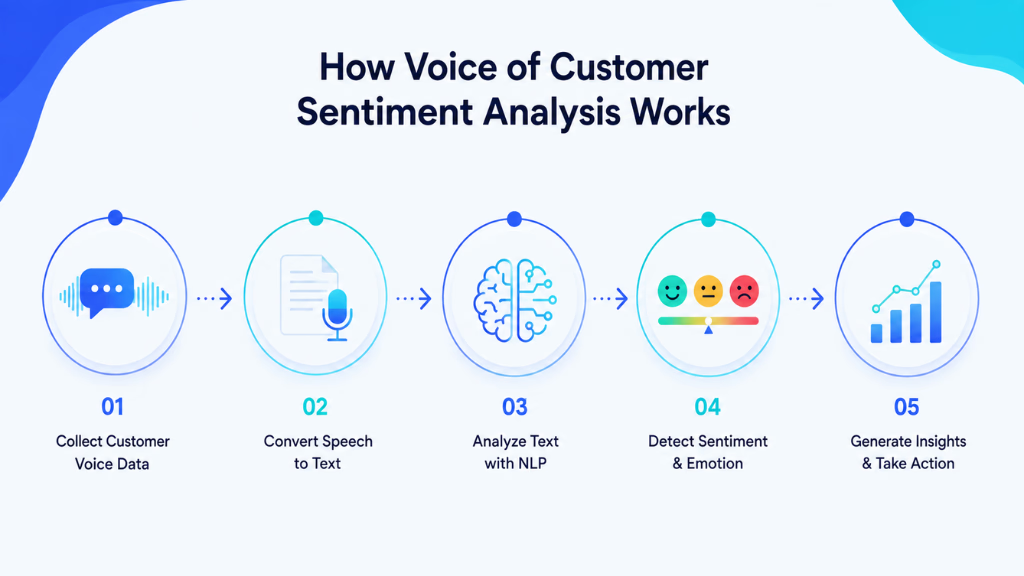
A typical process looks like this:
1. Collect Customer Feedback From Multiple Channels
The first step is bringing together customer feedback from the channels where customers naturally communicate with a business.
Common VoC data sources include:
- Customer satisfaction and NPS surveys
- Online reviews and ratings
- Customer support tickets
- Email conversations
- Live chat transcripts
- AI chatbot conversations
- Contact center calls
- Social media comments
- Product feedback forms
- Community discussions
- Sales conversations
- Cancellation and churn feedback
Using several data sources provides a more complete picture than relying on surveys alone. Customers who never complete a satisfaction survey may still express strong opinions during support calls, chats, or product reviews.
2. Prepare and Organize the Customer Data
Customer feedback is usually unstructured. Before meaningful analysis can happen, the information needs to be organized and normalized.
For voice conversations, speech-to-text technology can convert calls into transcripts. Written conversations can then be cleaned, categorized, and connected with relevant metadata such as channel, customer segment, issue type, product, location, or interaction date.
Personally identifiable or sensitive information should also be handled according to the organization’s privacy and data governance requirements.
Good data preparation matters because sentiment without context can be misleading. Knowing that a customer was frustrated is useful; knowing that frustration happened during a billing conversation after three previous support contacts is much more actionable.
3. Detect Customer Sentiment
Natural language processing and AI models evaluate customer language to determine the emotional direction of an interaction.
At the simplest level, sentiment can be classified as:
Positive: The customer expresses satisfaction, appreciation, confidence, or enthusiasm.
Neutral: The conversation contains little clear emotional language or primarily communicates information.
Negative: The customer expresses dissatisfaction, frustration, disappointment, concern, or another negative reaction.
More advanced systems can assign sentiment scores rather than using only three categories. This makes it possible to distinguish mildly negative feedback from interactions showing much stronger dissatisfaction.
4. Identify Topics and Customer Intent
Sentiment becomes significantly more useful when it is connected to a specific topic.
Consider these two pieces of feedback:
- “The product works really well.”
- “The product is great, but getting help from support takes forever.”
The overall sentiment may appear mixed or positive. However, topic-level analysis reveals two different signals:
- Product sentiment: positive
- Customer support sentiment: negative
Topic detection can automatically categorize feedback around themes such as:
- Product quality
- Customer service
- Pricing
- Billing
- Delivery
- Account setup
- Technical problems
- Onboarding
- Product usability
- Refunds
- Feature requests
This helps organizations identify exactly which parts of the customer journey are producing positive or negative experiences.
5. Track Sentiment Trends
A single unhappy customer does not necessarily indicate a widespread problem. A sudden increase in negative sentiment around the same issue may.
Organizations therefore need to analyze sentiment over time rather than looking only at individual interactions.
For example, a CX team might compare:
- Weekly negative sentiment rate
- Sentiment before and after a product update
- Sentiment by customer segment
- Sentiment across support channels
- Sentiment for individual products
- Sentiment during different customer journey stages
Trend analysis helps separate isolated complaints from emerging customer experience problems.
Types of Sentiment Analysis Used in Voice of Customer Programs
Different sentiment analysis techniques provide different levels of customer insight.
Basic Sentiment Classification
Basic classification places customer feedback into broad positive, neutral, or negative categories.
This is useful for monitoring large volumes of conversations and creating high-level CX dashboards. However, it may not provide enough detail for understanding complex customer interactions.
Fine-Grained Sentiment Analysis
Fine-grained analysis uses additional sentiment levels, such as:
- Very positive
- Positive
- Neutral
- Negative
- Very negative
This allows businesses to prioritize severe dissatisfaction instead of treating every negative interaction equally.
Aspect-Based Sentiment Analysis
Aspect-based sentiment analysis evaluates sentiment toward individual subjects within the same piece of feedback.
For example:
“The software is easy to use, but the reporting dashboard is too limited.”
The system may detect:
Ease of use → Positive
Reporting features → Negative
This is particularly valuable for product, SaaS, ecommerce, and customer experience teams because it reveals exactly what customers like or dislike.
Emotion Detection
More sophisticated customer sentiment analysis can go beyond positive and negative classifications to identify emotional signals such as frustration, satisfaction, confusion, disappointment, or urgency.
These insights can help contact centers recognize conversations where customers may require additional attention or faster escalation.
Intent Analysis
Intent analysis determines what the customer is trying to accomplish.
Common intents might include:
- Cancel an account
- Request a refund
- Report a technical issue
- Upgrade a subscription
- Ask about pricing
- Schedule an appointment
- Make a complaint
Combining intent + topic + sentiment provides much richer insight than sentiment classification alone.
For example:
Intent: Cancel subscription
Topic: Pricing
Sentiment: Strongly negative
This immediately gives the business a clearer picture of why the customer may be at risk of leaving.
Why Voice of Customer Sentiment Analysis Matters
Customer organizations collect enormous amounts of feedback, but collecting feedback does not automatically produce useful insight.
Sentiment analysis helps transform those conversations into information that teams can act on.
Identify Customer Problems Earlier
Negative sentiment trends can reveal emerging issues before they become widespread complaints.
If negative comments about a new feature suddenly increase after a software release, the product team can investigate the issue before it significantly affects retention.
Understand the Reasons Behind CX Metrics
Metrics such as CSAT, NPS, and customer effort score indicate whether customers are satisfied, but they do not always explain why.
Sentiment and topic analysis can add context.
For example, declining CSAT may be connected primarily to:
- Longer support response times
- Billing confusion
- Technical problems
- Complicated onboarding
- Poor delivery experiences
Teams can then focus improvements on the issues actually influencing customer sentiment.
Detect Customers at Risk of Churn
Repeated negative interactions may indicate increasing customer dissatisfaction.
By combining sentiment with account history and interaction patterns, companies can identify customers showing potential churn signals and determine whether proactive support or retention outreach is appropriate.
Improve Products Using Real Customer Feedback
Product teams can analyze large volumes of feedback without manually reviewing every comment.
Recurring themes can reveal:
- Missing features
- Usability problems
- Frequently reported bugs
- Confusing workflows
- Popular product capabilities
- Common feature requests
Sentiment adds another layer by showing which issues create the strongest reactions.
Improve Contact Center Performance
Sentiment analysis can help customer service leaders understand how interactions develop throughout a conversation.
Instead of evaluating agents only through metrics such as average handle time, managers can examine questions such as:
- Did customer sentiment improve during the conversation?
- Which issues generate the highest negative sentiment?
- Where do conversations frequently escalate?
- Which support workflows create customer frustration?
- Which interactions consistently produce positive outcomes?
These insights can support better training, quality assurance, and conversation design.
Voice of Customer Sentiment Analysis for Calls and Voice Conversations
Analyzing voice conversations requires additional steps compared with analyzing written feedback.
Customer calls first need to be converted into structured information using technologies such as speech recognition and conversation intelligence.
An AI-powered voice analytics workflow may analyze:
Call transcription: Converts spoken conversations into searchable text.
Speaker identification: Separates customer and agent dialogue.
Sentiment changes: Tracks whether the customer’s sentiment becomes more positive or negative during the interaction.
Conversation topics: Detects what the customer is discussing.
Intent: Identifies the customer’s goal or reason for calling.
Conversation outcome: Determines whether the request was resolved, transferred, escalated, or left incomplete.
This is particularly useful for businesses handling large numbers of inbound or outbound calls because only a small percentage of conversations can realistically be reviewed manually.
Key Metrics to Track
Sentiment should be evaluated alongside other customer experience metrics rather than treated as an isolated score.
Useful measurements include:
Sentiment Distribution
Measures the percentage of interactions classified as positive, neutral, or negative.
This provides a quick overview of overall customer sentiment.
Negative Sentiment Rate
Shows the percentage of customer interactions containing negative sentiment.
Tracking changes over time can reveal developing customer experience issues.
Topic-Level Sentiment
Measures sentiment for individual topics such as pricing, support, onboarding, product quality, or billing.
This is often more actionable than an overall sentiment score.
Sentiment Change During Conversations
Compares how a customer feels at different points in an interaction.
For example, a customer may start a support call frustrated but finish satisfied after the issue is resolved.
That change can provide valuable information about the effectiveness of the interaction.
Sentiment by Customer Segment
Businesses can compare sentiment across customer groups, subscription plans, products, locations, or lifecycle stages.
This can reveal problems affecting specific groups that would otherwise disappear inside company-wide averages.
Sentiment and Resolution Rate
Combining sentiment with first-contact resolution or ticket resolution data helps determine whether solving the customer’s immediate problem also improved the overall experience.
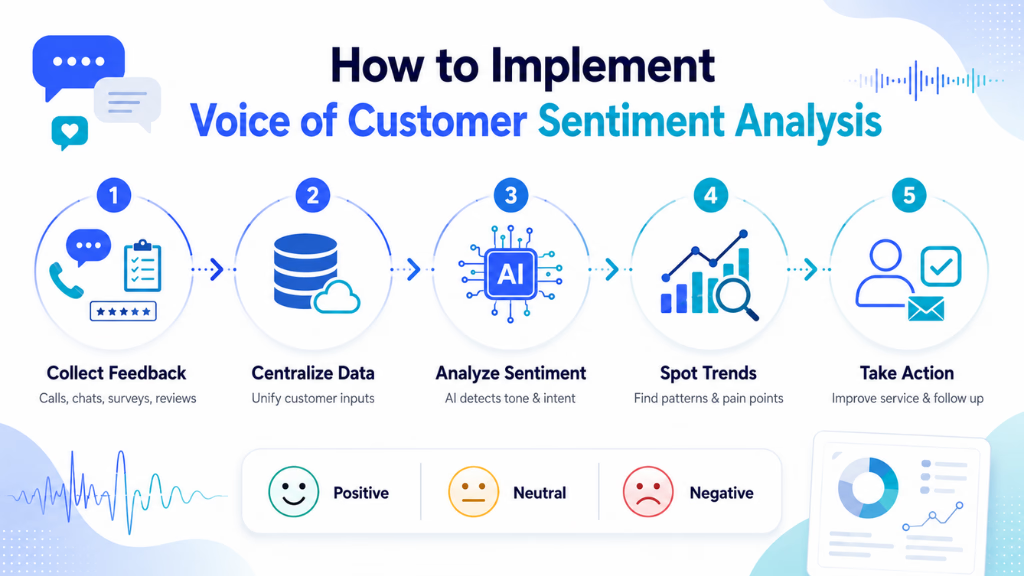
How to Implement Voice of Customer Sentiment Analysis
A successful program should begin with a clearly defined business problem instead of collecting as much data as possible without a plan.
Define the Questions You Want to Answer
Start with specific customer experience questions.
For example:
- Why are customers canceling?
- Which support issues create the most frustration?
- How do customers feel about a new product feature?
- Which stages of onboarding generate confusion?
- Is customer sentiment improving after support interactions?
Clear questions make it easier to determine what data and analysis are actually required.
Connect Relevant Customer Channels
Bring together feedback from the channels connected to the problem being investigated.
A contact center may prioritize calls, tickets, and chats, while a product team may combine support conversations, app reviews, surveys, and product feedback.
Avoid creating separate sentiment systems for every channel whenever possible. A unified VoC view makes cross-channel patterns easier to identify.
Build a Topic Taxonomy
Define the categories that matter to the organization.
For example, a SaaS company might use:
- Onboarding
- Features
- Integrations
- Reliability
- Pricing
- Billing
- Customer support
- Account management
The taxonomy should be specific enough to provide actionable insights without creating hundreds of categories that become difficult to manage.
Validate AI-Generated Sentiment
AI sentiment models should not be treated as automatically correct.
Language can contain sarcasm, ambiguity, industry-specific terminology, and contextual meaning that affects interpretation. Businesses should regularly compare automated classifications with human-reviewed conversations and refine the model or rules when consistent errors appear.
Turn Insights Into Actions
The objective of VoC sentiment analysis is not simply to produce dashboards.
Insights should be routed to the teams capable of solving the underlying problem.
For example:
| Customer Insight | Possible Action |
|---|---|
| Negative sentiment around onboarding | Simplify onboarding instructions |
| Increasing complaints about billing | Review invoices and billing workflows |
| Strong frustration during support transfers | Improve routing and escalation rules |
| Positive sentiment around a feature | Highlight the feature in marketing and onboarding |
| Repeated product complaints | Send findings to the product team |
| Negative sentiment before cancellation | Trigger retention review |
The strongest VoC programs create a closed feedback loop where customer signals lead to operational changes and the results of those changes are measured.
Best Practices for Accurate VoC Sentiment Analysis
Effective VoC sentiment analysis requires more than simply labeling feedback as positive or negative. Accuracy depends on understanding context, connecting sentiment with topics and customer intent, and continuously validating AI-generated insights.
Following these best practices helps businesses reduce misleading classifications and turn customer sentiment into more reliable, actionable CX insights.
Analyze Context, Not Individual Words
Words such as “problem,” “cancel,” or “expensive” do not automatically indicate negative sentiment.
The meaning depends on the surrounding conversation. Context-aware analysis is therefore more reliable than simple keyword matching.
Separate Customer and Agent Sentiment
In customer service conversations, analyzing the entire transcript as one block can distort the result.
Customer sentiment should be evaluated independently from agent language so teams can understand the customer’s actual experience.
Combine Sentiment With Topics and Intent
A negative sentiment score without context provides limited value.
Combining sentiment with the customer’s topic and intent produces an actionable insight:
Sentiment + Topic + Intent + Outcome
For example:
Negative sentiment + billing + refund request + unresolved
is far more useful than simply labeling the interaction “negative.”
Monitor Sentiment Over Time
Avoid making major decisions based on a small number of comments.
Look for recurring themes, increasing sentiment intensity, and meaningful changes across larger groups of interactions.
Keep Humans in the Review Process
Automated analysis can handle scale, while human review provides context and validation.
CX teams should periodically review conversations behind sentiment trends—especially unusual spikes or high-impact customer issues—to understand what is actually happening.
Common Challenges With Voice of Customer Sentiment Analysis
Although sentiment analysis can provide valuable insight, several limitations should be considered.
- Sarcasm and indirect language: Customers do not always communicate emotions literally.
- Mixed sentiment: One conversation can contain both praise and criticism.
- Industry-specific language: Terminology that sounds negative in general language may be normal within a particular industry.
- Multilingual conversations: Sentiment accuracy may differ across languages and dialects.
- Poor transcription quality: Voice sentiment analysis depends partly on accurate speech transcription.
- Lack of context: A sentiment score without customer history, topic, intent, or outcome may lead teams to the wrong conclusion.
For these reasons, sentiment analysis works best as part of a broader Voice of Customer program rather than as a standalone measure.
From Customer Feedback to Actionable Customer Intelligence
The real value of voice of customer sentiment analysis is not determining whether customers are simply “happy” or “unhappy.” It is understanding where sentiment is changing, what is causing the change, which customers are affected, and what the business should do next.
When sentiment is combined with conversation topics, customer intent, interaction history, operational data, and outcomes, Voice of Customer data becomes a practical source of customer intelligence.
Instead of manually reviewing scattered feedback, CX, support, product, and operations teams can continuously identify important customer signals and use them to improve experiences across the customer journey.
Where Tools Like Commplify Fit In
Unified omnichannel platforms solve many of these challenges by bringing every conversation, from every channel, into one analytics system. For example, Commplify’s conversation management and analytics engine captures voice, chat, email, SMS, and WhatsApp—all into a single inbox.
AI models then detect customer sentiment, urgency, and intent, regardless of channel. With built-in workflow automation, severe negative feedback can trigger immediate alerts, automated follow-ups, or escalation to a skilled human team member.
Commplify’s analytics let you segment results by journey stage, customer type, or product, revealing trends that drive real business action. The integrated approach ensures that sentiment signals never get lost in silos—and every customer gets noticed before it is too late.
Conclusion
Voice of customer sentiment analysis turns day-to-day feedback into strategic business value. When teams unify feedback, apply advanced AI, and act promptly, they surface not just problems but hidden pathways to delight and loyalty. The payoff is tangible—higher retention, better CSAT, and less churn.
From my experience, operationalizing sentiment analytics is less about technology and more about embedding insights into daily CX rhythms. Unified platforms like Commplify support this by closing the loop between the signal and the action.
AI-driven sentiment analysis will keep evolving, with richer emotion detection and even more timely insights. The teams who get ahead will be those who treat every customer message as a chance to learn—and act—faster than their competitors.
FAQs
What is voice of customer sentiment analysis?
Voice of customer sentiment analysis uses AI to interpret customer feelings and intent across every feedback channel, revealing actionable insights to improve experience and retention.
How does sentiment analysis fit into VoC programs?
Sentiment analysis helps VoC programs detect, quantify, and act on customer feelings in real time, guiding improvement efforts and reducing churn risk at scale.
What are the key benefits of analyzing customer sentiment?
Analyzing customer sentiment uncovers service issues, prevents churn, boosts NPS, and tracks experience trends—helping teams act promptly and prioritize resources.
How is VoC sentiment analysis different from traditional sentiment analysis?
VoC sentiment analysis unifies data from all customer channels and ties sentiment directly to operational actions and outcomes, while traditional analysis is often isolated to a single channel.
What types of data sources are best for VoC sentiment analysis?
Best sources include voice call transcripts, chat logs, emails, SMS, WhatsApp, open survey responses, and social messages—anywhere customers communicate in their own words.
What are the best tools for customer sentiment analysis?
Top tools unify omnichannel feedback, offer AI-powered analytics, and provide workflow automation. Examples include Commplify, Qualtrics, SupportLogic, and enterprise CX suites.
What challenges do organizations face with sentiment analysis?
Key challenges include nuanced language, multiple languages, channel silos, data fragmentation, and failure to act on insights in real time.
How does AI improve the accuracy of sentiment detection?
AI uses natural language processing and machine learning to identify emotions, intent, and context at scale, improving accuracy across unstructured feedback and channels.
How do you implement sentiment analysis in a VoC program?
Implement by unifying feedback from all channels, setting up AI models for analysis, segmenting results, and creating workflows for real-time response and escalation.
How do organizations act on insights from sentiment analysis?
Organizations act by routing negative signals to the right teams, automating follow-ups, coaching agents, and updating processes based on identified themes and trends.
How can you measure the ROI or impact of VoC sentiment analysis?
Measure ROI by tracking improvements in CSAT, reduced churn, NPS gains, resolution speeds, and cost savings from reduced manual review and proactive retention efforts.
This page was last edited on 10 August 2026, at 5:16 am