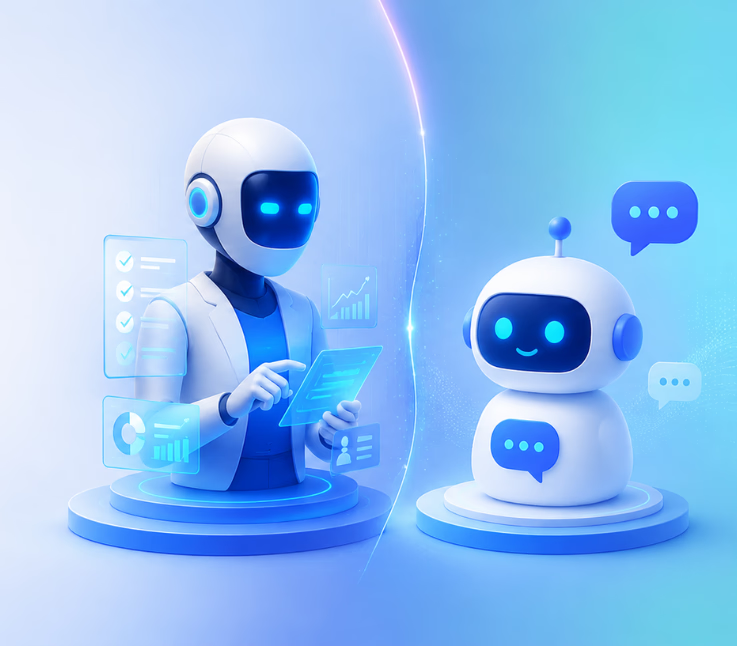
An AI agent works across channels, automates complex workflows, and understands context, while a chatbot follows preset scripts and handles only simple queries. Choose AI agents for advanced, personalized, and scalable customer experiences.
Customer support teams today face a rising tide of complex, high-volume customer inquiries. It’s not just chat volume — it’s expectations for quick, personalized answers on every channel, all the time.
Many leaders feel uncertain: Is a chatbot enough, or do we need something with more intelligence and flexibility? Choosing the wrong tool can slow digital transformation and frustrate both customers and internal teams alike.
In this article, I’ll break down the key differences between AI agents and chatbots, using real CX scenarios and industry insights. By the end, you’ll know exactly what each can do, how to evaluate tools, and when to upgrade.
What Is an AI Chatbot?
An AI chatbot is a software application designed to communicate with users through text or voice. Its main purpose is to answer questions, provide information, guide users through predefined processes, and handle repetitive conversations.
Traditional chatbots often rely on rules, decision trees, keywords, and scripted responses. More advanced AI chatbots use natural language processing (NLP) and large language models (LLMs) to understand conversational language and generate more natural responses.
For example, a customer visiting an ecommerce website might ask a chatbot:
- “Where is my order?”
- “What is your return policy?”
- “Which plan is best for a small business?”
- “How can I reset my password?”
The chatbot interprets the question, retrieves the relevant information, and responds. However, most chatbots primarily react to user requests rather than independently completing complex goals.
Common Chatbot Capabilities
Modern AI chatbots can typically:
- Answer frequently asked questions
- Recommend products or services
- Collect customer information
- Qualify basic leads
- Provide account or order information
- Guide users through troubleshooting steps
- Schedule appointments
- Route conversations to human agents
- Handle basic customer support conversations
Chatbots are particularly effective when the conversation follows a predictable path and the required actions are relatively simple.
What Is an AI Agent?
An AI agent is an AI-powered system designed not only to communicate with users but also to reason, make decisions, use tools, and take actions toward completing a goal.
Instead of simply answering a question, an AI agent can determine what steps need to be taken, interact with connected systems, process information, and perform multiple actions with limited human involvement.
For example, if a customer tells an AI agent:
“I need to reschedule my appointment to Friday afternoon.”
A chatbot might provide instructions or a scheduling link.
An AI agent could potentially:
- Identify the customer’s existing appointment.
- Check available Friday time slots.
- Select an appropriate option based on the customer’s preferences.
- Update the booking system.
- Send the customer a confirmation.
- Update the CRM automatically.
This ability to move from conversation to action is one of the most important distinctions between AI agents and traditional chatbots.
Common AI Agent Capabilities
Depending on how the system is configured, an AI agent may be able to:
- Understand complex requests
- Break goals into multiple tasks
- Choose appropriate actions dynamically
- Access external applications and databases
- Update CRM records
- Send emails or messages
- Schedule or modify appointments
- Process support requests
- Conduct lead qualification
- Trigger business workflows
- Retrieve and analyze information
- Transfer conversations to human employees when necessary
- Maintain context across multiple interactions
AI agents are therefore more suitable for workflows where simply providing information is not enough.
AI Agent vs Chatbot: Quick Comparison
Although AI agents and chatbots both use conversational interfaces, they are designed for different levels of automation.
| Feature | AI Chatbot | AI Agent |
|---|---|---|
| Primary purpose | Answer questions and conduct conversations | Complete goals and perform actions |
| Interaction style | Mostly reactive | Reactive and proactive |
| Decision-making | Limited or predefined | Dynamic and context-aware |
| Workflow complexity | Simple to moderate | Moderate to complex |
| Tool usage | Limited integrations | Can use multiple tools and systems |
| Multi-step tasks | Usually limited | Designed for multi-step execution |
| Business system integration | Basic | Often extensive |
| Autonomy | Low to moderate | Moderate to high |
| Memory and context | Usually conversation-based | Can maintain broader workflow context |
| Best suited for | FAQs, simple support, basic qualification | Customer service automation, sales workflows, operations, scheduling |
| Human involvement | Often required for complex requests | Can reduce human involvement significantly |
The simplest way to understand the difference is:
A chatbot mainly talks to the user, while an AI agent can talk, decide, and act.
AI Agent vs Chatbot: The Main Differences
AI agents and chatbots may look similar from the user’s perspective, but they differ significantly in how they operate. Chatbots primarily focus on responding to questions and guiding conversations, while AI agents can reason, make decisions, use connected tools, and complete multi-step tasks. Understanding these differences helps businesses choose the right level of automation for customer service, sales, and operational workflows.
1. Conversation vs Goal Completion
A chatbot is generally designed around conversations. Its objective is to provide useful responses to what the user says.
An AI agent is usually designed around an outcome.
Suppose a potential customer says:
“I’m interested in your enterprise plan and would like to speak with someone this week.”
A chatbot might explain the enterprise plan and provide a meeting-booking link.
An AI agent could collect qualification details, check a sales representative’s availability, schedule a meeting, update the CRM, assign the lead, and send confirmation messages.
The chatbot helps with the process. The AI agent can execute much more of the process itself.
2. Reactive vs Proactive Behavior
Most chatbots wait for a user to send a message before responding.
AI agents can operate more proactively when connected to business workflows. They may recognize when another action is required based on the current situation.
For example, an AI customer service agent could determine that a customer’s issue cannot be resolved through automated troubleshooting and initiate an escalation to the appropriate human team.
Similarly, a sales AI agent might recognize that a qualified prospect is ready for a demonstration and move the conversation into the scheduling stage.
This makes AI agents particularly useful for dynamic customer journeys.
3. Single-Step vs Multi-Step Tasks
Chatbots generally perform well when the interaction involves one or a few straightforward steps.
For example:
Customer: “What are your business hours?”
Chatbot: “We’re available Monday through Friday from 9 AM to 6 PM.”
The task is completed immediately.
AI agents are better suited for requests requiring a sequence of actions.
Consider:
Customer: “Cancel my existing appointment and book the earliest available appointment next week.”
An AI agent may need to:
- Authenticate the customer
- Retrieve the current reservation
- Cancel the appointment
- Search available dates
- Choose an appropriate slot
- Create the new reservation
- Update internal records
- Send confirmation
The important difference is that the agent can coordinate several steps toward one outcome.
4. Rules vs Autonomous Decision-Making
Traditional chatbots typically operate according to predefined conversation flows.
For example:
Question → Intent detection → Predefined response
Even AI-powered chatbots that use LLMs may still operate within relatively narrow response boundaries.
AI agents introduce another layer: decision-making.
An agent can analyze a situation and decide which tool or workflow should be used next.
A customer service AI agent, for example, might decide whether it should:
- Search the knowledge base
- Check the customer’s account
- Retrieve an order
- Update a subscription
- Schedule a follow-up
- Escalate to a human employee
This makes agent-based systems much more flexible for complex business environments.
AI Agent vs Generative AI Chatbot
Not every chatbot is a simple rule-based system.
Generative AI chatbots powered by LLMs can understand natural language, follow context, generate personalized responses, summarize information, and answer complex questions.
This has made the distinction between chatbots and AI agents less obvious.
The key difference is still action capability.
A generative chatbot may produce an excellent answer explaining how to change a subscription.
An AI agent may actually change the subscription through an integrated billing platform.
Similarly:
Generative AI chatbot:
“Here are three available service packages based on your requirements.”
AI agent:
“Based on your requirements, I’ve identified the appropriate package, generated the quote, updated your CRM record, and scheduled a follow-up with your sales representative.”
Generative AI improves the intelligence of the conversation. Agentic AI extends that intelligence into business actions.
How AI Chatbots Work
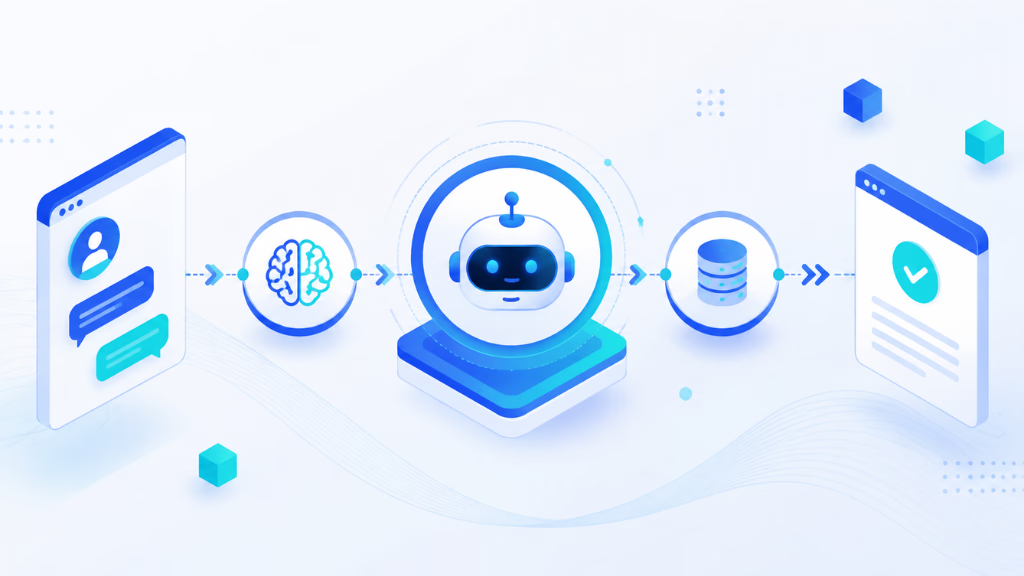
A typical AI chatbot workflow looks like this:
User Message → Intent Understanding → Knowledge Retrieval → Response Generation → User Reply
Modern chatbots often combine several technologies, including:
Natural Language Processing
NLP helps the chatbot understand what the user is asking even when the wording differs from predefined questions.
For example:
- “Where’s my package?”
- “Can you track my delivery?”
- “Has my order shipped?”
The chatbot can recognize that these questions share a similar intent.
Knowledge Bases
Chatbots may retrieve information from:
- FAQs
- Documentation
- Product catalogs
- Help centers
- Company policies
- Internal knowledge bases
This allows businesses to provide more accurate responses without manually scripting every possible question.
Large Language Models
LLMs allow modern chatbots to generate responses that sound more natural and adapt to conversational context.
However, an LLM by itself does not automatically make a chatbot an AI agent. The system usually needs tools, workflows, permissions, and decision-making capabilities to perform actions.
How AI Agents Work
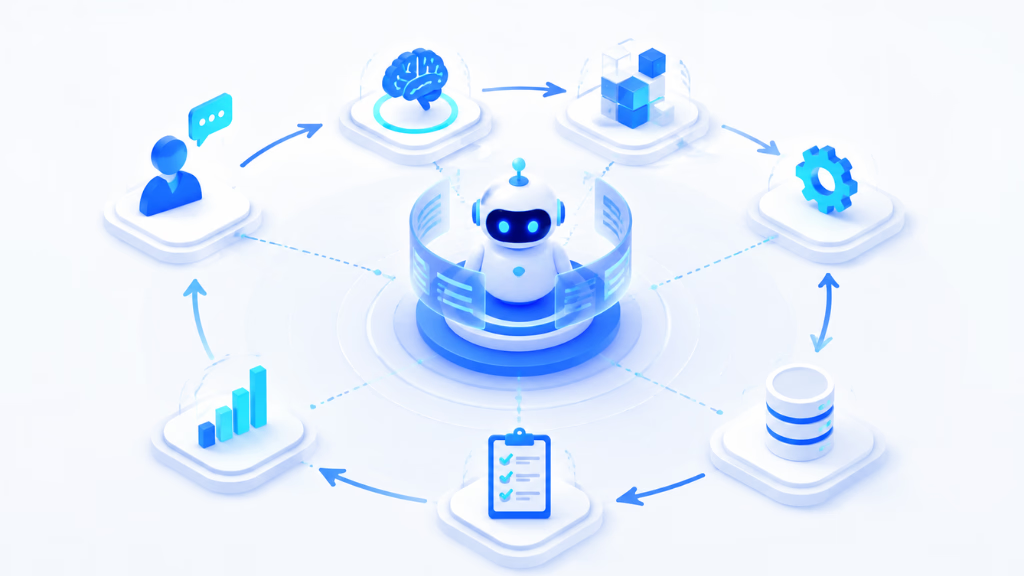
AI agents typically use a more advanced workflow:
Goal → Understand Context → Plan Actions → Select Tools → Execute Tasks → Evaluate Results → Continue or Escalate
An AI agent may contain several core components.
Reasoning Engine
The reasoning layer determines what the user wants and what needs to happen next.
Instead of matching a single intent, the system can evaluate the broader objective.
Tool Access
An AI agent becomes significantly more useful when connected to tools such as:
- CRM software
- Calendars
- Help desk platforms
- Email systems
- Payment platforms
- Knowledge bases
- Ecommerce platforms
- Databases
- Communication systems
The agent can use these tools to perform real business actions.
Workflow Orchestration
Some requests require multiple systems.
For example, qualifying and scheduling a sales prospect could involve:
Conversation → Lead Qualification → CRM Update → Calendar Check → Meeting Booking → Confirmation Email
The AI agent coordinates these steps as one workflow.
Guardrails and Permissions
Business AI agents should not have unrestricted access to every system.
Organizations typically establish permissions defining:
- Which systems an agent can access
- Which information it can retrieve
- What actions it can perform
- When human approval is required
- When the agent must escalate
These controls help businesses deploy AI agents more safely and reliably.
AI Agent vs Chatbot for Customer Service
Customer service is one of the clearest examples of the difference between the two technologies.
A customer service chatbot is useful for handling repetitive informational requests such as:
- Store hours
- Return policies
- Product information
- Shipping questions
- Troubleshooting instructions
An AI customer service agent can take automation further by completing tasks such as:
- Retrieving customer accounts
- Checking order status
- Modifying appointments
- Processing eligible service requests
- Updating customer records
- Creating support tickets
- Categorizing issues
- Routing customers
- Escalating sensitive cases
For businesses managing large customer service volumes, AI agents can therefore reduce the number of conversations that require manual processing.
Chatbots still remain valuable for simpler interactions where action-oriented automation is unnecessary.
AI Agent vs Chatbot for Sales
Both technologies can support sales teams, but they typically play different roles.
Chatbots in Sales
A sales chatbot may:
- Answer pricing questions
- Recommend products
- Capture contact details
- Ask qualification questions
- Share product information
- Direct prospects toward a booking page
AI Agents in Sales
A sales AI agent may:
- Engage incoming prospects
- Ask dynamic qualification questions
- Analyze buying intent
- Update CRM information
- Determine lead priority
- Recommend the next sales action
- Schedule sales meetings
- Send follow-up communications
- Route qualified prospects to the appropriate representative
For organizations trying to automate more of their sales pipeline, AI agents offer broader workflow capabilities.
AI Agent vs Chatbot for Voice Conversations
The same distinction applies to voice AI.
A voice chatbot may answer frequently asked questions over the phone using speech recognition and text-to-speech technology.
A voice AI agent can potentially handle complete phone workflows.
For example, an AI voice agent might:
- Answer an inbound call.
- Identify why the customer is calling.
- Access relevant customer information.
- Resolve routine requests.
- Update backend systems.
- Transfer the call to the correct human agent when necessary.
For outbound calls, AI agents can also support workflows such as lead qualification, appointment reminders, follow-ups, surveys, and customer outreach.
When Should You Use a Chatbot?
A chatbot is usually sufficient when your goal is primarily to provide information or guide customers through predictable conversations.
Consider using a chatbot when:
- Most customer questions are repetitive.
- Users mainly need FAQ answers.
- Workflows have limited complexity.
- Few external systems need to be updated.
- You primarily need website conversational support.
- You want a relatively simple automation solution.
For many websites, a well-designed chatbot can significantly reduce repetitive inquiries without introducing unnecessary system complexity.
When Should You Use an AI Agent?
An AI agent becomes more valuable when users expect the AI system to do something beyond answering questions.
Consider an AI agent when:
- Customer requests require multiple actions.
- AI needs access to business systems.
- CRM updates should happen automatically.
- Appointment scheduling is part of the workflow.
- Leads need dynamic qualification.
- Support requests require different resolution paths.
- Conversations occur across multiple channels.
- Human teams spend substantial time on repetitive operational tasks.
The greater the number of systems, decisions, and workflow steps involved, the stronger the case becomes for an AI agent.
Can AI Agents Replace Chatbots?
AI agents are unlikely to make chatbots completely unnecessary.
Instead, businesses can use different levels of automation depending on the complexity of each interaction.
Simple questions may still be handled efficiently by chatbot functionality, while more complex requests can trigger AI-agent workflows.
A modern customer experience platform could therefore combine both:
Simple Question → Conversational Response
Complex Request → AI Agent Workflow
Sensitive or Exceptional Request → Human Agent
This hybrid approach can give customers fast automated support while maintaining human involvement where judgment or specialized assistance is needed.
AI Agent vs Chatbot: Which Is Better?
Neither technology is automatically better. The right choice depends on what the business wants the AI system to accomplish.
Choose a chatbot when the primary objective is answering questions, collecting basic information, or guiding customers through straightforward conversations.
Choose an AI agent when the objective involves completing tasks, coordinating systems, making workflow decisions, or automating larger parts of customer service, sales, or operations.
For many organizations, the most effective strategy is not choosing one exclusively. Instead, they can combine conversational AI with agentic automation so simple requests remain efficient while complex customer journeys receive deeper automation.
The key question is no longer simply:
“Can the AI talk to our customers?”
The more useful question is:
“What should the AI be able to accomplish for our customers once the conversation begins?”
How Commplify Solves Omnichannel Automation and CX Pain
This is where many teams struggle: siloed channels, “dumb” chatbots, and patchwork integrations slow everything down. Commplify was built for this reality.
With Commplify, you can deploy AI agents across chat, voice, SMS, email, and WhatsApp, all managed from a single inbox. Each agent has configurable knowledge, workflows, tone, escalation policies, and reporting.
You get:
- Unified customer history and context, no matter the channel.
- Visual workflow automation across every communication method.
- Integrated knowledge intelligence, so agents always have the right answer.
- Advanced analytics for tracking CSAT, workflow drops, and escalation rates.
That’s how modern CX teams scale support without losing the human touch—or insight into what’s working.
Conclusion
The real difference between an AI agent and a chatbot is about power, context, and reach. Chatbots fill simple needs, but for high-volume, multistep, and cross-channel service, AI agents are the future. In my experience, choosing the right platform shapes the quality of every customer and team outcome.
If you’re feeling the pain of disconnected tools, missed follow-ups, or limited insight, it’s time to look beyond the basics. Omnichannel AI agents offer a path to smarter automation, stronger oversight, and measurable results—especially when managed through a platform that can unify and report on every interaction.
As customer expectations evolve and automation matures, now is the moment to reassess your approach. Teams that act early will set the CX standards others must follow.
FAQs
What is the difference between an AI agent and a chatbot?
A chatbot responds to simple questions using scripts. An AI agent handles complex, multistep tasks, remembers context, and works across channels, automating workflows and smart escalation.
How does an AI agent work compared to a chatbot?
An AI agent interprets requests, automates multi-channel tasks, manages context, and integrates with business systems. A chatbot follows preset rules for short, simple interactions on one channel.
When should I use an AI agent instead of a chatbot?
Use an AI agent when handling large volumes, complex workflows, omnichannel support, or compliance needs where context and escalation matter.
What are the top use cases for chatbots and AI agents?
Chatbots are best for FAQs and simple info. AI agents excel at lead routing, appointment scheduling, cross-channel support, and workflow automation.
How can my company transition from a chatbot to an AI agent?
Start by mapping workflows and pain points. Layer AI agents for complex tasks while keeping chatbots for simple cases. Monitor results using CX analytics.
Can a chatbot evolve into an AI agent?
A chatbot can be upgraded by adding AI capability, context retention, integrations, and workflow logic—but may require new architecture or smarter platforms.
Which is easier to deploy: chatbot or AI agent?
A chatbot is faster to deploy for simple tasks. AI agents require more setup due to workflow, channel, and integration needs but offer more value at scale.
What is agentic AI and why does it matter for customer experience?
Agentic AI combines autonomy, reasoning, and workflow automation. It matters for building adaptive, context-rich, and proactive customer experiences.
How do omnichannel AI agents improve workflow automation and analytics in the enterprise?
They automate tasks across all channels, provide context-aware escalation, and offer real-time analytics on CX outcomes and handling efficiency.
What does human escalation look like with modern AI agents?
When an AI agent detects complexity or risk, it escalates with full context and transcripts to human agents, ensuring smooth handoff and compliance.
This page was last edited on 13 August 2026, at 2:07 am