Conversational AI for customer service uses AI chatbots, voice assistants, and virtual agents to resolve customer queries, automate support, and connect conversations across channels, improving speed, consistency, and CSAT while lowering operational costs.
Contact volumes are rising, but customer patience is shrinking. As support leaders, we face intense pressure to scale, keep costs low, and meet round-the-clock expectations that legacy systems can’t handle.
I have seen this first-hand: missed calls, slow resolutions, and fragmented chat logs drive both agent burnout and customer churn. Executives and CX teams have started asking if AI can finally deliver something better—without trading cost for quality.
This guide shares what matters in conversational AI for customer service. I’ll cover definitions, real-world impact, practical rollout advice, pitfalls, and what to prioritize if you want modern, unified support—not just another chatbot.
What Is Conversational AI for Customer Service?
Conversational AI for customer service refers to technology that allows businesses to communicate with customers through natural, human-like conversations across channels such as phone calls, website chat, messaging apps, and support portals.
Unlike traditional rule-based chatbots, conversational AI can understand intent, maintain context, interpret natural language, and generate relevant responses based on what a customer is actually asking. More advanced systems can also connect with CRM platforms, help desks, order management systems, scheduling tools, and knowledge bases to complete tasks rather than simply answer questions.
For customer service teams, this means AI can handle a large portion of repetitive interactions while allowing human agents to focus on complex, sensitive, or high-value conversations.
How Conversational AI Works in Customer Service
A conversational AI system typically combines several technologies to understand a customer’s request and determine the most appropriate response or action.
The process usually works like this:
- The customer starts a conversation through voice, live chat, SMS, or another supported channel.
- The AI identifies the customer’s intent, such as checking an order, changing an appointment, asking about a bill, or requesting technical support.
- Context is analyzed using previous messages, customer records, account information, and connected business systems.
- The AI generates or retrieves the appropriate response based on approved knowledge and business rules.
- An action may be completed automatically, such as updating an account, scheduling an appointment, creating a support ticket, or checking an order status.
- The conversation is escalated when necessary if the AI cannot confidently resolve the request or the situation requires human judgment.
This combination of understanding and action is what makes conversational AI more useful than a basic FAQ chatbot.
Where Conversational AI Can Be Used in Customer Service
Conversational AI can support customers at almost every stage of the service journey.
Answering Common Customer Questions
A large percentage of customer service conversations involve recurring questions about pricing, account access, delivery times, business hours, policies, subscriptions, or product information.
Conversational AI can respond to these questions instantly using an approved knowledge base. Because customers do not need to wait for an available agent, simple inquiries can often be resolved within the first interaction.
The AI can also ask follow-up questions when the customer’s original request is unclear instead of forcing the customer through rigid menus.
Handling Customer Service Phone Calls
AI voice agents allow conversational AI to manage inbound customer service calls.
Instead of asking callers to navigate a traditional IVR menu such as “Press 1 for billing,” an AI voice system can allow the customer to explain the problem naturally.
For example, a customer might say that they want to change an appointment or check whether an order has shipped. The voice AI can identify the request, retrieve relevant information, complete the required action, and provide the customer with an immediate response.
This can significantly reduce the number of routine calls that must be handled manually.
Customer Identification and Routing
Conversational AI can collect important information before transferring a conversation to a human agent.
Depending on the business, this may include:
- customer name
- account or order number
- reason for contacting support
- product or service involved
- urgency of the issue
- preferred department
The system can then route the customer to the appropriate team instead of transferring them between multiple departments.
When the conversation is transferred, the AI can also provide the agent with the context already collected so the customer does not have to repeat the entire problem.
Order and Delivery Support
Ecommerce and retail companies can use conversational AI to handle common post-purchase questions.
Customers can ask questions such as:
- Where is my order?
- Has my order shipped?
- Can I change my delivery address?
- When will my package arrive?
- What is the return policy?
When connected with order management and shipping systems, conversational AI can retrieve real-time order information and provide personalized responses.
This reduces the need for support agents to manually search for basic order details.
Appointment Scheduling and Rescheduling
Service businesses can use conversational AI to automate appointment management.
The AI can check available times, schedule appointments, confirm bookings, cancel appointments, or help customers find a different time.
Industries where this is particularly useful include healthcare, home services, automotive businesses, financial services, property management, salons, and professional services.
Automated appointment handling also helps reduce repetitive administrative work for front-desk and support teams.
Billing and Account Support
Conversational AI can assist with many routine account and billing questions.
For example, customers may ask about:
- payment status
- billing dates
- subscription plans
- account balances
- invoices
- payment methods
- account information
The AI can authenticate the customer when required and retrieve relevant account information from connected systems.
More complicated issues, such as disputed charges or unusual account activity, can then be transferred to a human representative.
Technical Support and Troubleshooting
Conversational AI can guide customers through structured troubleshooting processes.
Instead of giving every customer the same static support article, the AI can ask questions to understand the specific problem and provide instructions based on the customer’s responses.
For example, it might determine whether a problem relates to an account setting, network connection, device configuration, or product feature before recommending the next step.
If the issue remains unresolved, the conversation history can be sent to a technical support agent along with the troubleshooting steps already attempted.
Benefits of Conversational AI for Customer Service
The value of conversational AI comes from its ability to improve customer access to support while reducing the amount of repetitive work performed by service teams.
24/7 Customer Support
Customers often need assistance outside traditional business hours.
Conversational AI allows businesses to answer questions and complete common service requests at any time. Customers can receive support during evenings, weekends, holidays, or periods when human agents are unavailable.
For international businesses, this can also make it easier to provide consistent support across different time zones.
Faster Response Times
Long waiting times are one of the most frustrating parts of customer support.
AI systems can handle multiple customer conversations simultaneously, meaning customers can often receive an immediate response instead of waiting in a phone queue or support inbox.
Human agents are then available for the conversations that actually require their expertise.
Lower Customer Service Workload
Many customer service teams repeatedly answer the same questions.
Automating high-volume requests such as order tracking, password assistance, appointment changes, and basic account questions reduces the amount of manual work required from agents.
This does not necessarily mean replacing the support team. Instead, conversational AI can act as the first layer of service while human agents handle exceptions and more complicated situations.
More Consistent Customer Responses
Different agents may occasionally provide slightly different answers to the same question.
Conversational AI can use a centralized knowledge base and approved response logic, helping businesses maintain more consistent information across customer conversations.
When policies, prices, or procedures change, the underlying knowledge can be updated centrally instead of relying entirely on individual agent training.
Better Agent Productivity
AI can also support human agents during live customer conversations.
An AI assistant may summarize the customer’s issue, retrieve relevant information, recommend responses, display knowledge-base articles, or automatically prepare conversation notes.
This reduces the amount of time agents spend searching through multiple systems and allows them to focus more attention on the customer.
Improved Scalability
Customer service demand often changes because of seasonal peaks, marketing campaigns, product launches, outages, or rapid business growth.
Hiring and training new agents for every temporary increase in demand can be expensive and slow.
Conversational AI provides additional capacity because automated systems can handle many interactions simultaneously without requiring businesses to expand their support team at the same rate.
Conversational AI vs Traditional Chatbots
Traditional chatbots and conversational AI are often grouped together, but their capabilities can be very different.
Basic chatbots usually depend on predefined rules, buttons, decision trees, or keyword matching. They work well for simple interactions where the possible customer questions are predictable.
Conversational AI is designed to understand more flexible language and maintain context throughout a conversation.
For example, a customer might first ask:
“Where is my order?”
Then follow with:
“Can I change the delivery address?”
A conversational AI system can understand that the second question relates to the same order without requiring the customer to start the process again.
This ability to maintain context makes conversational AI more suitable for complex customer service interactions.
Conversational AI vs Human Customer Service Agents
Conversational AI works best when it complements human agents rather than attempting to handle every possible customer situation.
AI is generally well suited for:
- repetitive questions
- information retrieval
- order status checks
- appointment scheduling
- basic troubleshooting
- customer qualification
- ticket creation
- routine account requests
Human agents remain important for situations involving complex decision-making, sensitive complaints, unusual cases, negotiation, relationship management, or issues that require judgment and empathy.
A strong customer service strategy therefore combines automation with clear escalation rules.
When the AI reaches the limits of its knowledge or confidence, it should transfer the customer to a human agent while preserving the conversation context.
How Conversational AI Improves the Customer Journey
Conversational AI can support customers throughout multiple stages of their relationship with a business.
Before a purchase, customers may use AI to ask questions about products, services, pricing, or availability.
During the purchasing process, conversational AI can help customers understand options, schedule consultations, or find information needed to complete a transaction.
After a purchase, it can provide order tracking, account support, troubleshooting, billing assistance, returns information, and ongoing service.
Using the same conversational AI infrastructure across these stages can create a more connected customer experience because information from previous interactions can be used to understand future requests.
How to Implement Conversational AI for Customer Service
Successful implementation requires more than simply adding an AI chatbot to a website.
Businesses should begin by identifying the customer conversations that are both frequent and suitable for automation.
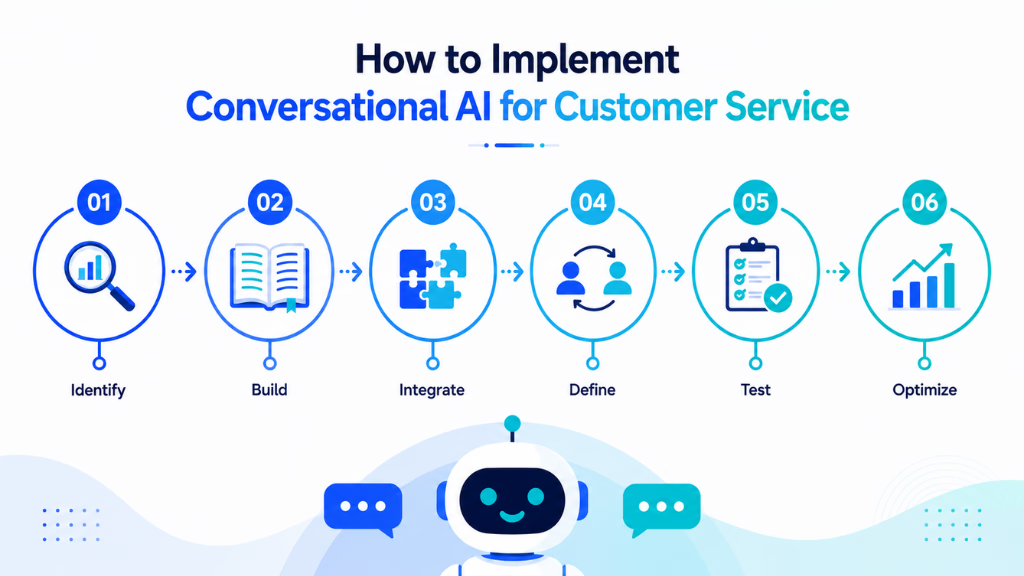
1. Identify High-Volume Customer Requests
Review support tickets, phone call recordings, live chat transcripts, and frequently asked questions.
Look for recurring requests such as appointment changes, order tracking, password issues, account questions, or basic troubleshooting.
These usually provide the best starting point because automation can immediately reduce support volume.
2. Build a Reliable Knowledge Source
Conversational AI needs accurate information.
Businesses should organize their FAQs, policies, product documentation, troubleshooting guides, pricing information, and internal knowledge so that the AI has a reliable source for generating responses.
Outdated or inconsistent information can lead to inaccurate customer answers.
3. Connect Business Systems
Conversational AI becomes significantly more valuable when it can take action.
Depending on the use case, integrations may include:
- CRM platforms
- help desk software
- ecommerce systems
- scheduling platforms
- payment systems
- customer databases
- shipping providers
- knowledge bases
Without integrations, the AI may only provide general information instead of completing the customer’s request.
4. Define Human Escalation Rules
Businesses should clearly define when a conversation should move to a human agent.
Common escalation triggers include low AI confidence, repeated misunderstanding, customer requests for an agent, sensitive complaints, unusual account issues, or high-value customer situations.
The transfer process should preserve the conversation history so the customer does not need to explain the issue again.
5. Test Real Customer Scenarios
Testing should include more than ideal customer questions.
Customers may use slang, incomplete sentences, unusual phrasing, background noise during calls, or multiple questions in the same conversation.
Testing these realistic situations helps businesses identify gaps before deploying conversational AI widely.
6. Monitor and Improve Conversations
Conversational AI should be continuously evaluated after launch.
Teams can review conversation data to identify:
- frequently misunderstood questions
- unresolved customer requests
- common escalation reasons
- outdated knowledge
- automation opportunities
- customer satisfaction problems
These insights can then be used to improve prompts, workflows, integrations, knowledge sources, and escalation rules.
Important Features to Look for in a Conversational AI Customer Service Platform
Not every conversational AI platform offers the same capabilities.
When evaluating a solution, businesses should consider whether it supports:
- Natural language understanding: The system should understand different ways customers may express the same request.
- Context retention: Customers should be able to ask follow-up questions without repeatedly providing the same information.
- Voice and messaging channels: Businesses may need support across phone calls, web chat, SMS, and other communication channels.
- CRM and help desk integrations: The AI should be able to retrieve and update customer information when appropriate.
- Real-time human handoff: Customers should be transferred smoothly when automation cannot resolve the issue.
- Conversation analytics: Teams should be able to review customer intents, resolution rates, escalation patterns, and conversation quality.
- Knowledge-base integration: Responses should be grounded in trusted company information rather than relying on unsupported answers.
- Workflow automation: The platform should be capable of completing customer actions rather than simply responding with information.
Challenges of Using Conversational AI in Customer Service
Conversational AI can improve customer support significantly, but poor implementation can create new frustrations.
One major challenge is inaccurate responses. If the AI relies on outdated information or lacks appropriate safeguards, customers may receive incorrect answers.
Another problem occurs when businesses automate too many situations. Customers dealing with unusual, sensitive, or complex issues should have a clear way to reach a human agent.
Integration quality also matters. An AI assistant that cannot access customer records, order information, or support systems may force customers to repeat information or complete tasks manually.
Businesses must also consider privacy, data security, access controls, and regulatory requirements when customer information is processed through AI systems.
The goal should not be to automate every conversation. The goal should be to automate the interactions where AI can reliably provide a faster and easier customer experience.
Measuring the Success of Conversational AI in Customer Service
Businesses should monitor customer service performance before and after introducing conversational AI.
Important metrics include:
- first response time
- average resolution time
- first-contact resolution rate
- AI containment or automation rate
- escalation rate
- customer satisfaction score
- support cost per interaction
- agent workload
- repeat contact rate
- conversation abandonment rate
However, automation rate should not be treated as the only measure of success.
A high automation rate has limited value if customers frequently receive incorrect answers or struggle to reach a human representative. Customer satisfaction and successful resolution should remain the primary indicators of whether conversational AI is actually improving service.
The Future of Conversational AI in Customer Service
Conversational AI is moving beyond simple question answering toward systems that can understand requests, access customer data, make decisions within predefined rules, and complete multi-step service workflows.
As these systems improve, customer interactions are likely to become less dependent on traditional menus, forms, and long support queues.
Customers will increasingly be able to explain what they need naturally while AI handles the background work required to resolve the request.
The most effective customer service operations will likely use a hybrid model: conversational AI handling high-volume and predictable interactions while human agents focus on conversations where expertise, judgment, and personal attention provide the greatest value.
Why Omnichannel Matters in Conversational AI
Many CX leaders say they want omnichannel, but most platforms just add new silos. True omnichannel conversation management means every interaction—no matter where it starts—feeds into a unified inbox, with real-time memory across channels.
I have seen how this addresses two big headaches:
- Context loss: No more making customers repeat details moving from chat to voice.
- Escalation chaos: Agents have the full conversation thread and can action or escalate based on the whole picture.
For example, Commplify’s unified conversation management system brings all channels—voice, SMS, chat, email, WhatsApp—into one dashboard. AI agents manage, escalate, and assign each conversation, carrying full history, regardless of channel-switching. This not only helps customers, but reduces manual follow-up and support gaps.
Conclusion
Conversational AI for customer service has matured into a practical, business-critical tool. The right approach brings together 24/7 coverage, real context, and smooth automation—while keeping humans in control when it matters.
The future of support is unified. Omnichannel conversation management and workflow automation are not “nice to have”—they’re the operational backbone for high-performing CX teams. In my view, platforms that solve context loss, support true human + AI collaboration, and deliver deep analytics are the best path forward.
If your team is rethinking support, start with your real process pain points, prioritize transition, and demand true unification across channels. The most successful organizations invest in tools and practices that let AI and people work together, using every conversation as both a service moment and a learning loop.
CX is moving fast—and so are customer expectations. Intelligent, unified, adaptable support is not the end goal; it’s the new standard.
FAQs
What is conversational AI for customer service?
Conversational AI for customer service uses AI-powered chatbots, virtual agents, and voice assistants to automate and manage customer interactions across digital channels, improving speed and consistency.
How does conversational AI work in customer support?
Conversational AI identifies customer intent, retrieves details from a knowledge base, provides responses, and hands off to humans if needed—all while tracking context across chat, voice, SMS, email, or WhatsApp.
What are the benefits of conversational AI in support teams?
Conversational AI improves first-response times, cuts costs, reduces agent workload, boosts CSAT, supports 24/7 service, and gives customers consistent, context-aware answers across their preferred channels.
How is conversational AI different from a chatbot?
Chatbots follow scripts and handle simple queries. Conversational AI uses advanced AI to understand context, manage multi-turn conversations, recall history, and escalate to humans.
What’s the difference between conversational AI and generative AI?
Conversational AI uses defined workflows, knowledge bases, and NLU. Generative AI (LLMs) can generate original, open-ended responses but may need extra guardrails to avoid incorrect answers.
Can conversational AI enable true omnichannel support?
Yes, when built with unified conversation management, conversational AI links all channels—voice, chat, SMS, email, WhatsApp—so conversations continue without context loss.
What are best practices for implementing conversational AI?
Start with needs analysis and defined goals. Prioritize omnichannel coverage, knowledge curation, escalation paths, workflow automation, analytics, and ongoing tuning.
What are common challenges with conversational AI in support operations?
Challenges include missing escalation paths, poor knowledge management, over-automation, lack of analytics tracking, and difficulty maintaining consistent tone.
Which industries can benefit most from conversational AI for customer service?
Healthcare, fintech, e-commerce, real estate, BPO, home services, legal, recruitment, and travel/hospitality see strong ROI from conversational AI in customer service.
What analytics should I track when using conversational AI?
Track AI-handled vs human-handled ratio, response times, CSAT, escalation rate, customer sentiment, intent patterns, and conversation outcomes to drive continuous improvement.
This page was last edited on 11 August 2026, at 4:50 am